23 April 2014

A rush of bilingual blood to the head

Coucou Madame,
I've been thinking.....(as Richard Prebble is reputed to have said) and here is the product of my reflections:

Inspired by a recent stuff article based on a Uni of Auckland Education lecturer, John McCaffery's research into bilingual education, through a case-study of Richmond Road School, I was reflecting on the feasibility/desirability of setting up similar bilingual units in other primary schools around the country. It would necessarily involve only small numbers of students but it might answer a need/ be an interesting enquiry project/ promote sustainable, effective language learning/ be a basis for research into the value of bi-lingualism in cognitive development.

Why would I like to be involved in this process?
  • It seems to me a worthwhile goal, relevant to my aim of encouraging students to share my passion for speaking other languages and experiencing other cultures.
  • It would be a parallel structure rather than something that competes with any existing structures and initiatives.
  • I feel I have a lot of expertise that would be valuable to such an initiative.
  • I have doubts, as does John McCaffery, that the current regime is the most effective way to learn languages.
  • Having taught primary students languages last year, I can see how rapidly they soak it up, even with relatively little time spent on it, and how enthusiastic and uninhibited they are about communicating.
  • The primary level is undoubtedly when students are most receptive to learning languages (other than pre-school)
  • The language required to teach other subjects in the Target Language is no doubt less complex at junior level than it would be at senior
  • At last one would be free of the constraints of having to groom prospective NCEA candidates.
  • Cohorts would be together all day, so it would be easier to be flexible about scheduling.
So, I've made a wee 'carte heuristique' with some preliminary musings which I submit for your input, in case you have a nano-second to think about it????
Am I being totally unrealistic to imagine that one might get something like this off the ground?
Even since I photographed this mind-map just now, I've added new things to it.  Such as:
  • should one target public or private education? 
  • Should it be restricted, as I think Richmond Road is, to families that have a TL speaking parent who can support their child's learning.? (which defeats the purpose of making it accessible to a wider public)
  • Could one conceivably think of offering parallel classes to parents of students in bi-lingual classes to help them support the learning?
  • Could one imagine incorporating virtual classes to make smaller units more viable and reduce costs?
Here are another couple of links to articles that have fueled my enthusiasm, in English and in French
What do you reckon? Am I being pie in the sky? It's a bit more challenging and interactive than sitting at my computer translating, although I'm still working on that idea too. I'm off to sit the C2 in AK on 3 May. Will I be 'à la hauteur'? It'll depend on the subject matter and my ability to process the info super quickly. Never my forte..... On verra.
Bises
^..^
=+=

2 March 2014

Puisque tu nous as posé un lapin hier......

Salut Madame,
Tu nous as manqué hier, du coup j'ai pensé qu'un petit effort de ma part pour rendre compte de la réunion ne serait pas mal reçu..... je continue donc en anglais.

So there we were at AUT for the symposium on all things intercultural. I was surprised it wasn't better attended, as I felt it was very worthwhile. I had come with expectations of getting a stronger handle on what intercultural pedagogy looks like on a practical day-to-day basis. The weekend reminded me once again that mind-shift is an iterative process, requiring repeated exposure to the same ideas, albeit expressed slightly differently each time, in order to be able to move beyond the theory to its incorporation into your practice.
Tony Liddicoat's Friday evening keynote speech covered his intercultural principles which I felt were somewhat more explicit than Newton's. He described processes of
  • Active construction
  • Making connections
  • Social interaction
  • Reflection
  • Accepting responsibility
(rather than elaborate on each one here, I'll wait and share his presentation with you once it has been forwarded to participants next week)
He shared his four-way process for treating texts (be they written or visual) with which I was already familiar  (the flow diagram of NOTICING > COMPARING > REFLECTING > INTERACTING, elaborating on each of these phases.
On Saturday he kicked off with a work-shopped exercise which put us in the position of learners, approaching a series of authentic texts / images in a language we were unfamiliar with, and inviting us to approach them (in pairs and groups) according to the four stages above. The subject was 'school' which is an obvious choice of theme for intercultural exploration. The process necessarily involved no use of oral target language (because we didn't have any of course), and I am still somewhat dubious about the possibility of conducting this sort of activity in target language, especially at junior level. In another session we discussed the development of a target language repertoire in which the same expressions could become part of the transactional repertoire. I mentioned that such expressions could be the subject of a table mat specifically for intercultural discussion.
As I see it, what this pedagogical shift requires is a complete overhaul of the sort of materials teachers commonly still use in their classrooms, much of which offers very limited scope for intercultural exploration and reflection. It would be really good to develop a bank of material suitable for generating 'discovery'. I don't mean detailed 'fiches pedagogiques' with their predetermined learning outcomes, but just a lot of authentic material stored according to theme, which teachers could draw on to get students actively noticing, comparing, reflecting and interacting.
My hopes of finding ways to seamlessly integrate language acquisition with intercultural exploration are still largely unfulfilled, I must admit. When I look at the amount of language that needs to be acquired before students are NCEA-ready, I just can't see how it can be done by consistently basing your teaching around this model. At some point the students need to be drawn to reflect on the linguistic aspects of the language, as much as the cultural, if the aim is to enable them to communicate. I can't quite see how they can be done simultaneously, although the same texts could be used for both cultural and linguistic exploration, I suppose. Images are great for developing intercultural competence. Maybe the language acquisition could come out of the observations that the students make. Au fur et à mesure. I can imagine that a lot teachers would find that approach to language acquisition too ad hoc, although I don't think I would have a problem with it. I'm just thinking aloud here. I know from my own language learning experience, I tend to pick up and retain language better if it hasn't been handed to me on a plate but has arisen out of necessity through an authentic situation and has been followed by my own reflection. But is this because I'm already a competent language learner? How much do I rely on those early years of language learning that took me tediously through the basics, which I now find indispensable to my understanding of how languages work? Is there any way of providing students with a sound linguistic basis, in other words some rule-based competency, without boring them in the process? (Or do I really mean 'without boring myself in the process' :-D ?)  I'm rabbiting on here. Must be the influence of that pink dude above.

In addition to Tony Liddicoat's sessions there were presentations by AUT staff on teachers' understanding and implementation of iCLT principles, leading to their production of a matrix which I can share later, and which teachers may find valuable for focusing their intercultural pedagogy. It looks at what students are able to do, what teachers need to provide and a series of questions to guide discussions (which could possibly be framed in target language).
They followed this up with a session on LIA awards, based on analysis of their report to the Ministry on the effectiveness of LIA awards. It led to some interesting discussion at which I aired my views, of course!
After lunch, in language specific groups we focused on our own experiences of intercultural misunderstandings which was fun and wide-ranging.

It was a well-run, well-catered event and we were made to feel very welcome at AUT. And it was free!!!!!

\ /
(*)

^. .^
=+=


27 January 2014

PLE ponderings.......

Ah yes..... the PLE. It makes me increasingly reluctant to contemplate a return to a conventional learning structure such as one inevitably finds in schools, with time neatly partitioned into units and little choice about the 'how, why and when', even if there is a certain amount regarding the 'what'.

Reflecting on my own PLE, I recognise that it has always been pretty learner-driven, which has sometimes brought it into conflict with expected outcomes. I have always felt myself to be at odds with any prescriptive approach to learning. As a result, I always responded much better to the open-ended task where the outcome was a product of my own exploration than the task which required me to quote the recognised experts and regurgitate the lecturer's notes.

My PLE is benefitting greatly from having my daughter at home for 6 weeks. She has been helpful in channeling my thoughts about my future career. Whereas I'd been rather lacking in direction, she encouraged me to do a bit of brainstorming to clarify things. For herself she has a sort of mantra of 'Hell, yeah!' or 'Not at all'. In other words, she's keen to eliminate things from her life that she's only half-hearted about. It then requires a lot of effort to create or build on the opportunities that will lead to her being thoroughly in her ELEMENT (Ken Robinson). So, I've been thinking a lot about what makes me feel in my element. It entails using my skills and talents to meet challenges and break new ground. It entails interacting with interesting people, people who are on a similar learning path, possibly, or at least people who believe that existing educational structures need radical overhauling. it also entails a sense of agency (which was sadly lacking last year).

I've identified that I find translation very satisfying (as long as its not drivers' licences and birth certificates) and that I would like to factor it into my future on a more official basis. I've begun by contacting the people I know who work in the area of translation. Out of this I've gleaned some very valuable information to inform the next steps. I had been thinking that maybe the AUT course for translators would be a good starting point but that it may be too elementary, in which case I would be paying fees and wasting time. The most helpful info from a friend in the game, has led me to NAATI, the Australian accreditation organisation for translators and interpreters, which has reputable qualifications. Instead of having to follow a course in order to get the qualification, it operates more like the DELF/DALF, except that you can sit it when it suits you. They have sample kits and books to guide you through the pitfalls of becoming a self-employed translator.

So, the plan of action is taking shape. I'll assess my level according to the sample material and aim to sit the test when I'm ready. I also intend to do the DALF C2 sometime this year, as I think that would add to my credibility.

What about getting oneself out there? Louise is on hand to get me up and running with a web-site, as she is currently doing this for herself. So, once I've got the domain name and Wordpress, I should be ready to roll (well, ready to start marketing my services). I might yet be seen on Twitter !!

You mention the challenge of making boundaries between personal and professional self. I have always found this difficult but it's not something I've ever really been concerned about, as, in the past, my professional interests have been so closely linked with my passions. I don't think it's helpful to have a union-minded approach to these things. I'm happy with periods of intense activity followed by periods of calm and reflection. At the moment I'm enjoying one of the latter. They're vital if you're to avoid just being swept along in the tide of someone else's decision making.

I keep hearing echos of the session on start-ups from U-Learn and thinking about the desirability of having a product rather than a service to offer, but I can't see how this can be avoided in the area of translation. I don't intend it to be a great source of income but more a means of keeping a valuable professional identity and having a continuous challenge to keep me intellectually on the ball. What if it fails? As it doesn't involve a large initial outlay, I'm not really worried about that.  On verra.......
^. .^
=+=

25 January 2014

PLE I hear Thou

(cross posted from here)

"- Can you picture and describe your Personal Learning Environment?
- Learning? Isn't that the stuff I had to do at school?
- Yes.. but surely you did not stop learning the day you graduated, did you?
- True… I suppose my experiences, my goals, my thoughts, my responsibilities, my training, my projects, all constitute ongoing learning..
- And it looks you are onto a good thing, so keep with it as "your ability to learn is the only lasting competitive advantage!"
I have been thinking about the place of the ePortfolio in a Personal Learning Environment. ePortfolio and Personal Learning Environment can both be a software system or a concept. I am considering the latter here.

The ePortfolio is a great personal space to collect, select, and make sense of information, throw ideas around and verify the more potent ones.
The Personal Learning Environment (PLE) is a layered, variable, distributed, open, collaborative space.
ePortfolio and Personal Learning Environment are inherently linked, each feeding the development and make up of the other.
PLE is nothing new, but since it is bound with technology its form, shape and purpose continue to evolve with it.
 
To me a Personal Learning Environment is a self crafted connected ecosystem comprising of people, tools, and spaces:

 - that I build, maintain
 - that grows and adapts to my needs
 - that is both physical and digital
 - that serves my purpose,
 - from which I collect information,
 - with which I experience new learnings, am comfortable with or challenged into doing new things,
 - that lets me engage in conversation around topics of interests
 - with which I interact and share my understanding of these common interests
 - that allows me to chose the media, the time and the place at which any of this happens
 - where I feel "at home"
 - that lets me dream, frame ideas and act on them

My PLE is a mash up of : friends, peers, mentors, with whom I have a relation of trust, clients, influencers that I respect and who I connect with via a range of tools, Twitter, my go to social media for short and sharp info and for just in time conversations on specific topics, ePortfolio as planning and goal setting space where I archive and reflect on flow, blogs, including mine , Feedly where I make up my own reading lists from blogs of interest, online forums and groups,  and google scholar on serious topics, google alerts, Youtube for "how to" do something, curating tools like Scoop It and Pinterest when researching for a project, LinkedIn as my office, Facebook as my playground, Quora as my knowledge base where I sit tight and absorb,  Evernote to keep notes, email where many a one on one conversations are continued and developed, Pocket to save and organise links of interest… Elements in my PLE are public, others are shared with a selected audience, some face to face, others online, some are private to me.

Some spaces come and go, some topics come and go, according to my needs and wants, new people are added as connections widen and grow, interests evolve, opportunities arise. My PLE is a living space.

It is undeniable: the way I learn and work is increasingly project based, individualised, flexible and is also increasingly less structured, less time and space dependent. And adapting to new ways of working and learning require more self discipline, self determination and independent thinking to answer questions such as "how am I doing?" "what problem am I trying to solve?" "how can I do this better faster more efficiently?". Hence my need to articulate my understanding of my own online presence and pin my position in this environment I create.

As I develop the skills and the mindset to evolve in this environment I develop a more open approach to sharing ideas and meeting new people. I engage more in conversations, seeking new information, making new knowledge, and together with my network push my own boundaries. The Internet has multiplied the opportunities to become agent of my learning, transferring knowledge between context and domains as well as people, so I ask myself:

Taking charge of one's own learning is the default attribute so do I want to be limited by institutionalised software?  
Sharing what I know and make it explicit is not an option, do I want to have control of how and when and with whom I do this?

With a device at my fingertips any time any where, it is easy to access an ongoing flow of information, to communicate, to create, share, cross pollinate thoughts and ideas, to participate in a network I build over time,
I can also capture and archive meaningful pieces, organize them for a purpose, and reflect upon them. I blend formal learning with informal, learning is no longer the work of the individual, it is the work of the network! I am "done learning" I am self directing it!

Along the way the boundaries between my personal self and professional self blur and blend.  And with it the need to "develop a strategy to manage the various information streams" and design and organize my own learning, and recognize it happens in different places, with different people, in different contexts.

The challenge for any learning institution, should they be schools, universities, training providers, companies L&D, is to recognize that individuals' access to information, tools, devices, experts and peers impacts on their ability and willingness to drive how, what and when they learn. The learning institution have to adapt their learning design, the tools they provide, to support the development of learner attributes. Through fostering a sense of community, nurturing a stimulating environment and culture conducive to serendipitous knowledge transfer, ideas and solutions generation the learnplace/workplace will start realising the potential of knowledge sharing and the innovation and opportunities it brings about.

The challenge for the individual is to have awareness of their own network, maintain it, grow it and diversify it. And to realise its potential for personal and "collaborational" growth. My PLE is constantly changing making managing time, sources and relationships within it unprecedented and complex. My PLE is constantly challenging, hence my deep engagement with it.

Readings:

Photo courtesy of: tata_aka_T [CC-BY-2.0 (http://creativecommons.org/licenses/by/2.0)], via Wikimedia Commons


7 December 2013

The year that has been

The year that has been… I woke up this morning realising today is December 7th. 2013 is nearly over.
There has been some good, some great and some less good and some messy! 

I have:

 - deepened my understanding of the scope and role of ePortfolios, researched and analysed methods of implementation outside of schools, inquired into their potential for employability, professional certifications and acreditations, as well as personal branding.
- dived in to identify and articulate the attributes of the Life Long Learner
- related the building of an ePortfolio to digital identity, digital footprints and key digital literacies.
- made sense of the inherent links between personal learning and social learning and how to scaffold them
- assessed ways of restructuring the way we work to make best use of both personal and social learning
- evaluated a range of online tools and services to support the ePortfolio approach
- started using design thinking
- worked on OpenBadges, instructional design
- realized I am only a technology consumer ...
- had a first go at synthesing this into a minimum value proposition to get started with ThinkAgency
- contributed by invitation to many projects and conversations but failed (so far) to get all the stakeholders I have engaged with to contract me…

This has led me to:
 - identify salient common points between the "world of education" and the "world of work"
-  slowly break away from my "edu" echo chamber and go and listen/participate in other communities
-  discover an engaging and switched on to learning professional community
 - see the need for a common vocabulary when labeling and describing skills, strengths, competence
-  invest in attending conferences where I have listened, participated, presented, met with
-  see and work through others' problem with them
-  value openness as the modus operandi
-  talk a lot around dreams and ideas (sigh…)
-  throw myself in a lot of new related stuff wanting to start to understand OpenBadges potential, IT stuff around metadata, experiencing basic coding...
-  feel frustrated by not staying focus


Which in turns has opened my eyes to:
(the confronting....)
- how limited I actually am to see the big picture: I find it hard placing boundaries around my ideas to have them evolve beyond just that
- the tyranny of too much autonomy! (especially let lose with a connected device)
- how limited my mastery around IT is beyond using/consuming
- how easily I forget I can't assume and must verify all hypothesis...
- how unable I seem to be at actually establishing my own actionable purpose!

Yet fabulous stuff happened such as:

- experiencing the world of entrepreneurship and start ups
- getting a feel for this whole ecosystem and going in with eyes wide open
- drawing some connections to the world as I have known it so far
- acquiring vast amount of new learning (some of it yet to be connected)
- witnessing what truly persuasive and convincing look like in practice
- starting to understand value in a commercial and business sense
- developing solid partnerships


I have maintained and grown lasting existing friendships.
I have worked on balancing my PLN, opened new channels and participated in a range of conversations.
I might have done it with too much gusto….
My teenage-like heart has fallen in love at first sight with many enlightening, supportive, challenging, critical new friends.
I count on time and actions to tell how these influences evolve!
I live with and love the most honest and caring dragon. I must never lose sight of this.

2013 as the "Year of Trying"! 
In the unstoppable momentum I have been saying yes yes and yes to so many things: I have done, got feedback, got knocked, undone, redone.
Today it feels that in terms of accomplishments for the year, well,  it is close to a "not a lot to show for". 
To move forward into 2014 I will need to do less Yes to learning and more Yes to executing.
I have a few weeks before making New Year's Resolution. Phew.

Why am I doing this?
The ability to learn is the only lasting competitive advantage for any organization. H. Jarche
Can I build a business model around this?
I have the ideas, the people, the want and the drive.
2014 will be the Year of the Concrete Steps.

12 November 2013

Starting with the Who

Last week saw the launch of Shared Histories, a France-New Zealand schools cross-curricular project  spanning the five years of the commemoration of World War One Centenary, starting 2014.
Initiated by the French Embassy in Wellington it corresponds with both the signing of an Arrangement of Education Cooperation between the Ministries of Education of France and New Zealand, the official launch of the Centenary Commemoration by François Hollande, President of France, and of many initiatives up and down New Zealand.
Shared Histories in New Zealand currently receives the coordinating support of the French Embassy, the Ministry of Education (NZ), NZAFT  and ILEP

Shared Histories is about fostering the Duty of Remembrance. Participants will interact around building a consciousness that human experiences are universal.
It provides a framework for New Zealand and French schools to form partnerships and work on common projects on the theme of WW1.

It is not about simply developing language skills:  it is about developing personal relevance for the all the students involved, through genuine social interaction and explorative reflection, supported with authentic documents and experiences.

This is a personal account of two extremely rich days, working with competent, visionary and courageous colleagues who see Shared Histories as the framework for cross curricular collaboration in their schools as well as the opportunity to engage with their students in the discovery and analysis of the world around them.

I was invited to facilitate the conversation around collaborative project building and the scaffolding role of ICTs.

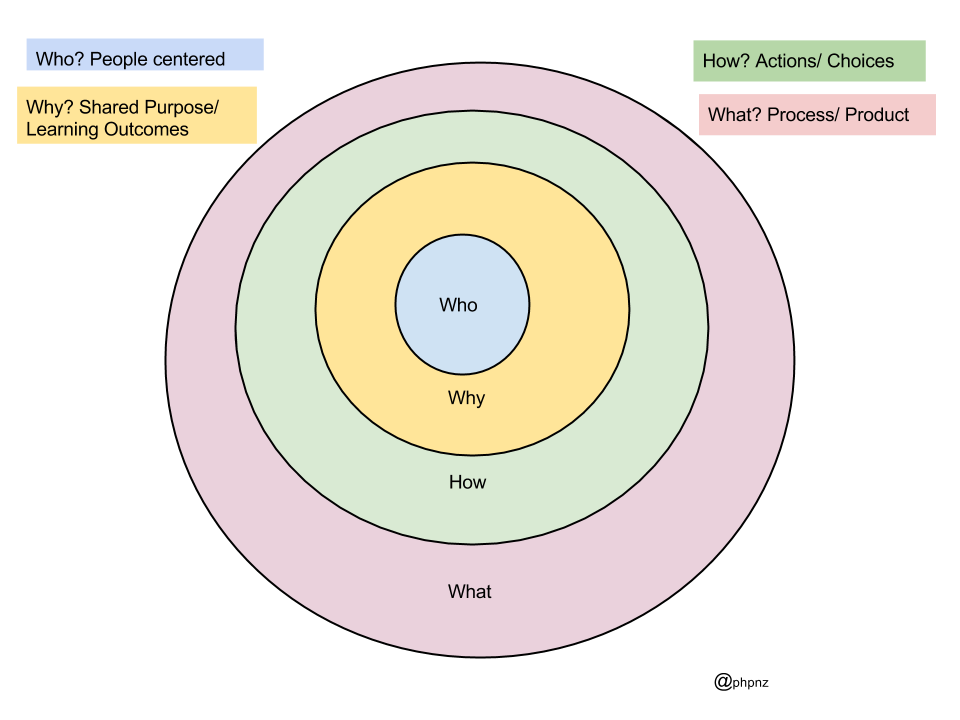
inspired from Julia Atkin's Values & Beliefs about Learning to Principles and Practice
It is about project co-construction at all levels involving conversations and negotiations to establish grounds for collaboration and cooperation, to take action and make choices together but also independently from each other.

We worked around this starting with Who. Quite a few participants had already thought through and defined the project that they would like to carry. Starting with Who reminded them to consider who are the participants in their project  and potentially questions their assumption about the fact that the project they have in mind is the best idea until they know for sure that it is wide enough and encompassing enough for all participants to take ownership of it also.

WHO as identified by participants:
students in French class, History class, English class, vertical classes, librarian , Media studies , art, music teacher/students extra curricular students, principal, parents, school community, RSA, old boys network,

Considering Why also drew in a fair amount of conversation, as the Why? participants came out with is their Why, not the Why that is a common purpose designed and adopted by the community of Who which is going to give the project a life! This served as a reminder that in designing a project, it is important to consider who executes the project, their reasons, their motivation, and to provide a scaffold that allows participants to find their own drivers.

WHY as identified by participants:
opportunity for a cross curricular French led project, create a school partnership with a French school, create a product, opportunity to use language in an authentic communicative context, multilevel, identity, cross generational

Moving onto the How was about thinking of actions that will make the project happen. It was a worthwhile step as it focussed participants on the type of learning outcomes  they want their students to get out of the project. This was also a starting point to think about the type of tools that can serve the purpose and forced people to consider the capturing, selecting, curating of information, the creation of content during the process, the feedback and conversations emanating from this process…

HOW as identified by participants:
research, gather, archive, share, connect, build framework, involve, define setting, communicate for the project, communicate about the project, relate, reflect, build collectively, discuss, manage contacts, feedback, develop global citizenship awareness.

Arriving at the What, participants were invited to consider the value of capturing the process that leads to the completion of a project. Often the proposed projects at this early stage are prescriptive. The stages of development to lead to this are worth capturing as they will tell the story of the project and also allow to get feedback and tweak/progess. Building in regular check points also gives visibility to individual and groups contribution so that all involved have a clear view of their involvement, what they are learning and how they are learning. What is produced out of this process can end up being a range of creations, and a quick brainstorm around what it can look like indicated that participants were considering a product they could have control over (e.g.: a video, a wiki etc). This led to go back to Who? and to build a project framework that allow for creativity and interpretation for all involved to shine through.

Key Words for building a Shared Histories project as identified by participants:
Time, sustainability, partnership, flexibility, communication about the process, about the product, visibility.

Participants can use the Who, Why, How, What circles to work with their partners in their school as well as their French partners. Getting to know each other from the outset is essential to work towards defining a common framework that is negotiated and  actionable over time and distance, including a range of actors, supported by ICTs that are accessible to all involved.

Shared Histories provides an ambitious opportunity. The scope and range of the project came to life as teachers from French and New Zealand met on Saturday morning via video conference. Shared Histories is definitely real and the welcome as well as the input of the French from the Amiens academy was an amazing reminder that what we had been working on for the last few days was actually starting now!

Schools had been provisionally paired in the light of their initial project outline.  Each introduced each other, in their respective or the other's language, exchanged a few ideas around how they envisage to go about the project.

Shared Histories in NZ school actually started on Saturday 7th November. It is an exciting challenge ahead.


2 November 2013

Digital Presence? Digital Identity? Digital Citizenship?

Introducing, facilitating, training and talking about ePortfolios inveriably leads to consider digital identity, digital competencies and digital citizenship. These are the concepts bandied in educational circles. Increased use of tools purposefully to support learning and framed targeted use of tools to make sense of and create own understanding of the information we have access are redefining how we learn.
Developing an ePortfolio is one way to build sound digital competencies, alongside leaving a purposeful digital footprint.
I read an article this week that prompted me to think about Digital Identity, Digital Presence and Digital Citizenship.
In "What digital presence?" Louise Merzeau describes and explains how we build a digital presence from managing our Digital Identity and exercising our freedom to act or think online.
Her view point has resonated with me: while the technology as it stands to date only allows us to take limited steps to fully control our digital identity,  we as individuals can apply consciousness to our actions when using online services, and develop a managed digital presence. And collectively as users we can establish good practice.
Louise's analysis starts with the traces left behind as we use the internet.
She describes some traces as deliberate: we fill in a form when shopping online.
Some others are created when communicating and sharing: we "like" a Facebook friend's status, we leave a comment on a blogpost.
In both cases these traces are left voluntarily.
Our online activity, using a browser or being connected on LinkedIn, also and mainly generates quantities of traces that we leave behind unintentionally. As a result we in fact have very little control over the activity that shapes our digital identity.
Given the current technology, networks and economic strategies, we leave traces that we do not manage and thus we can not manage our digital identity if we reduce it to the traces we leave. While personal data, traces, privacy... are the object of necessary, current political, ethical and technical debates, they take time to concretise.
What to do in the meantime? We can be proactive and build a digital presence, with applying  deliberate behaviors associated with its management. Louise is not talking about an online presence from a marketing perspective though. While having a digital presence, reputation, clout are legitimate quests that relies on the traces left, she talks rather of being digitally present.
She proposes to include elements of temporality, just like in real life: our digital life is not made of traces that accumulate and that can be used in any order. Introducing the concept of time into our digital activity allows to evaluate and give context to the traces that are left behind for ever. And developing a coherent, rich presence in networks is the surest way to leave traces that are managed.
 Gmail and Facebook, amongst others, are free but we actually pay for them with our personal data: it is the currency, it has economical value for these businesses. Rather than being paranoid and buy in the media frenzy around the topic, best is to get informed, investigate options and negotiate what we are prepared to concede.
Developing sound digital competencies, expressing oneself in the right place in the right tone is also empowering beyond protection per se. Digital competence involves moving from being a consumer of services to being a content producer. Digital competence also involves using the tools to serve our purpose, for information gathering, collaboration, etc.  Just as we do in real life, we need to experience different settings, learn about them, adjust our behaviours, develop our memory of what we did, what we chose to forget, what we develop, what we can share when online.
Information on the web has also become highly personalized, we go and get the information we want and often we go to information that has been validated by someone on our networks, Twitter for instance. Information across the board is no longer top down. Louise argues that beyond the public/private debate, it is the high degree of personalization of the information that is influencing behaviors: we are not reading any article, we are reading an article that has been recommended.
The lines between our private (family, friends…) and public (work, community…) lines feel they are blurring since we are using similar platforms to live our digital life. But Louise also argues that not all conversations on networks are to be considered as public, just like the conversation at a nearby table in a café. It is how we use the information we have about others that matters: can we exploit any information we may come across? Is it because it is technically accessible that we can drop our ethical considerations and use the image of a drunken 16 year old to refuse him a job when five years on he presents an otherwise good CV?

All these behaviors are fairly new still and we all are learning together, while big corporate online services companies are moving at a very fast pace with their offerings so that we have little time to pause and think about what we are actually doing!
Schools and universities have a big role to play in framing theses competencies as they have no choice but to work with the tools.
Careful choice around sustainable online practices, scaffolded by teachers who themselves are proactive about their digital presence is attainable for learners from an early age, it is about instilling valuable behaviours that grow and evolve with the different life cycle we go through. Which could be captured, thought about and shared meaningfully and purposefully in an ePortfolio! I know you knew this was coming!

6 October 2013

ePortfolio Forum Takeaways

Thoughts in no particular order arising from having attended the 2013 ePortfolio forum organised by ePortfolioAustralia.

- Met lots of like minded people whom you don't need to explain what an ePortfolio is!
But:
- What is an ePortfolio? remains an open question. A tool? A space? An approach? A story?
For me the ePortfolio starts with the "who". Who is  making use of it? "Who" moulds the shape the ePortfolio takes as it is his/her specific purpose (evidencing of learning for assessment, reflective practice, professional learning, workforce entry, employability, career management, online presence, showcase of achievements, process of learning etc) that is the driver. "Who" 's life journey leaves positive digital traces, the ePortfolio, dynamic by nature, documenting and keeping a memory of experiences and accomplishments.
So:
- When introducing ePortfolio it is crucial to know "who" and empathize with the needs and wants, the goals and aspirations of "who".
The actions involved in building a structured ePortfolio (collecting digital assets, selecting them for a purpose and a determined audience, of connecting ideas through thinking, and connecting with others for comments/ collaboration) constitute a personal, educational, professional story.
And:
- by showing selected parts of a structured, purposeful ePortfolio, users demonstrate digital competence. And a digital presence. Enough said.
Also:
- Implementing an ePortfolio has to combine a top down and bottom up approach, framed by learning design. Top down to ensure infrastructure, access, support are available. Top down to support relevant curriculum development and pedagogy that lend themselves to ePortfolio development. Bottom up by giving tangible, relevant, authentic reasons to develop an ePortfolio and opportunities to users. Bottom up by making explicit the potential for developing digital literacy as well as making visible a wide range of skills beyond the qualification recognized by the institution.
Talking of skills:
- More and more conversations around employability revolve around not only the hard earned qualifications, but also around soft skills (communication, critical thinking, willingness to learn, knowledge sharing, being a team player, listening skills and ability to teach, mentor…) The ePortfolio is a perfect venue to evidence and develop these skills.
Thus:
- To engage learners into an ePorfolio development, they must be involved in shaping it and taking control of it from the outset, through punctual explicit training if necessary, but mainly by empathizing with each individual's goals and scaffolding their steering.
Moreover:
- an ePortfolio is not just the work of an individual: the sharing with an audience, commenting from peers, feedback and feedforward from teachers or lecturers, collaborating on projects and gathering feedback, communicating on forums, crowd sourcing an idea that shape a personal ePortfolio. Learning is social.
Which leads me to the tool:
- Mahara allows for granular permissions, ensuring privacy if/when/where needed, has a resume building, aggregates productions made in range of files off or online, has a built in social network. It allows for pages to be submitted for assessment. It can be hosted on a dedicated server or online. Which means also that it has got to be institutionalized in the first place… This is important for context. At least to start with!
What is (even more) exciting?
-   ePortfolio, the learning centre, evidence gatherer, thought processor + open badges, the visible indicator of accomplishments, skills, interest, across communities and platforms = lifelong and life wide learning!

Why are ePortfolio supporters still pushing the rock uphill?


- Learning in 21st c has changed. Not everyone has noticed.
- ePortfolio have mainly gained traction in education so far. Period.
- Technology is changing everyday. It is not at the heart of ePortfolio building though.
- ePortfolio as a vehicle for common vocabulary across stages of life (school> training/university> work/life) is yet to be realized (although OpenBadges may offer a step towards this!)
- their potential for employability and careers is huge, or so it promises. Employers need to be shown ePortfolio more readily. Employers want qualifications AND skills so employers need to be involved and asked if/ how they can make use of eportfolio for recruitment but also for productivity and skill evidencing for themselves and their employees. While supporting digital literacy development. Or else it will remain an academic pursuit.
- Professional associations need to be made aware of ePortfolio potential for ongoing professional learning, accreditations and evidencing of on the job skills. That could have some impact on the employers' perception of ePortfolio.
- Careers services outside of learning institutions (job re entry, immigration, skills gap analysis etc) need to be made aware also.
- There is no longitudinal research (that I am aware of so please do correct me and comment if I am wrong) to see if ePortolios continue to be populated by their owner pass education.

It's time to get out the building and into the "world" post education to go and find out if ePortfolios live up to their status of life long learning companion!
That is the road I am choosing to take with ThinkAgency. While remaining faithful and committed to my interest in ePortfolios in schools.


References: 
Prof Phillip Long from the University of Queensland’s Centre for Educational Innovation and Technology will share what the role of the eportfolio will have in a distributed digital learning future.
Dr Alan McAlpine (Queensland University of Technology’s Career and Employment Unit) will share what’s happening with the use of eportfolios in the recruitment and employment marketplace.
(Will link to both keynotes recording when made available)
Shane Nuessler Learning Design Reflections in Higher Education
Portfolio the work of an individual? Kristina Hoeppner
Pictures from the ePortfolio Forum
Angela Shetler' Storify of ePortfolio Forum


29 September 2013

OpenBadges Potential

MOOC "Badges: New Currency for Professional Credentials" - Understanding the Open Badges Ecosystem and Building a Badge System

CHALLENGE TWO: Define the Currency of an Ecosystem
____________________________________________________________________________________

Tania  a Spanish teacher in an Auckland (NZ) secondary, undertook a year long Professional Learning course. Her focus is on improving her classroom pedagogy and deepening her understanding of second language learning acquisition. A fluent Spanish speaker who has travelled extensively to Spain and South America before settling into work and family life, she has developed a love of all "things Spanish" and often refers to her experiences as a language learner to support her students' learning experience and help them empathize with others' culture and ways of doing things, the Language curriculum resting on developing language as well as intercultural competencies for the purpose of communication.
Tania, through experiencing with Task Based Learning with expert support during her course, now realizes the importance of assessment for learning, and of providing timely feedback and feedforward to support her students' next step in their learning. This practice helps her and her students manage the evaluation of the internally assessed standards. She initially felt she was assessing all the time but now she sees her students identify their next step more rapidly. Tania also realizes the importance of providing authentic learning opportunities to motivate her students' engagement and scaffold their language learning. By authentic she understands authentic for her students, learning that will serve them in real life. Tania connects "real life" to jobs using languages. She has coffee with Ian, in charge of the school's career program and they discuss where languages currently fit in career pathways, in connection with assessment standards and credits. As always, Languages are not prominently featured, and retaining students from one year to the next can prove difficult.  It is a timely conversation though:  Ian reminds her to focus on the skills involved in learning a language, such as communication and use of technology to access native speakers for instance, and how these skills, if made explicit, have huge currency for employability.
Tania prints the "Know your own skills" quick reference published by CareersNZ  and takes it to her Department meeting. This prompts the team to revisit the Key Competencies, the "capabilities for living and lifelong learning" as outlined in the NZC. The NZC states that Key Competencies ought to be kept track off continually, monitored rather than assessed. Her school has not explicitly identified a focus on these Competencies, and they have not always been at the forefront of her and her team's attention when developing their learning programs which are articulated around content knowledge.
Yet the deliberate crosschecking by the Language team of the Key Competencies and the employment skills reveals a wide range of common vocabulary. Tania undertakes to unpack the Key Competencies, break them down in more granular skills, especially around Managing Self and Participating and Contributing, which are two competencies that develop in the unfamiliar learning context of Spanish immersion learning:  Managing Self because students need to structure their portfolio of evidence, use a range of tools to produce this evidence and meet deadlines for submission. Participating and Contributing as students must practice to be understood, and interactions in Spanish require that they are both listeners and speakers.
Tania decides on a set a key words for each competence and uses them to label the resources and activities she has uploaded on her Moodle course. She decides that she is going to track how her students develop these particular competencies for a term, as well as draw students' attention to them explicitly in her teaching, making connections with the skills they will require in the workplace.

Abbi is close to making her choices for her subjects for her final year. She has considered more than once to drop Spanish. It is tough and it requires quite a lot of self study for her to complete her assignments. Managing deadlines for submitting portfolio pieces, alongside the volume of her activities in other subjects and out of school is difficult. She finds it hard too to communicate verbally in the target language unless she has learnt a piece off by heart. But through listening to her teacher's consistent use of formulaic phrases in the classroom, she is starting to build a repertoire for herself. She is reusing some of it quite successfully now and can even provide some feedback to her peers when they are working on a common task together. Neither of them can speak English in the classroom (or else, which is "enforced" in a friendly manner by her teacher!) so she is developing new strategies to communicate, sometime using gesture, or her laptop to look up phrases, practice saying them, and then use them when interacting with others. It is really what has been keeping her in the Spanish class that, the fact that tasks require that they work in small groups, assign roles and go and find a way together to solve the problem at hand. It is a nice change from her other academic subjects where she is doing a lot of writing. Verbal interactions are captured by way of videos too, so she and her friends can make good use of their smartphone. Feedback she receives regularly from her teacher helps her decide when she ought to give recording a go. She has now worked out how to upload her video files to her ePortfolio, and she has made good use of the forum function to first ask for help and now to give a few tips on how best to do it. Her teacher recently has started to talk about work skills, and as a class they have spent sometime deciding on a set of labels that describe what skills they are actually developing in class. Since she contributed to the list, she understands all of what these words mean. A girl in her class pointed out in the group forum that Miss was using these labels on Moodle activities. This leads the conversation to the use of tags when organizing evidence of learning in their portfolio. Abbi can see her tag cloud develop and the word "helping others" and "communicating" get bigger. Her teacher has noticed she has helped others in the ePortfolio system through posting replies in the group but also has observed that Abbi is showing peers tips to access good Spanish podcasts and other resources online.  Her teacher awards her a "helping others" badge that she pins on her lapel alongside her Captaincy badge and her Service to Charity badge. Moreover Abbi can identify these two skills are developing now and can relate to this as she has recently filled in a Careers Questionnaire which indicated that if she wanted to work in Early Childhood Education (something she is considering at this stage) these skills were important to foster. Upon reading her Spanish teacher's feedback on her latest assignment she realizes the "time management" word in her tag cloud is yet to appear: her dad has been moaning over dinner at how poor at time management some of the people he employs can be. She makes note to self to ensure she will meet the next deadline. Abbi has noticed her teacher has changed her approach to delivering her lessons. She is starting to get into the swing of self and peer assessment rather than always relying on her teacher to get to her. While she would not say she is taking risks with her learning, she understands from the feedback she gets regularly that she takes initiative and is curious to learn more. Abbi might well take Spanish next year, as she has gained confidence in her ability through persevering. Some practical skills acquired along the way are developing, and are made visible as her teacher makes them explicit in her lesson outlines but also through her tagging. Abbi is starting to see the relevance this subject has with what her life may have in store after school.

Greg notices Abbi's new badge on her lapel as he drives her to school. He congratulates his daughter and asks her how come she has been awarded it. To his surprise, as Abbi usually is quite vague when it comes to talk about school matters, Abbi launches into a list of what she has done to get it, and is quite eloquent when describing how she uses her ePortfolio system. Greg is surprised but suddenly realizes that school is actually preparing his daughter for the real world.


My attempt at a first visualisation
This story takes place in a secondary school (NZ) environment where most of the learning is happening face to face in a classroom setting, with only some elements of the course delivered digitally and some opportunities to use devices. Few connections between Learning Areas are made explicit to the learner. The potential to make the Key Competencies visible, traceable and "rewardable" is being explored and it could help with this.  The teacher is the assessor, she and her students are unpacking the Key Competencies together in their unique way, in their context. This teacher is "creating a mechanism to make students learning visible" (OpenBadges for Life Long Learning, p.3), in a formal context.  The Key Competencies are "future focussed, student centered and interconnected", and school is one of several environments where they can be gained.  To move from a 'Physical badge" system to an Openbadge system would further enhanced the interconnected nature of these competencies. But first of all, the system would need to be tested with other learning areas. It may be with the in school careers' program initially as students have the opportunity to identify a career journey. This would require that Tania took risks to continue her investigation through teaching as inquiry, was willing to share her ideas with colleagues (she is already working well with her Department) and was prepared to face ambient cynicism about change and new ideas. Secondly, it could bring to the fore that the badge can communicate information about the holder which could complement the NCEA qualifications. To that effect, it would be necessary to develop consistent, reliable and valid assessment activities with a determined success criteria to issue a badge, that is valid and recognized across the learning areas of the school. This could be tested by working in tandem with one other department at a similar year level for instance. MyPortfolio/Mahara as badge displayer with Moodle as issuer  would require more teachers and students jumped into the innovation bandwagon to make use of the learning systems available in the school. Badges would have more value if used school wide and recognized for what they represent. Schools have been in the business of issuing badges to recognize achievement outside of the classroom for a long time. What needs to be established is the specific skills they each represent, define a learning path (on and offline) to capture them, to ensure that the badges represent the development of the competencies. It is a dynamic process, a living record. Students have to see for themselves what is in it for them. That will motivate them to lead the development of their own Key Competencies and encourage them to seek opportunities to earn badges. If students recognize the value of badges for themselves and for the reputation of their peers, then there could lay the most potent strength of the system.

20 September 2013

Meet Abbi


MOOC "Badges: New Currency for Professional Credentials" - Understanding the Open Badges Ecosystem and Building a Badge System

CHALLENGE ONE: Define a Current Ecosystem.
Consider an industry or community of practice where you anticipate that badges could have a positive impact
 _______________________
       Meet Abbi. Abbi is quickly coming to her seventeenth birthday, with mixed feelings about leaving school. She lives in Takapuna, north of Auckland New Zealand. She started college in brand new buildings 4 years ago. Abbi is in year 12 now, and in a year's time in December she will have to have decided what she wants to do next. Abbi does not mind going to school, even if sometimes the 5 lessons a day get in the way of all the other things she really wants to do. She is quite athletic, and with the school' s soccer team training in winter and the surf life saving club in summer, she keeps fit.  Abbi's efforts in both disciplines are often celebrated, as her soccer team came first of their division this season under her captaincy, and she has received many a trophy already for her surfing ability. Abbi is a popular girl with a good group of friends and she often signs them up as a team for charity events, organized both at school and the community. Her goal this year is to get the largest team to raise money for CanTeen, since her team only came second last year and missed on the "big prize"! She knows she needs to draw on her organizational skills as well as on her time management to pull this off this year: her part time job at the local supermarket is now taking up 10 hours a week. She needs to save up as much as she can for when she leaves school, should it be for university or training or maybe a gap year.  Abbi is busy. She goes from one lesson to the next with long to do lists of assignments deadlines for her 6 different subject areas. Most of her NCEA standards  being assessed internally, she has to compile a portfolio of evidence over the course of the year, culminating to selecting the best pieces for final submissions. Her teachers are on the whole pretty helpful and keen to support her but she finds she needs constant help with unpacking the achievement objectives. Above all the sheer volume of what needs to be produced for each of her courses puts her under pressure. Abbi does not actually have neither the time, nor is she regularly offered the incentive to step back and consider and reflect on her learning. She wants to achieve with Excellence as her mum keeps telling her that it will give her more options for after school. While she has overall above average literacy and numeracy, she gets little feedback in the way of the skills she is developing through managing all of this coursework, participating in all the extra curricular activities . She is also considering going back to handing her work in written form since her teacher, while providing positive oral feedback on her creativity, found it hard to assess the cartoon strip she designed with an online tool and presented as evidence towards her History credits via her ePortfolio.  Abbi is concerned mainly by getting school work done, rather than how she is getting it done.


        Meet Tania. She is Abbi's Spanish teacher. Tania is in her early 30s and likes her job. The school environment is pleasant, she has been here for three years now and has built a good rapport with her colleagues and her students, who respect her. She likes the area, her young family and partner live nearby, and they can enjoy the proximity of the ocean year long. Tania has had to change a lot to her teaching since she started ten years ago. The New Zealand Curriculum was implemented in 2007, and was quite a departure from the previous documents. This fairly slim document intends to be a holistic guide to all New Zealand schools to review their own curriculum and align it with the firmly student centered vision of the National document. Tania has been involved from the outset to grasp all of its intent, based on community engagement, learning to learn, and future focus. She is experimenting with her teaching, and has moved away from the painstakingly crafted units of work she used to base all her teaching on.  She is making some use of the School Moodle where she posts resources for her students to access. She'd like to use it more as she sees the potential but she has also undertaken a year long Professional Learning course which aims to accompany her pedagogical evolution towards a task based approach to teaching and learning. Tania uses the teaching as inquiry cycle to ensure her teaching meets the learning needs of her students. Tania is busy. She has a range of classes and responsibility for her learning area. She knows she could engage in her inquiry with more depth. Tania does not actually have neither the time, nor is she offered the incentive to step back and consider and reflect on her learning as a teacher. She also knows that deadlines for the high stake NCEA assessment are always looming. Despite having been aligned to the New Zealand Curriculum, offering students a more personalized and individualized pathway to achievement, the managing of portfolio of evidence proves very tricky and imply students taking "more ownership of their learning". Tania witnesses that all of her students are also getting to grip with their new responsibility, and the response varies greatly according to their level of engagement. Plus, Tania is intent on getting good grades, as the overall image of her Faculty and of her school, will be reflected on the results. To maintain her students' level of success, as measured by the tests, she is putting on the back burner discovering with them what online tools they could use to produce work, and her students, while they BYOD, use their device mainly for research, word-processing or sharing a googledoc and sometime use language learning apps. Tania feels she "does" teaching to her students while she wishes she could do more to get them to make sense of their own learning, as intended by the NZC. She also knows that the Key Competencies too often slips under her and her students' radar. When she stops and considers, she knows they ought to be the common language across all learning areas, as they encompass knowledge, skills, attitudes and values. Tania knows too that these competencies are for teachers, learners and anyone beyond the school community.


        Meet Greg. Greg owns a medium size business, based on hydraulic engineering. He still drops his daughter Abbi at school in the morning: she can sleep in a bit longer if she rides with him rather than bus it. He has an engineering qualification and his business, thanks to a recent contract with a Chinese manufacturer, is doing quite well. Greg has been in the area for twenty years and benefits from the import/export activity generated by the Port of Auckland, the most active in the country.  Greg typically employs between 25 to 30 people. He would like this to stabilize but the lower skill employees come and go, often at the drop of a hat. He has also found it hard to find suitable match to join his management team, as he is often left disappointed that the qualification and veneer presented on the resumé does not convert into workplace skills once hired. Overall, he finds critical thinking and problem solving skills, often coupled with below par communication skills, are sorely missing. Greg is busy. He needs to travel to get more work. Competition from cheaper countries is a constant threat. While he knows he ought to do something to invest in the professional development of his employees to retain them and also to support them gain more quickly the skills he views are essential, he needs to invest in other areas first. Greg always wonders what the kids really learn at school. 


These descriptions showcase there are some good bases on which to dream a badge system development in New Zealand.

Here comes the not so distant future:

Abbi will start gaining badges, hopefully Openbadges, identifying and showcasing her sporting and community engagements and successes, issued by the reliable institutions that are offering these opportunities. Those institutions will find badges a natural digital extension to the cups, badges and certificates they already issue.  She will display them on her ePortfolio (MyPortfolio powered by Mahara, available to all New Zealand schools as SaaS) which won't be the rather dry venue where she has only been collected her speaking and writing evidence for Spanish. She will see her achievements accumulate. Abbi will start to engage in keeping a more consistent record of her learning, and possibly seek more opportunities to earn badges.  Or, why not, start issuing some to her friends when they achieve the Canteen challenge?
Through seeing the badges displayed on Abbi's portfolio profile, and engaging in conversation with her about their significance, not only will Tania get to know her student just that little bit more, but also will start thinking how she will herself issue badges. Not only it would get her to look more deeply into Moodle functionalities, she has always wanted to do to spend more time on that, but it will also be a way to finally evidence the Key Competencies in a concrete, visible, understandable manner: students getting expandable badges for essentials skills they progress on, but also for the aptitudes and competences they develop. Issuing badges credentialing time management, intercultural competence, communication skills... Tania is getting very exciting at the prospect! The visual badge would go a long way in materializing the complexity of each of these concepts, the task is now to be break them down in simple manageable steps.
When Greg reads Abbi's report inviting him to view Abbi's eportfolio, as she has not had the time to show him her badges, he will discover the Openbadges Abbi has been collecting and the competencies she has developed. Greg will relate to the vocabulary being used in the description, as these are the very things he wishes to see his employees develop or at least articulate. Short of thinking he could build badge issuing into the professional development plan he is currently considering to offer to retain his employees, he understands the value the Openbadges would bring to the interview table, or better still, prior to that as he selects the resumés. Greg  will start to see that kids in New Zealand schools really learn to learn at school.

I would argue that the New Zealand strong sport and service community coupled with a forward thinking education system offers, in appearance, a fertile ecosystem where there could be a multitude of opportunities to try and build a Badge System with a concerted approach. The next challenges will definitely allow to dive more deeply in the complexity of what it entails.


Pascale Hyboud-Peron
20th September 2013

14 September 2013

A Lot of Learning

A week on, I can articulate (I think!) some takeaways from the Tauranga StartUp Week End
Rewind back 7 days:  I pitched, my idea did not get traction, went round the room, liked a few ideas, hard to put forward my "soft skills" when people just want to get going, needing a developer or a designer, and then chose to hang around an idea that inherently involved learning and self directed learning, as well as speaking competence and ability, and enhancement of these through feedback and feedforward, through the development of an online community dedicated to do just that. All stuff that I relate to through language teaching, ePortfolio development, understanding of what good expert and peer feedback consists of,  credentialing of evidence with Open badges, online community building experience both as a user and a facilitator... The SpeakEazy idea talked to me on many levels.
Now to make a Minimum Viable Product from an idea like this and turn it into a convincing business plan...That's the challenge.
Lean Canvas
This is where the words Motivation, Team and Leadership come alive. Those very words that are the foundation for a positive productive and supportive learning environment.
The team had a difficult challenge, the one they set themselves to solve.
The team had the tools: each other's experience, expertise and contribution, the devices, the internet, an outline of the success criteria, and the Lean Canvas.
The team had the support: honest mentors with a range of expertise, a set framework, food, drink, attentive organisers
The team had time: well not really (54hrs sounds a lot but...) in fact yes there was time since we were in "locked down" doing anything but work on the project uninterrupted.
Challenge+Tools+Time+Support =  Motivation.
> Isn't this level of engagement that we want in school?

Co constructed under effective leadership
The team members have never met before.The team recognised the role individuals within the team could play, and the strengths and limitations each has. There is respect, there is collaboration and there is ownership.  The sum of their contributions will lead to solving the problem if the pathway to it is underpinned by a thought through strategy, facilitated by a leader. The team was well lead indeed, by someone who not only had given careful consideration to what it will take to succeed but who also could articulate the steps, as well as enable team members to contribute at their level of competence, while providing opportunities to stretch beyond.
> Isn't this the type of  leadership of learning we want in school?

Then came the evaluation, the 5 minute presentation of the project to the Judges, in front of your peers turned audience, culmination of the hard work but also the competition. And the celebration of success, not just for the winning team, but for all that have fully immersed in the experience, each individual taking away with them something to reflect on, grow, emulate, extend.
> Isn't this the type of individualised learning we want in school?

In learning mode...
Just felt I have actually lived Ewan McIntosh's Design Thinking for Learning, including the ah ah moment! That ah ah moment applies actually to ThinkAgency as I have been working on getting to the value proposition. It is about serendipity also!
Isn't this the type of success what we want all learners to experience?   ;-)

5 September 2013

A different kind of a week end...

How to find real life learning, with an authentic purpose, in a supportive, energetic environment, where collaboration and competition keep momentum, curiosity and drive going?
How to test what I can add to a team of people I don't know, in an unknown setting with an unknown challenge?
I have signed up for Tauranga StartUp Weekend•, a 54hr "learning curve" where up to 80 people from various professional backgrounds (tech, design, marketing, entrepreuneurs...) get together to form/join a team on an idea that is pitched on the first night, build a viable business, convince investors.
This is going to be a little... "uncomfortable"!

So what shall I take with me to "pad the ride?"
- a bit of tech end user experience,
- some facilitation skills
- a burgeoning understanding of the Design Thinking mindset (I'll have to tell you about that as I am putting this in real time practice for ThinkAgency!)
- my ability to generate ideas
- a capacity to look for, find and analyse relevant information
- my "to do" list obsession
- an aptitude to look for "work arounds"
- all that the world of teaching and learning has armed me with: patience, stayability, keeping things simple, working with others, curiosity, solving problems... will all this come handy?
- an open mind, ready to fill the kete!
- my brand new phone (again!) my laptop, my chargers.

And here is what I shall leave behind:
- preconceived ideas
- fear of the unknown
- feeling overwhelmed in front of awesomeness
- worry that I will be out of my depth.

So will I pitch on the night or what? One minute to convince an audience that your idea is worth spending time and energy on? It has got to be done.

About Startup Weekend: Startup Weekends are 54-hour events designed to provide superior experiential education for technical and non-technical entrepreneurs.  Beginning with Friday night pitches and continuing through brainstorming, business plan development, and basic prototype creation, Startup Weekends culminate in Sunday night demos and presentations.  Participants create working startups during the event and are able to collaborate with like-minded individuals outside of their daily networks. All teams hear talks by industry leaders and receive valuable feedback from local entrepreneurials. The weekend is centered around action, innovation, and education.  Whether you are looking for feedback on a idea, a co-founder, specific skill sets, or a team to help you execute, Startup Weekends are the perfect environment in which to test your idea and take the first steps towards launching your own startup.

3 September 2013

ePortfolio: what tools, what functionalities?

I have recently come across two amazing examples of professional ePortfolios:

- @traintheteacher is a regular and prolific blogger whose reflections are tagged, using the Registered Teacher Criteria, collected and selected for the purpose of her PRT ePortfolio using Wordpress (a powerful blogging platform)

- Don Presant's career ePortfolio presents selected personal information, his CV as well as the services he offers, alongside much evidence of his research and presentations, using Mahara(a purpose built ePortfolio system).

A range of online services can be used and combined and together make an ePortfolio for their owner who want to showcase and flesh out their achievements, skills, and competences beyond the wording on their CV.

Typically the blog (like this one!) is a place of where one goes to put down ideas, or accounts of experience, or reflect on what they have done, where they are now and what they can do next. 
What else is there?
Vizify can be used as a visually pleasing aggregator of the stuff one produces in a range of spaces, for a range of interests (eportfolio for life wide learning!)
About.me can be used as a cover page to your ePortfolio.
Belonging to groups (on Facebook for instance), nings , listserves,  having a twitter account,  etc is a way to bring in the social component to one's learning, where you get some and you give some and where ideas can be tested out.

Using online services like those imply that the user has embedded a level of comfort with publishing online for a purpose that is usually self determined, or for personal branding.

Developing an ePortfolio, and the mindset to go with it, is the result of a range of factors: it is undoubtedly beyond the "tick the box" requirement that any professional body or employer may require. ePortfolios are a place where one can let things stew and develop, as work in progress. They also allow the owner to showcase their stuff when/where/to whom it is necessary or timely. One does not become a reflective practitioner the minute they create an account on MyPortfolio nor do they always keep organised, meaningful traces of their learning with Instagram or SoundCloud. Nor necessarily act on the feedback left on way of comments... That is why I am talking about adopting a ePortfolio mindset! And having a self chosen purpose to get started.

Developing an awareness that any of these tools actually support learning by making it visible to the owner while at the same time making the owner visible to a chosen audience or to the world at large is well worth investigating. ePortfolios have the potential to accompany the development of a range of digital competencies as well as being a space to display them.

I have also recently stumbled upon netice.fr a French start up focused on providing ePortfolio services as well as a Mahara instance, for employability with an emphasis on insertion in the world of work (post formal education or after unemployement)  supported by the development of digital competencies. Netice.fr has caught my attention, in particular as it seems to be what I would like to be part of here in NZ!

So that finally takes me to the point of this entry, phew! Why a dedicated ePortfolio space like Mahara for instance rather than a suite of etools that the owner bundles together? After reading the report of ePortfolio use at Plymouth State University to which Ellen Mary Murphy contributed (and which link is no longer available), here is what I came up with to start visualising what functionalities support ePortfolio development, when they accompany the development of digital competencies and require an element of privacy and control over what is published. Work in progress...