Showing posts with label Intercultural principles. Show all posts

12 November 2013

Starting with the Who

Last week saw the launch of Shared Histories, a France-New Zealand schools cross-curricular project  spanning the five years of the commemoration of World War One Centenary, starting 2014.
Initiated by the French Embassy in Wellington it corresponds with both the signing of an Arrangement of Education Cooperation between the Ministries of Education of France and New Zealand, the official launch of the Centenary Commemoration by François Hollande, President of France, and of many initiatives up and down New Zealand.
Shared Histories in New Zealand currently receives the coordinating support of the French Embassy, the Ministry of Education (NZ), NZAFT  and ILEP

Shared Histories is about fostering the Duty of Remembrance. Participants will interact around building a consciousness that human experiences are universal.
It provides a framework for New Zealand and French schools to form partnerships and work on common projects on the theme of WW1.

It is not about simply developing language skills:  it is about developing personal relevance for the all the students involved, through genuine social interaction and explorative reflection, supported with authentic documents and experiences.

This is a personal account of two extremely rich days, working with competent, visionary and courageous colleagues who see Shared Histories as the framework for cross curricular collaboration in their schools as well as the opportunity to engage with their students in the discovery and analysis of the world around them.

I was invited to facilitate the conversation around collaborative project building and the scaffolding role of ICTs.
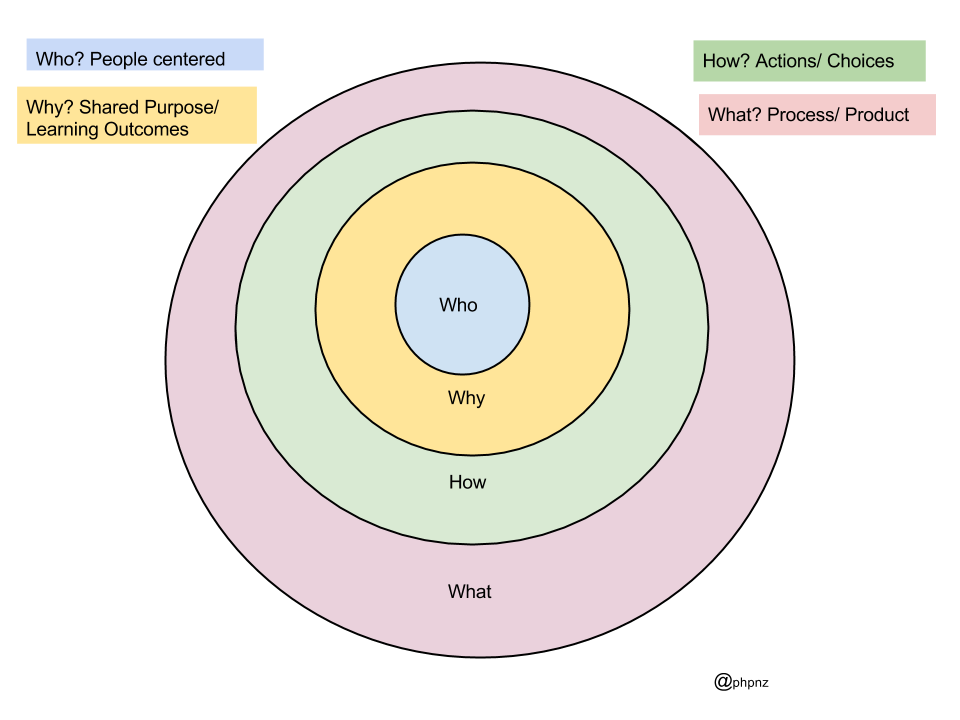
inspired from Julia Atkin's Values & Beliefs about Learning to Principles and Practice
It is about project co-construction at all levels involving conversations and negotiations to establish grounds for collaboration and cooperation, to take action and make choices together but also independently from each other.

We worked around this starting with Who. Quite a few participants had already thought through and defined the project that they would like to carry. Starting with Who reminded them to consider who are the participants in their project  and potentially questions their assumption about the fact that the project they have in mind is the best idea until they know for sure that it is wide enough and encompassing enough for all participants to take ownership of it also.

WHO as identified by participants:
students in French class, History class, English class, vertical classes, librarian , Media studies , art, music teacher/students extra curricular students, principal, parents, school community, RSA, old boys network,

Considering Why also drew in a fair amount of conversation, as the Why? participants came out with is their Why, not the Why that is a common purpose designed and adopted by the community of Who which is going to give the project a life! This served as a reminder that in designing a project, it is important to consider who executes the project, their reasons, their motivation, and to provide a scaffold that allows participants to find their own drivers.

WHY as identified by participants:
opportunity for a cross curricular French led project, create a school partnership with a French school, create a product, opportunity to use language in an authentic communicative context, multilevel, identity, cross generational

Moving onto the How was about thinking of actions that will make the project happen. It was a worthwhile step as it focussed participants on the type of learning outcomes  they want their students to get out of the project. This was also a starting point to think about the type of tools that can serve the purpose and forced people to consider the capturing, selecting, curating of information, the creation of content during the process, the feedback and conversations emanating from this process…

HOW as identified by participants:
research, gather, archive, share, connect, build framework, involve, define setting, communicate for the project, communicate about the project, relate, reflect, build collectively, discuss, manage contacts, feedback, develop global citizenship awareness.

Arriving at the What, participants were invited to consider the value of capturing the process that leads to the completion of a project. Often the proposed projects at this early stage are prescriptive. The stages of development to lead to this are worth capturing as they will tell the story of the project and also allow to get feedback and tweak/progess. Building in regular check points also gives visibility to individual and groups contribution so that all involved have a clear view of their involvement, what they are learning and how they are learning. What is produced out of this process can end up being a range of creations, and a quick brainstorm around what it can look like indicated that participants were considering a product they could have control over (e.g.: a video, a wiki etc). This led to go back to Who? and to build a project framework that allow for creativity and interpretation for all involved to shine through.

Key Words for building a Shared Histories project as identified by participants:
Time, sustainability, partnership, flexibility, communication about the process, about the product, visibility.

Participants can use the Who, Why, How, What circles to work with their partners in their school as well as their French partners. Getting to know each other from the outset is essential to work towards defining a common framework that is negotiated and  actionable over time and distance, including a range of actors, supported by ICTs that are accessible to all involved.

Shared Histories provides an ambitious opportunity. The scope and range of the project came to life as teachers from French and New Zealand met on Saturday morning via video conference. Shared Histories is definitely real and the welcome as well as the input of the French from the Amiens academy was an amazing reminder that what we had been working on for the last few days was actually starting now!

Schools had been provisionally paired in the light of their initial project outline.  Each introduced each other, in their respective or the other's language, exchanged a few ideas around how they envisage to go about the project.

Shared Histories in NZ school actually started on Saturday 7th November. It is an exciting challenge ahead.


2 March 2013

Cultural, intercultural, bicultural, multicultural - 3

So what tools have we got at our disposal to support the work of the Language teacher to be culturally and interculturally competent?

(I am writing this post to support the facilitation of some aspects of the upcoming ILEP workshops . It is a means to get my head round the complexity! It will be interesting to see how the "knowledge and experience in the room" during the workshop make the conversation evolve! I hope that participants do not turn up thinking they will be given ready solutions!)

Te Tātaiako- Cultural Competencies for Teachers of Maōri Learners
has been developed to meet the goals of Ka Hikitia so that teachers think of what it takes to have success in teaching Maōri learners. Ka Hikitia, the Government Maōri Education strategy is being redeveloped for another 5 years starting 2013.
Te Tātaiako
Te Tātaiako (here) is a highly readable (and printable) 20 page document to support teachers' work in personalising education for Maōri students.
It lists 5 main competencies (in orange my quick summary) :
Wānanga - dialogue with learners and communities
Whanaungatanga - active engagement in working relationships
Manaakitanga - integrity, sincerity and respect towards learners' culture
Tangata Whenuatanga - providing context where the identity, culture, language of the learners affirmed
Ako - teachers taking responsibility for their there own learning as well as for the learning of the learners
Then the document goes on to detail each competence with explanatory criteria as well as examples of learner voice and whanau voice.  "For registered teachers, the focus is möhio: knowing how to validate and affirm Mäori and iwi culture, and applying that knowledge." (p.4 Te Tātaiako)

It is the must-print and the must-discuss when work is done around supporting the achievement of Maōri learners.

I would like to discuss with you and other Language teachers, who may have internalized these, if I am right in thinking that these competences and behaviours are also at the heart of Intercultural competencies, or if not at the heart where they sit in relation with the iCLTs.

Should this turn out to be verified, what needs to be mobilized by the teacher in order to:
- make the connections cultural competence-intercultural competence and ensure they are explicit for all learners?
- provide culturally responsive and engaging contexts for learning?
- provide regular timely feedback/feedforward to help progress and make it visible?
- develop a relationship with all the language learners, with respect of all of the languages and cultures they are bringing in the classroom?
- document classroom and outside actions, student voice, whanau engagement, achievement, success, trials, steps taken to support learner's progress?
- reflect upon progress against the criteria?

In comes the unmissable opportunity to see how ICTs and eLearning can help with evidencing the development and growth of the cultural and intercultural competence of the teacher.
There are many tools out there that allow to :
- access information (eg: MoE websites, professional reading, NZCER, Universities etc)
- initiate/participate in conversations (eg:, professional forums, VLN groups, listserves, social media...)
- collect evidence (eg: webtools, cloud drives, apps, pictures, videos, sound files)
- select and display evidence to demonstrate some particular aspect of the competence
- reflect (individually and/or through sharing with others, in or outside your school) on progress being made, where you were at when starting, where you are now, where you are going next.

I can see how an eportfolio* system like MyPortfolio come in as a handy tool as it allows for all of that to happen in one space!

And in order to document and think about what I am doing and how I am doing it, I really need a meaty driving question which is going to be at the heart of my professional goals for a determined period of time. Central to effective pedagogy is Teaching as Inquiry and this simple reflection tool can be a step to start the process. Teaching as Inquiry has plenty of benefits as it allows to incorporate all of the school/teacher initiatives (eg: particular aspects of Cultural Competence/elearning/ iCLT) in one cycle, and allows to establish a time scale for steps to happen by.
I would actually think along these same lines to document and reflect on my practice over time if my professional goals were assessed through Appraisal. It is a matter of lining up what I set out to do in knowledge of what I ought to do within my context with what I want to achieve over that cycle.

And if carrots are needed to effectively get started or get serious...   Professional learning goals must be aligned with the Registered Teacher Criteria. Te Tātaiako have direct links with all of the twelve criteria. So by working on developing these competences, teachers are effectively working on demonstrating that they are meeting aspects of these criteria. But it is not a box ticking exercise that can be crammed in a month prior to renewing your Teacher Registration. It needs to be planned over a cycle (3 years), all twelve criteria need to be evidenced, the key indicators defining the set of values to measure against. 

The Enabling eLearning Registered Teacher Criteria and eLearning is a "resource that illustrates how e-learning examples can be used to support the  Registered Teacher Criteria. The twelve criteria have been "unpacked" with examples provided for each criteria"(Source).  I used to refer to its precursor a lot and this current version is very recent. I will make use of this and link to MyPortfolio use in the upcoming workshops. Numerous tools are mentioned, there are many options to investigate.


           Cultural Competence + Teaching as Inquiry +  eLearning
=
        effective culturally responsive Language Teacher

Phew...
___________________________________________________________________________________
*an eportfolio lands itself to this type of documenting: it is about filming the process. Understanding, developing, using competences and skills happen over time. It does not all happen at once nor is there a right or wrong. An eportfolio allows to show steps taken to work towards a competence (collecting and selecting evidence), in knowledge of the criteria, to reflect over these steps, to connect with others (HoD, colleagues etc) for feedback and feedforward,  then to decide on the next steps in a learning process knowing what has come before. Hence an eportfolio suits an inquiry and along the way users of an eportfolio gain in digital competence and capability.
___________________________________________________________________________________

1 March 2013

Cultural, intercultural, bicultural, multicultural - 2


Ko te kai o te rangatire he kōrero (leadership is putting words into action) summed up Deanne Thomas and Wharehoka Wano's  ICOT2013 breakout Cultural Leadership

When I saw De and Whare presented, I jumped to the opportunity to "meet" them. I had listened to their Keynote Language, culture, identity and raising student achievement a while back. It had sat at the back of my mind since for two reasons:
 - the importance and place of story and personal story telling
 - the importance of history
in any educational context and more particularly the educational context of Aotearoa.
De and Whare in this Keynote pointed out that some Maōri students know little about their language their culture, their place, and that is a slow process to re establish that. Part of this process is acknowledging local histories and tikanga of the students, so that all are "comfortable in (their) own self, (their) own boots before moving on into the wide word".  

Can iCLT techiques, which aim to foster interculturally competent learners who can confidently navigate intercultural interactions and relationships, apply to support Maōri learners learn as Maōri?

I need help understanding what cultural responsive pedagogy encompasses. For that I wrote  Tamara Bell  an email to ask her if she could help:
"... I was wondering if you could put me in the direction of a couple of edtalks or other short videos that could be used as a starter and/or support to conversations around teaching and learning strategies for Māori learners and raising/working on cultural responsiveness in the Language secondary classroom please.
I see there is a wealth of information out there. But I would like to make the right choices to instill curiosity and foster reflection for the participants at upcoming workshops for French and Spanish teachers, organised by ILEP,*  to continue to look into this post workshop, to make connections with what is happening school wide in their institutions
Language teachers base their curriculum on the Six principles for intercultural communicative language teaching and if you had any suggestions to make on how this can, potentially, link with cultural responsiveness, I would be grateful for your input... "
Tamara graciously replied really shortly afterwards with a wealth of resources! I felt so supported!

Here are some clips Tamara has recommended
to watch:
(>what follows each resource are my quick notes upon listening)

Russell Bishop "A Culturally Responsive Pedagogy of Relations"
> care for Maōri students as Maōri, for their performance, that they learn/embrace/give opportunity for the funds of knowledge they bring to the classroom, interact, negociate, use strategies to engage effectively, keep evidence of student performance to guide where the teacher is taking the teaching and the students know their outcome in a formative way.
> improving teaching strategies and the effectiveness of teachers in increasing the engagement and academic achievement of Māori students.

Phoebe Davis "Critical Elements for Raising Maōri Achievement"
> forming relationship with students and whanau is fundamental
> know that there are a range of kids, which iwi  and acknowledge whakapapa
> it says that you are for real and they are for real > what matters is that you try

> make the effort, think of activities that connect the teacher and the students (eg: acknowledge the different places, the people you may know in common etc)
> being culturally located >  talk to maori iwi > Where is our school? what does it mean? acknowledge the community
.

Maria Tibble "Professional Responsibility to Maōri students"
> what has had the most impact for Maria are Te Kotahitanga and Ka Hikitia as both allow to move away from an emotional approach to an evidence based professional approach to discuss the types of relationships, the pedagogy that make a difference for Maōri students.
> Rather than the teachers intellectualising the situation it is the students' voices that said that pedagogy, culture and relationship make the difference to Maōri students
> Maria urges all teachers to read, reflect, keep informed and relentlessly look into what makes a difference to Maōri Students, to commit to change.


Maria Tibble "Culture Counts"
> locate yourself culturally (where I am from, who I am )
> show you care about students as people (you invite students into your world as you culturally locate yourself, this opens a pathway for the students to follow and in return bring into the classroom their story)

> engender a relationship that has to be authentic,  spend the time, authenticate your commitment to Maōri students by saying to them "your culture counts"
> show you care about their learning


Questions: So what to take away from these videos? Do I recognise the cultural differences?  What does cultural responsiveness look like in the language classroom? How is the scene set? How do we know the rapport is building? Which activities foster inclusiveness? What has been tried and tested? Where is the part of the Target Language? How do we know it works? What do I adapt in my teaching?

Tamara also shared this acronym listing key ingredients to consider to that effect :


Questions: Which of these ingredients make it regularly, all the time, seldom in the language classroom? What do they look like in practice? Which activities are they incorporated in? How aware of them are we? What contributes to embedding them? What do we action to know the students in front of us? How do students and teachers keep trace of their performance? How do we know it works?
Another two great resources Tamara shared for feeding the conversation and the reflection:
  • Culturally Responsive Practice in a mainstream school
  • a Refresher about What Works for Maōri Learners a forum on the VLN where educators exchange stories and ideas. Lots to read and learn from, and definitely the type of conversation to aim for with Language Learning in mind. Many Language teachers work with Te Reo teachers and form the same Department. What can be learnt from each other?

    Where am I at now? Can iCLT techniques apply?
  • To move on to implement a more culturally responsive pedagogy there is need for conversation amongst teachers who are actively involved, for seeking and finding evidence, keeping track of it (taking responsibility for their learning), for making connection with the students, knowing what they have got to say, bearing it in mind in the teaching, using it to inform the next steps of learning,  connecting and interacting with family and community, enabling support from within the institution, for wanting to keep informed and reflect on practice often and meaningfully.  These to me are the tenets of effective pedagogy.
  •  What if a more culturally responsive pedagogy brought about the better more effective teacher and thus benefited all of our learners, regardless of cultural and ethnical backgrounds?
  •  And in order to make this learning journey "visible, traceable, rewindable and sharable" what if it was the perfect opportunity to blend in tools and online spaces in the practice to assist in this journey?
Writing this post is about raising my own awareness of what Cultural Competence entails. I am hoping to learn from your own experiences and other colleagues' who may have been more exposed than me in their school environment and have started to embed or are embedding these competences in their teaching. 
I also start to see where culturally responsive pedagogy and iCLT interweave as there is a common vocabulary and a common intent.  It may be worth bearing in mind the teams of extremely competent educators that might support Language teachers in their inquiry, namely TMoA at Core Education and Te Toi Tupu Blended learning PLD (that I am aware of). I would like to suggest that NZALT and ILEP make contact with these organisations in order to invite them to facilitate workshops and give presentations.
________________________________________________________________________________
*the workshop that I will facilitate aims to raise awareness of moments of learning, capturing these moments in order to be able to say how we know where we are at and decide on a next step: this can happen with the digitalising, collecting and organising of learning evidence (for students) and of professional engagement(for teachers) and the tools that support the necessary reflection that emanates from this process.

26 February 2013

Cultural, intercultural, bicultural, multicultural - 1

I am setting out here to try to debunk some stuff I am finding somewhat hard to get around. It is likely to take more than this post, so I will start here with what I am trying to do and with some resources gathered to inform my exploration.

Intercultural Communicative Language Teaching is "a set of techniques", six principles "for putting interculturally informed pedagogy into practice"

"Students build their awareness of language and culture, their language knowledge, their cultural knowledge, and positive attitudes towards themselves and others. Intercultural communicative language teaching (iCLT) encourages students to make comparisons and connections between languages and cultures"
(Learning Languages Pedagogy, TKI)

In this 6 principles I recognise the following words that relate directly to Learning:
    - actively involves
    - make connection
    - social interaction
    - reflect
    - take responsibility

"The development of intercultural competencies" has become an essential feature of school education in NZ and other Western countries, and the responsibility for this falls to some extent, but not only, on languages education and thus on the Language teacher.

Statistics New Zealand, in its National Ethnic Population projections, informs us that Maori (+29%), Asian (+145%) and Pacific (+59%) populations will continue to increase their share of the NZ population by 2021 (that's 8 years away!), with Europeans only increasing by 5%. All ethnies bar Europeans will have a much younger age structure on average of NZ population bar Europeans,  who are overall getting older. And all ethnies bar Europeans will have more babies thus more children going through school. Add to this the growing diversity of cultures, backgrounds, religions and languages that migrants bring to any NZ regions (example in the Bay of Plenty) and it is looking vibrant indeed!

All of these reasons (and the specific context of teaching Languages in Aotearoa NZ) makes me want to move on with "developing my intercultural competencies" as this multicultural mix is coming to a classroom near me rapidly (or is already there depending where you are located geographically).

Source


These are all reasons why as a teacher of French,  I am not to merely transmitting information about my culture but I have "focus on raising awareness of culture and culture-in-language in the lived experience of the students and people from the target language culture(s) as well as other cultures present in a classroom or community"

 Language learning itself won't necessarily foster a positive attitude to other's culture hence the need for interculturality to be addressed explicitly and openly in the classroom.


What does interculturally informed pedagogy look like in the language classroom?

  • construct knowledge through EXPLORING cultural practices
  • make CONNECTIONS between cultures, and between existing knowledge of culture and language, and new learning
  • social INTERACTION that involve communicating across cultural boundaries
  • REFLECT ‘critically and constructively on linguistic and cultural differences and similarities’
  • TAKE responsibility for their intercultural growth, assisted by teachers who, for example, foster engagement with difference and awareness of stereotypes. (Ref: Dellit 2005, pp. 26–28)
I would like to discuss this specifically to think of actions in the classroom that support this (use of some radical controversial materials to engage? role playing? online communication with native speakers? make culture explicit, open with key questions to wonder about eg: how do they do it, how do I do it, is it different, the same, what do I notice, why, what do I learn from it, what do I learn about my own culture, myself from what I have learnt? )

What is iCLT setting out to do?


"to foster interculturally competent learners who can confidently navigate intercultural interactions and relationships"
,
  • who are tolerant and have a positive attitude towards others' culture,
  • who can communicate with a native speaker without necessarily being fluent themselves,
  • who welcome diversity and also are able to see some universal similarities amongst cultures including their own,
  • who can confront and reflect on their preconceptions and prejudices,
  • who can resolve and/or learn from misunderstandings arising from miscommunication,
  • who develops a strong sense of one's own identity
    who is a cultural intermediary between one' s own culture and the foreign culture
So what do I do as Language teacher?

I am a French teacher who is French. "What does it mean to me to be French?" "What does it mean to be French in NZ?" "What makes me French?" "Who am I?" are questions that I am now more curious to think about. And if I am to grow a culturally responsive pedagogy, I ought to develop intercultural competences which ban assumptions, distance myself from conventional attitudes about differences, show deep interest in others' cultures, including of my students in my classroom, provide these students with the opportunity to not only eplore another culture and language but above all gain or strengthen their awareness of their own cultural and language through discovering another.

To move forward with this I need to go back and the urgency is to know my students, all of them, for who they are really.
And to learn to do that in a New Zealand context I want to turn to the kaupapa around teaching/learning strategies for Maōri learners and raising Cultural Responsiveness.


18 February 2013

Un peu de ménage.....

Salut ma co-bloggeuse,

It occurs to me (again) that responding to posts with 'comments' runs the risk of things slipping under the radar. I've just been back through the comments and see I've missed yours because I don't seem to get any notification about comments, so I thought I'd bring them back from the dead and combine them with some of mine in a housekeeping post. Well, that's the plan but you know me...... Here goes. Your comments are in italics. Mine are as is. I'll put my responses to your comments in blue.

Loving the new found discipline, secretly wishing it was going to be a constant as it is really a huge bonus for our conversation here! It is all very coherent Ruth and highlights the need indeed for a "method to our madness". 
In my case the discipline is entirely generated by hedonism!! You know me well enough to realise that if there were any sense of obligation or duty associated with this undertaking then I would be off like a rocket. I'm doing it because I love it. INTRINSIC MOTIVATION PAR EXCELLENCE. You couldn't coerce me into blogging previously because I would've derived no pleasure from a one-sided conversation. I'm an interactive dude!! Actually, although I often claim to be ill-disciplined I think I may be motivated by a deep underlying discipline driven by perceived needs or wishes to go down a particular path when the time seems right. Synchronicity. I also prefer to have things ordered in my mind rather than on a piece of paper that I may not refer to. You can't escape your own mental order. I spend a lot of time just thinking about things. I've discovered about myself that I have to be very careful not to impose too much obvious order on what I do as it tends to elicit a rebellious response in me. If, for instance, in a fit of uncharacteristic efficiency I decide to plan my day in an orderly fashion, I can almost guarantee that I'll end up doing something else (unless the plans involve others). It'll always be something worthwhile as I'm not a time-waster, but it just won't be what I planned to do. That's just me and it's something I've come to understand about myself. I'm a great believer in the old Delphic oracle tenets 'Know thyself' and 'Nothing in excess', both of these help to keep my life in pretty good balance while still leaving scope for risk-taking and exploration. Having said that, I can be highly disciplined in certain spheres where there's no margin for error, such as planning for our school France trips. I could almost have been described as a control-freak. They went off very smoothly due to meticulous dotting of 'i's and crossing of 't's.

None of this above is very practical for "la rentrée" I am afraid. We need a list of classes (year group) and a list of key ideas to tackle the diversity with gusto! I have a couple more ICOT posts to add to the smorgasbord, I know you dont do recipes. Or can this too evolve?
I'm sure it was practical, whatever it was. However, I now have a list of classes but I'll have to wait until I've got to know the students a bit before making too many decisions on how to tackle the diversity. I have a number of things that I'm interested in trying, for example designating at least one lesson a week for completely student-directed study where they're identifying their needs (a la Ewan McIntosh) and devising their own strategies (with my support) for meeting them. There remains the question of harmonising with the departmental goals and I can't walk in with hob-nailed boots and presume to change the world, if indeed it needs changing, but I envisage making incremental changes, some of which will involve quite a mind-shift for the students who, I suspect, have been fairly spoon-fed and exam-prepped. I'll be teaching in optimal conditions, for teacher well-being, anyway, as my largest class has 20 students. The others are in the 17 - 20 range with the smallest being a Year 10 of 11 students. Given that they all have laptops and the classroom is well equipped and supported for IT, there should be scope for integrating IT creatively. Yesterday I was planning with Ostiane Amigues Mathon, who has a CM1/CM2 (as well as her teacher training) to see if we could get an exchange going with my youngest Year 4 group. Her class has both a Twitter account and a blog. That's what's generated my latest appearance on Twitter. Will it last?

Yep. (re ICOT) It's certainly great to be able to benefit from others' synthesis and analysis of such events. Even though I would love to have been there, I feel that I haven't missed out, thanks to the conversation we're now having and reading of the links.
As far as Twitter is concerned, I can see you've missed your calling as a super saleswoman. I have never doubted the value of Twitter for creating a sense of community and sharing of great stuff but for me it's just too fast. I'm a bit like Mainland Cheese and take a long time to mull over things. I find Twitter vaguely unsettling, as though I can never quite catch up with it. You're a speedier person in every respect. So I rely on other ways of accessing great ideas. As you know I'm somewhat of a Facebook junkie and following various pages and belonging to various groups, as well as exploring links suggested by friends from all over the world, in areas other than education, is about the right pace for me. As far as developing a following is concerned, it would be nice to think that whatever I write could be of potential value to someone else out there but it's mainly a reflective tool for me at this stage, as I undertake a major challenge. The other thing about Facebook I really like is taking part in educational conversations in the threads and having random real time chats with Art teachers in Lithuania, English teachers in Turkey, friends from closer to home that I don't see often enough. Since I joined Facebook I find I feel connected and think about my friends more than I did before. I've tried Twitter 3 times and failed to get hooked. It's just the way I am. I'm a long-winded and ruminative old carthorse rather than a thoroughbred racehorse. We both get there in the end.

Would love a job with Twitter :-)! Yep I find Twitter hugely unsettling too (and horses too by the way!)and it needs some taming to extract the goodness. And also if I am not careful it is very easy to follow and read from people that sort of think like me, and that does not make me progress in my thinking much. One can only take so much affirming! I get my head out of the "education" thread. I am enjoying following a range of tweeps, who keep me real: fashion, activists,journalists, businesspeople etc. People I am unlikely to meet in real life.
I would not go as far as envisaging to develop a following and making the buzz, but you and I have friends and colleagues whose awesome contributions would be very beneficial to help us in our thinking. Lesley is very keen on "Starting with the end in mind", Kheya teaches in an inquiry school, Simon has huge experience and expertise in language teaching, at that is just to namedrop a few! I would like to think that we could at times invite their feedback. 

Yep, it's great to get inspiration from outside the educational sphere. Things that you can mull over and perhaps incorporate into your teaching. Important, as you say, not to limit your reading/viewing to those already of your persuasion. Broadens the mind and opens you up to new possibilities. It would be very good to share ideas with Lesley and Kheya. 'Starting with the end in mind' is a logical modus operandi, as long as the end isn't too set in concrete. There has to be room for flexibility. As my colleague and friend Simon put it 'If you know exactly what it's going to look like before you arrive, what's the point of going there?' Likewise, it's helpful to know what the objective is (preferably an open-ended one) but maybe you don't need to map out the entire itinerary, which could be different for each traveller. It might be convenient and tidier for the driver or tour guide that everyone travel together by a predetermined route but possibly less interesting and rewarding for the travellers than if they had more autonomy and input into the process.

"The heart of our problem is indeed in the task design..." Yes indeed.
I'm thinking a lot about the affective element of learning and Ken Robinson's 'exile of feeling'. I couldn't agree more.
As far as a more scientific approach is concerned, it isn't really a method that I warm to. I know it might unsettle some of the students not to know at every step of the way where they're going but isn't this a more accurate microcosm of life? I may in the short term be obliged to stick with some of the tired old material but together we can devise ways of making it relevant, in some wider, more open-ended context.
 As far as the key attributes that I would like to help my learners develop, we need look no further than Guy Claxton's Magnificent 8 Qualities. I've internalised them in the same way as I've internalised the Key Competencies and Ellis' principles and am trying to internalise Newton's Intercultural Principles, so that they provide a constant filter through which I pass my pedagogy. What is this activity doing to help develop .....?
I've just had another look at Ewan McIntosh's Problem Finding Ted Talk and that has also reassured me that I don't need to map my methodology out in advance. I need to follow my instinct and intuition, honed over the years and trust that my experience both as a linguist and a teacher will be equal to whatever comes up. I have a few doubts about the German for precisely the reason that my lack of depth here won't allow me to be such a flexible resource as I can be in French or Spanish.

My prompts worked: you did "list" your principles! Yes step by step and back to the drawing board if needed I would be happy to devise materials with you as the need arise. All to be revealed when you meet your students, discover the learning environment and take stock! 
Indeed, indeed. It'll be great to incorporate you in the process. In particular your e-portfolio expertise will be invaluable. I haven't had an answer to my question regarding the school and Google. We'll see.

Wow I am very awake! We indeed learn and process information really differently: I enjoy getting the info "second or third" hand from a respected "intermédiaire" before going to the source. Not necessarily the most adventurous way but... I had secretly wanted you to tell me more about your take on Guy Claxton for a long time and here it is. I am also glad that you have an opportunity to consign to the page what you stand by, clearly and loudly. I have heard you before and this has been at the heart of many conversations.I know you will tell me how to go about acquiring the first chunks of language learning to enable this interaction, in TL, happen. I look forward to your post on the NZC now. Surely there is going to be something about formative assessment...
We have a point in common: I am well used to the concept of sharing good ideas which after polite enthusiasm are relegated to the too-hard basket too: the relative slow uptake of eportfolios by our language colleagues is leaving me perplexed. I am convinced that developing an eportfolio is an awesome way to develop and strengthen Key Competencies in language learners but I have obviously not done a good job at selling it to them... I did throw in NCEA many times even...
To your relief I am sure, I have nearly "emptied my bag" about ICOT apart from a couple of things I will add. I never envisaged when we started talking about this blog a couple of weeks ago that I would actually be able to write anything. I have put it all out there as it may be something I/we would want to revisit/refer to at a later stage, who knows? I don't pretend that any of it would be of any influence as you are about to go and meet your many students (name tags, does it still work :-)?) In a couple of weeks I envisage that our conversation here will have slowed right down, in frequency and quantity, as you will be otherwise engaged. I ll ensure to probe and poke, such is my curiosity as getting to know your learners alongside you. Eh, are you still awake?And yep conversation in a post is the way to go! Loving it!
I'm hoping our conversation won't slow right down when I get started in a couple of weeks. It'll be a privilege to have your continued support and input as I negotiate my way around this new challenge. It's bound to be a re-learning curve from the structural point of view. I can well remember the uncomfortable feeling of being on a mouse-wheel, at the mercy of bells and time constraints. About things which offer no choice, it's best to go with the flow.

Yay!! Problem solved with a modicum of tinkering and fine-tuning. (in response to posting photos and comments directly from a smartphone) This is a perfect example of working things out by trial and error. Text, although written above, appears below on the blog. :-)
That reminds me.... did I ever tell you about the great 'distance' plumbing lesson that François Muller gave me when I was staying at their place in Bagnolet? The bathroom shower tap was on it's last legs and had a habit of shooting off and flooding the bathroom, however, with careful adjustment it could be coaxed back onto the straight and narrow. Well, I was staying there by myself when the family were down in Tarbes, and the tap did the dirty on me. I knew where to turn the water off but didn't know the 'astuce' for fixing the tap. I texted François and he tried to contact his brother (you know, first response - get a man in) but when that failed I suggested we might try a virtual repair lesson. First he sent me off to locate a set of allen keys (or was it a phillips screwdriver?) (I can't remember the translation for allen keys, and who the hell was Allen anyway?). Then, armed with the requisite tools, I effected a magnificent repair following François phone-delivered instructions. Difficult to hold a phone and grapple with a defective tap but we got there.(You'll immediately notice that I didn't think of putting the phone on speaker!!) François observed with satisfaction that it was a perfect example of peer collaborative learning. It was even more satisfying, from my point of view, as it took place entirely in French. 

Voilà pour le ménage.
^. .^
=+=