Showing posts with label Ellis' Principles. Show all posts

12 November 2013

Starting with the Who

Last week saw the launch of Shared Histories, a France-New Zealand schools cross-curricular project  spanning the five years of the commemoration of World War One Centenary, starting 2014.
Initiated by the French Embassy in Wellington it corresponds with both the signing of an Arrangement of Education Cooperation between the Ministries of Education of France and New Zealand, the official launch of the Centenary Commemoration by François Hollande, President of France, and of many initiatives up and down New Zealand.
Shared Histories in New Zealand currently receives the coordinating support of the French Embassy, the Ministry of Education (NZ), NZAFT  and ILEP

Shared Histories is about fostering the Duty of Remembrance. Participants will interact around building a consciousness that human experiences are universal.
It provides a framework for New Zealand and French schools to form partnerships and work on common projects on the theme of WW1.

It is not about simply developing language skills:  it is about developing personal relevance for the all the students involved, through genuine social interaction and explorative reflection, supported with authentic documents and experiences.

This is a personal account of two extremely rich days, working with competent, visionary and courageous colleagues who see Shared Histories as the framework for cross curricular collaboration in their schools as well as the opportunity to engage with their students in the discovery and analysis of the world around them.

I was invited to facilitate the conversation around collaborative project building and the scaffolding role of ICTs.
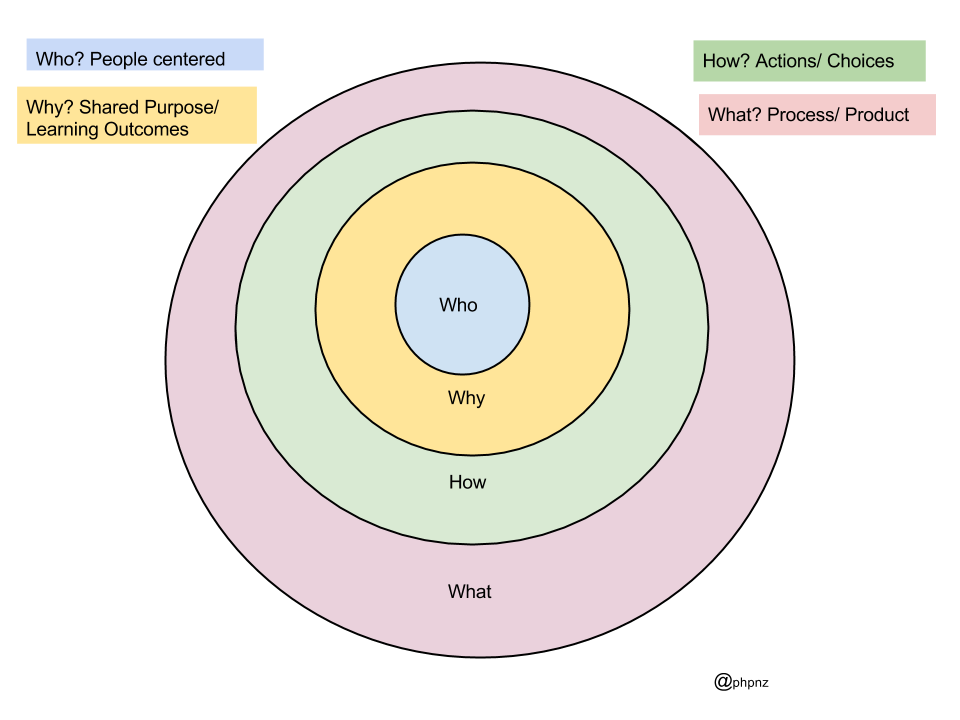
inspired from Julia Atkin's Values & Beliefs about Learning to Principles and Practice
It is about project co-construction at all levels involving conversations and negotiations to establish grounds for collaboration and cooperation, to take action and make choices together but also independently from each other.

We worked around this starting with Who. Quite a few participants had already thought through and defined the project that they would like to carry. Starting with Who reminded them to consider who are the participants in their project  and potentially questions their assumption about the fact that the project they have in mind is the best idea until they know for sure that it is wide enough and encompassing enough for all participants to take ownership of it also.

WHO as identified by participants:
students in French class, History class, English class, vertical classes, librarian , Media studies , art, music teacher/students extra curricular students, principal, parents, school community, RSA, old boys network,

Considering Why also drew in a fair amount of conversation, as the Why? participants came out with is their Why, not the Why that is a common purpose designed and adopted by the community of Who which is going to give the project a life! This served as a reminder that in designing a project, it is important to consider who executes the project, their reasons, their motivation, and to provide a scaffold that allows participants to find their own drivers.

WHY as identified by participants:
opportunity for a cross curricular French led project, create a school partnership with a French school, create a product, opportunity to use language in an authentic communicative context, multilevel, identity, cross generational

Moving onto the How was about thinking of actions that will make the project happen. It was a worthwhile step as it focussed participants on the type of learning outcomes  they want their students to get out of the project. This was also a starting point to think about the type of tools that can serve the purpose and forced people to consider the capturing, selecting, curating of information, the creation of content during the process, the feedback and conversations emanating from this process…

HOW as identified by participants:
research, gather, archive, share, connect, build framework, involve, define setting, communicate for the project, communicate about the project, relate, reflect, build collectively, discuss, manage contacts, feedback, develop global citizenship awareness.

Arriving at the What, participants were invited to consider the value of capturing the process that leads to the completion of a project. Often the proposed projects at this early stage are prescriptive. The stages of development to lead to this are worth capturing as they will tell the story of the project and also allow to get feedback and tweak/progess. Building in regular check points also gives visibility to individual and groups contribution so that all involved have a clear view of their involvement, what they are learning and how they are learning. What is produced out of this process can end up being a range of creations, and a quick brainstorm around what it can look like indicated that participants were considering a product they could have control over (e.g.: a video, a wiki etc). This led to go back to Who? and to build a project framework that allow for creativity and interpretation for all involved to shine through.

Key Words for building a Shared Histories project as identified by participants:
Time, sustainability, partnership, flexibility, communication about the process, about the product, visibility.

Participants can use the Who, Why, How, What circles to work with their partners in their school as well as their French partners. Getting to know each other from the outset is essential to work towards defining a common framework that is negotiated and  actionable over time and distance, including a range of actors, supported by ICTs that are accessible to all involved.

Shared Histories provides an ambitious opportunity. The scope and range of the project came to life as teachers from French and New Zealand met on Saturday morning via video conference. Shared Histories is definitely real and the welcome as well as the input of the French from the Amiens academy was an amazing reminder that what we had been working on for the last few days was actually starting now!

Schools had been provisionally paired in the light of their initial project outline.  Each introduced each other, in their respective or the other's language, exchanged a few ideas around how they envisage to go about the project.

Shared Histories in NZ school actually started on Saturday 7th November. It is an exciting challenge ahead.


21 February 2013

Tagging, portfolio pondering and John de Mado

Coucou Pascale,
I've just had a second read of your synthesis of our various frameworks with Ewan McIntosh's tagging for self-assessment and your reflection on incorporating e-portfolios as an integral part of the learning and assessment process. Lots to be digested here but it's certainly going in the right direction in terms of passing the responsibility onto the learner. One of my first tasks when I get to my new school will be to ascertain what they already have in place, if anything, and then take it from there. It's certainly the way I intend to go.
For years I've felt that there was something radically wrong with teachers going home night after night with a pile of books to make laborious comments that students rarely act upon. It's just too passive. It's a form of martyrdom which makes teachers seem very busy, but how often do they ask themselves "WHY am I doing this? Is this helpful for the learning process or is it just generating grades for my mark book and ultimately for the sacrosanct school report?". In other words, is it being done for purposes of compliance because someone else is going to check that work is dutifully done and marked?
I dislike imposing anything on students that smacks of duty or 'cod-liver oil' - you have to do this because it's good for you. I don't think that learning out of a sense of obligation, and at the teacher's instigation, is likely to elicit the intrinsic motivation required for real engagement with the subject.  I like the idea of students deciding when they're ready for their teacher to comment and/or grade their work as I totally agree that they all learn at different rates and don't have to be assessed on exactly the same thing at the same time. The only advantage it has is its convenience for the teacher who likes to tick things off as they go, under the illusion that if it's been taught, it should've been learned.
In fact I even have difficulty telling any group of learners what I think they should learn and when, as this robs them of ownership of their learning. I have also felt that instead of producing a quantity of work they would learn much more from reworking and polishing fewer items. An e-portfolio seems a perfect vehicle for doing just that. All this fits in very well with the model you propose. If I had to tag it à la Ewan McInstosh, what would I say? What is it? > Tagging, student-centred assessment, e-portfolios. What skill/competence is involved? developing learners' autonomy and self-reflective capacity  How do I feel about it? Enthusiastic, optimistic, curious, exploratory......

As you know, my blue sky vision for language teaching is partly shaped by the ideas of John de Mado who maintains that language is acquired rather than learned, that students self-select language in accordance with their interests. His presentations at the Queenstown NZALT conference made a deep impact on my thinking as they articulated precisely my own feelings about what's really important. He outlined the difference between Language Knowledge and Language Proficiency, saying that language teachers traditionally focus on, value and assess against Knowlege whereas it's Proficiency that fosters communication. Language Knowledge values accuracy and complexity and tends to give rise to inhibition and risk-averseness. Language Proficiency on the other hand is about survival strategies for communication. In other words, what you say (the message) is much more important than how you say it. The key element in communication is vocabulary, as it's impossible to understand or express ideas without a good repertoire of words at your command. You can communicate a great deal with nouns or verb infinitives with gestures or simple time words to indicate tenses. This is unsettling for many teachers who feel strongly that language should be used correctly. John de Mado drew a rather neat analogy to illustrate his point about what's essential to communication. What he said was frankly liberating as it fast-tracks students to a stage where they can say practically anything provided the listener has a tolerance of errors.
Here is his analogy. Supposing vocabulary was represented by consonants and structure by vowels.
Would it be possible to make something comprehensible purely out of vowels (=structure) ? ae i u ouie. NO (That was 'my name is Ruth Bourchier'). Would it be possible to make something comprehensible out of consonants (=vocab)? My nm s Rth Brchr ALMOST.
He illustrated his point further by asking us whether the letters BTTR were comprehensible. Well ALMOST. What would be required for those letters to have only one meaning? Most people answered 2 vowels but on closer inspection it was only the first vowel that was really necessary to distinguish BATTR, BETTR, BITTR, BUTTR, but that the second vowel, E, although adding to accuracy actually added nothing to the comprehensibility of the word.
Thus he underlined the importance for teachers and students of identifying and devoting time to essential structure and elements of language that allow language users to avoid miscommunication. So if we take a quick look at French it becomes clear that most structure turns out to be largely decorative - aesthetically pleasing but not essential for communication. This includes some biggies that normally hog lots of teaching and learning time.
  • verbs conjugated with être in the passé composé 
  • gender 
  • the subjunctive 
  • most agreements 
to name but a few. Essential things could include subtleties of pronunciation such as the distinction between u/ou which can lead to problems (merci beau cul,  cou/cul) or the tu/vous distinction which is so important interculturally, but which we tend to delay tackling because it's felt to be too difficult for beginners to grasp. French has traditionally been taught in a fairly standard progression based on a perception of what's easier or more difficult for students to assimilate, with the present tense preceding the passé composé, preceding the subjunctive etc. There has been little account taken of what students are actually interested in being able to say. My argument now is that if we were less precious about errors and allowed students to experiment and try getting their meaning across with survival French, not only would this more closely equate to the experience of anyone learning an additional language in an authentic context, but it would be a jolly sight more motivating and fun, as it would no longer be a case of pre-learning prescribed language for the purpose of practicing it. Can you see how well this fits in with  the notion of students being responsible for their own learning? Considering the majority of students don't continue learning languages beyond Y10 why are we clipping their wings with structural constraints when they could be having fun exploring and making their own meaning? This would be a better preparation for the real world. Let's tap into their creativity!!

Nothing is plain-sailing though. According to the Ellis' principles, effective language acquisition depends on having plenty of input, output and interaction as well as an extensive repertoire of formulaic language and some rule-based competence. My question to myself is 'If students are all self-selecting and building their own individualised repertoire, how can teachers guarantee that they will end up with enough common repertoire to be able to interact effectively? They might be able to interact with a teacher or native speaker but not necessarily with each other'. I'm still pondering my way through that problem. On the one hand I'm adamant that we should be looking beyond the time-honoured boring, neutral old topics to something of real interest, more likely to engage the learners emotions, but what can I put in their way instead, which will give rise to some common ground on which to interact? This is not a problem for writing so maybe that's where there should be much greater freedom. For interaction it's vital to develop a good repertoire of language that can be adapted to lots of different contexts and topics. I think perhaps one of the best ways of doing this is to get the students to monitor how frequently the same words and expressions pop up in English in class. These should become the transactional target language, generated by need rather than habit. This would be more effective than my presenting the students with my pre-prepared list, even though they're likely to come up with something very similar.

Getting back to subject matter, I was interested to see the FLIP lessons on Chris Harte's website, Learner Evolution. These clearly gave students more responsibility for their own learning but I couldn't help noticing that the subject matter was unchanged. The students were building Spanish sentences with cards, which they seemed to be enjoying but they were still saying 'I don't like maths because it's difficult and the teacher is too strict' which is the same sort of predictable utterance students have been trotting out forever. It's dictated by the obligation for everyone to learn the same words and expressions. There's no evidence of being encouraged to put one's own stamp on the content by asking 'How do you say........ in Spanish/French....?' Where's the students' creative input? Maybe they have little choice with regard to content. In New Zealand we're particularly fortunate to have 'carte blanche', as our language curriculum no longer has suggested topics or prescribed structure, although there is a list of prescribed NCEA vocab, designed less to constrain learners than exam-setters, and very broad proficiency descriptors for each curriculum level. I wonder, then, why most teachers still adhere to the same old stuff. WHY ARE WE WAITING?

So how do I see my role as a teacher of French, if it's not to push all students through the same mold? I can draw on my own experience of learning languages and share with them strategies that have helped me to become fluent in French and proficient in Spanish. I can put them in contact with native speakers both in person and virtually. Some would say that it's best to stick to authentic materials that adolescents are likely to engage with but how can we be sure this is not short-changing them? For me what has been memorable has been the unexpected, often moving, inspiring things that I might never have come across without guidance from the teacher (poetry, art, music, history, literature). I wouldn't have wanted my teachers to limit themselves to my popular culture or keep me fixed in my present. I'm looking for myriad ways to inspire my students and foster their intrinsic motivation.

Wow, this is a ramble. Congratulations for getting to the end of it!


18 February 2013

Un peu de ménage.....

Salut ma co-bloggeuse,

It occurs to me (again) that responding to posts with 'comments' runs the risk of things slipping under the radar. I've just been back through the comments and see I've missed yours because I don't seem to get any notification about comments, so I thought I'd bring them back from the dead and combine them with some of mine in a housekeeping post. Well, that's the plan but you know me...... Here goes. Your comments are in italics. Mine are as is. I'll put my responses to your comments in blue.

Loving the new found discipline, secretly wishing it was going to be a constant as it is really a huge bonus for our conversation here! It is all very coherent Ruth and highlights the need indeed for a "method to our madness". 
In my case the discipline is entirely generated by hedonism!! You know me well enough to realise that if there were any sense of obligation or duty associated with this undertaking then I would be off like a rocket. I'm doing it because I love it. INTRINSIC MOTIVATION PAR EXCELLENCE. You couldn't coerce me into blogging previously because I would've derived no pleasure from a one-sided conversation. I'm an interactive dude!! Actually, although I often claim to be ill-disciplined I think I may be motivated by a deep underlying discipline driven by perceived needs or wishes to go down a particular path when the time seems right. Synchronicity. I also prefer to have things ordered in my mind rather than on a piece of paper that I may not refer to. You can't escape your own mental order. I spend a lot of time just thinking about things. I've discovered about myself that I have to be very careful not to impose too much obvious order on what I do as it tends to elicit a rebellious response in me. If, for instance, in a fit of uncharacteristic efficiency I decide to plan my day in an orderly fashion, I can almost guarantee that I'll end up doing something else (unless the plans involve others). It'll always be something worthwhile as I'm not a time-waster, but it just won't be what I planned to do. That's just me and it's something I've come to understand about myself. I'm a great believer in the old Delphic oracle tenets 'Know thyself' and 'Nothing in excess', both of these help to keep my life in pretty good balance while still leaving scope for risk-taking and exploration. Having said that, I can be highly disciplined in certain spheres where there's no margin for error, such as planning for our school France trips. I could almost have been described as a control-freak. They went off very smoothly due to meticulous dotting of 'i's and crossing of 't's.

None of this above is very practical for "la rentrée" I am afraid. We need a list of classes (year group) and a list of key ideas to tackle the diversity with gusto! I have a couple more ICOT posts to add to the smorgasbord, I know you dont do recipes. Or can this too evolve?
I'm sure it was practical, whatever it was. However, I now have a list of classes but I'll have to wait until I've got to know the students a bit before making too many decisions on how to tackle the diversity. I have a number of things that I'm interested in trying, for example designating at least one lesson a week for completely student-directed study where they're identifying their needs (a la Ewan McIntosh) and devising their own strategies (with my support) for meeting them. There remains the question of harmonising with the departmental goals and I can't walk in with hob-nailed boots and presume to change the world, if indeed it needs changing, but I envisage making incremental changes, some of which will involve quite a mind-shift for the students who, I suspect, have been fairly spoon-fed and exam-prepped. I'll be teaching in optimal conditions, for teacher well-being, anyway, as my largest class has 20 students. The others are in the 17 - 20 range with the smallest being a Year 10 of 11 students. Given that they all have laptops and the classroom is well equipped and supported for IT, there should be scope for integrating IT creatively. Yesterday I was planning with Ostiane Amigues Mathon, who has a CM1/CM2 (as well as her teacher training) to see if we could get an exchange going with my youngest Year 4 group. Her class has both a Twitter account and a blog. That's what's generated my latest appearance on Twitter. Will it last?

Yep. (re ICOT) It's certainly great to be able to benefit from others' synthesis and analysis of such events. Even though I would love to have been there, I feel that I haven't missed out, thanks to the conversation we're now having and reading of the links.
As far as Twitter is concerned, I can see you've missed your calling as a super saleswoman. I have never doubted the value of Twitter for creating a sense of community and sharing of great stuff but for me it's just too fast. I'm a bit like Mainland Cheese and take a long time to mull over things. I find Twitter vaguely unsettling, as though I can never quite catch up with it. You're a speedier person in every respect. So I rely on other ways of accessing great ideas. As you know I'm somewhat of a Facebook junkie and following various pages and belonging to various groups, as well as exploring links suggested by friends from all over the world, in areas other than education, is about the right pace for me. As far as developing a following is concerned, it would be nice to think that whatever I write could be of potential value to someone else out there but it's mainly a reflective tool for me at this stage, as I undertake a major challenge. The other thing about Facebook I really like is taking part in educational conversations in the threads and having random real time chats with Art teachers in Lithuania, English teachers in Turkey, friends from closer to home that I don't see often enough. Since I joined Facebook I find I feel connected and think about my friends more than I did before. I've tried Twitter 3 times and failed to get hooked. It's just the way I am. I'm a long-winded and ruminative old carthorse rather than a thoroughbred racehorse. We both get there in the end.

Would love a job with Twitter :-)! Yep I find Twitter hugely unsettling too (and horses too by the way!)and it needs some taming to extract the goodness. And also if I am not careful it is very easy to follow and read from people that sort of think like me, and that does not make me progress in my thinking much. One can only take so much affirming! I get my head out of the "education" thread. I am enjoying following a range of tweeps, who keep me real: fashion, activists,journalists, businesspeople etc. People I am unlikely to meet in real life.
I would not go as far as envisaging to develop a following and making the buzz, but you and I have friends and colleagues whose awesome contributions would be very beneficial to help us in our thinking. Lesley is very keen on "Starting with the end in mind", Kheya teaches in an inquiry school, Simon has huge experience and expertise in language teaching, at that is just to namedrop a few! I would like to think that we could at times invite their feedback. 

Yep, it's great to get inspiration from outside the educational sphere. Things that you can mull over and perhaps incorporate into your teaching. Important, as you say, not to limit your reading/viewing to those already of your persuasion. Broadens the mind and opens you up to new possibilities. It would be very good to share ideas with Lesley and Kheya. 'Starting with the end in mind' is a logical modus operandi, as long as the end isn't too set in concrete. There has to be room for flexibility. As my colleague and friend Simon put it 'If you know exactly what it's going to look like before you arrive, what's the point of going there?' Likewise, it's helpful to know what the objective is (preferably an open-ended one) but maybe you don't need to map out the entire itinerary, which could be different for each traveller. It might be convenient and tidier for the driver or tour guide that everyone travel together by a predetermined route but possibly less interesting and rewarding for the travellers than if they had more autonomy and input into the process.

"The heart of our problem is indeed in the task design..." Yes indeed.
I'm thinking a lot about the affective element of learning and Ken Robinson's 'exile of feeling'. I couldn't agree more.
As far as a more scientific approach is concerned, it isn't really a method that I warm to. I know it might unsettle some of the students not to know at every step of the way where they're going but isn't this a more accurate microcosm of life? I may in the short term be obliged to stick with some of the tired old material but together we can devise ways of making it relevant, in some wider, more open-ended context.
 As far as the key attributes that I would like to help my learners develop, we need look no further than Guy Claxton's Magnificent 8 Qualities. I've internalised them in the same way as I've internalised the Key Competencies and Ellis' principles and am trying to internalise Newton's Intercultural Principles, so that they provide a constant filter through which I pass my pedagogy. What is this activity doing to help develop .....?
I've just had another look at Ewan McIntosh's Problem Finding Ted Talk and that has also reassured me that I don't need to map my methodology out in advance. I need to follow my instinct and intuition, honed over the years and trust that my experience both as a linguist and a teacher will be equal to whatever comes up. I have a few doubts about the German for precisely the reason that my lack of depth here won't allow me to be such a flexible resource as I can be in French or Spanish.

My prompts worked: you did "list" your principles! Yes step by step and back to the drawing board if needed I would be happy to devise materials with you as the need arise. All to be revealed when you meet your students, discover the learning environment and take stock! 
Indeed, indeed. It'll be great to incorporate you in the process. In particular your e-portfolio expertise will be invaluable. I haven't had an answer to my question regarding the school and Google. We'll see.

Wow I am very awake! We indeed learn and process information really differently: I enjoy getting the info "second or third" hand from a respected "intermédiaire" before going to the source. Not necessarily the most adventurous way but... I had secretly wanted you to tell me more about your take on Guy Claxton for a long time and here it is. I am also glad that you have an opportunity to consign to the page what you stand by, clearly and loudly. I have heard you before and this has been at the heart of many conversations.I know you will tell me how to go about acquiring the first chunks of language learning to enable this interaction, in TL, happen. I look forward to your post on the NZC now. Surely there is going to be something about formative assessment...
We have a point in common: I am well used to the concept of sharing good ideas which after polite enthusiasm are relegated to the too-hard basket too: the relative slow uptake of eportfolios by our language colleagues is leaving me perplexed. I am convinced that developing an eportfolio is an awesome way to develop and strengthen Key Competencies in language learners but I have obviously not done a good job at selling it to them... I did throw in NCEA many times even...
To your relief I am sure, I have nearly "emptied my bag" about ICOT apart from a couple of things I will add. I never envisaged when we started talking about this blog a couple of weeks ago that I would actually be able to write anything. I have put it all out there as it may be something I/we would want to revisit/refer to at a later stage, who knows? I don't pretend that any of it would be of any influence as you are about to go and meet your many students (name tags, does it still work :-)?) In a couple of weeks I envisage that our conversation here will have slowed right down, in frequency and quantity, as you will be otherwise engaged. I ll ensure to probe and poke, such is my curiosity as getting to know your learners alongside you. Eh, are you still awake?And yep conversation in a post is the way to go! Loving it!
I'm hoping our conversation won't slow right down when I get started in a couple of weeks. It'll be a privilege to have your continued support and input as I negotiate my way around this new challenge. It's bound to be a re-learning curve from the structural point of view. I can well remember the uncomfortable feeling of being on a mouse-wheel, at the mercy of bells and time constraints. About things which offer no choice, it's best to go with the flow.

Yay!! Problem solved with a modicum of tinkering and fine-tuning. (in response to posting photos and comments directly from a smartphone) This is a perfect example of working things out by trial and error. Text, although written above, appears below on the blog. :-)
That reminds me.... did I ever tell you about the great 'distance' plumbing lesson that François Muller gave me when I was staying at their place in Bagnolet? The bathroom shower tap was on it's last legs and had a habit of shooting off and flooding the bathroom, however, with careful adjustment it could be coaxed back onto the straight and narrow. Well, I was staying there by myself when the family were down in Tarbes, and the tap did the dirty on me. I knew where to turn the water off but didn't know the 'astuce' for fixing the tap. I texted François and he tried to contact his brother (you know, first response - get a man in) but when that failed I suggested we might try a virtual repair lesson. First he sent me off to locate a set of allen keys (or was it a phillips screwdriver?) (I can't remember the translation for allen keys, and who the hell was Allen anyway?). Then, armed with the requisite tools, I effected a magnificent repair following François phone-delivered instructions. Difficult to hold a phone and grapple with a defective tap but we got there.(You'll immediately notice that I didn't think of putting the phone on speaker!!) François observed with satisfaction that it was a perfect example of peer collaborative learning. It was even more satisfying, from my point of view, as it took place entirely in French. 

Voilà pour le ménage.
^. .^
=+=