Showing posts with label Ignite. Show all posts

22 April 2013

#ignition13

I marvel at what happens when 80+ teachers get together during the holiday for some self directed learning. This is now happening now at Ignition13
I admire the commonality:
All deeply care for their students' learning. All deeply care that the students own their own learning.
The participants embody change as it is enabled through NZC, effective pedagogy, aligned NCEA standards, natural use of ICTs...
All are practitioners that are effecting change.
I am in owe of the sharing of ideas taking place.
I appreciate the mix of primary and secondary teachers exchanging.
All talk thinking, talk inquiry, talk modern learning environments, talk evidence of learning, talk assessment for learning, talk mindsets and mindfulness.
All prepare clever, crafted and convincing Ignite talks on subjects as diverse as "flipped Library", "Music as alchemy", "Mindfulness", "Exploration", "Call of Duty", "Overcoming stigmas"... (I ll edit here to link to them when they are posted).
All are change agents because this is what they want to model to their students to enable them to be change agent themselves.
I appreciate the goodness of what is shared and learned as it will keep on giving as it will be in turned shared to those not present.

I respect that all are prepared to stick their neck out, have their views challenged, stumble and start again.
I have all to learn from this ever growing group of emerging leaders: their risk taking, their clarity of purpose, their drive, their confidence in their role, their enthusiasm.

All today embody this culture of "working together to make things better for all". How long before this mindset is mainstream in NZ schools? 


17 February 2013

Conference or not? ICOT2013

No doubt I took away from ICOT2013 heaps to think about , discuss, weigh etc. BUT!

I sat for five days and listened for five days. I took in: I wanted to be there, both the keynotes and presentations engaged me. I had built my own programme selecting from hundreds of breakouts. I was prepared, I knew what to expect, it was part of the deal.

The speakers were big guns that I respected and wanted to learn from. There was a bit of "fangirl" time going on there.

But a dimension was lacking: I wished some unconference times had been scheduled : I could have heard more but also talked and exchanged, built a better picture there and then.

Hazel blogged live here about her wish to an alternative approach to the conference lecture

And Viv captured it very well in this tweet:


Not saying that big ticket conferences need to go: maybe to be attended sporadically (cost, time value for money, reporting back etc. to be taken into consideration) for the big picture inspirational stuff, where some seriously good presenters are truly going to kick your thinking into action... Or I say, read about it online and engage in discussions with others on matters arising on social media or discussion groups to make sense of it.
What is an alternative? I believe in the value of robust conversations with colleagues,anytime anywhere, as a pillar of professional learning.  User driven conferences, where practitioners share experiences, discuss, make sense of together on matters which actually really matter to them and make the necessary connections, provides a frame for these conversations to take place. Attend an educamp sometime,  there is always one near you. Or there may be a repeat of a frenchCamp!  (Note: what you get out of it is proportional to what you put int, and those gatherings do have a method behind their madness, it's a matter of do what you want in a framework. Nuance!)
Not a place where practitioners expect content delivered in a tidy one hour slot of listening before moving to the next tidy one hour slot, not necessarily connected to the previous, not a space that is partitioned, not an environment that is close to only those present, not a time where somebody tells me what I am going to listen to. I want to choose, I want to lead my learning, I want to decide what I need to learn about to further my understanding, I want to do it as I own it. Stuff that conference conveners,  no matter how much they labour on a programme, coerce presenters to deliver, decide on a venue but are limited by cost, choose what I will eat and drink, try to keep the cost down but still there is a cost, just can not decide for me.
Then that will be teachers embracing their learning and thus being able to truly get students to embrace theirs.

11 February 2013

ICOT Part 2: Reporting Back

I wish now I had been disciplined enough to put down some reflections at the end of each day at ICOT2013... See the line up of keynotes and presenters here

Mai Chen reminded me in her outstanding keynote (listen to it here) that the students we have in front of us in the classroom need to also be empowered to be citizens with a voice, empathy and willingness to make a difference beyond “Me”. The day after her keynote an article was published in the Herald: “It is becoming clear that we need to be measuring the performance of government very differently”
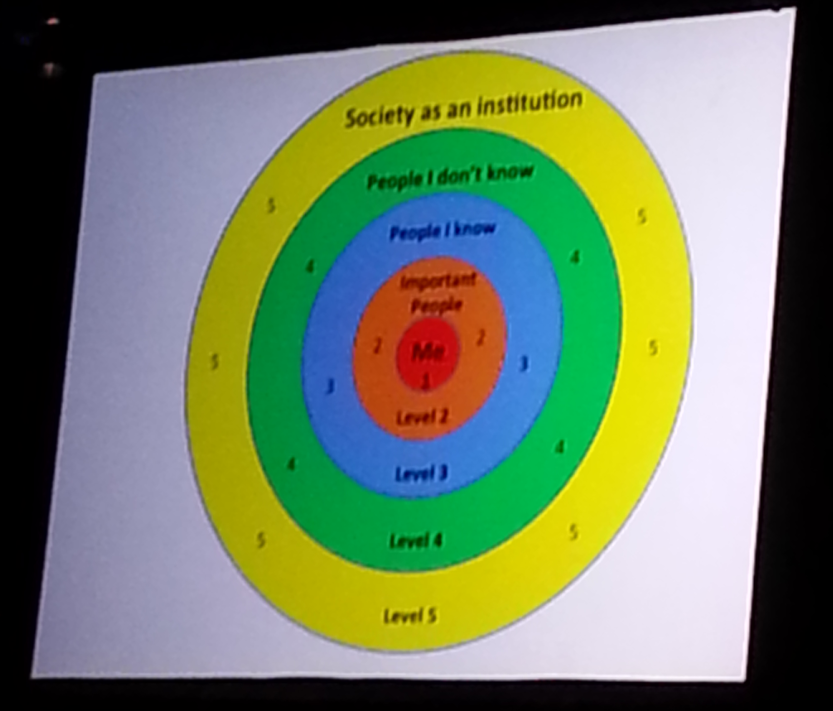
Picture taken during the subsequent Kerry Spackman Keynote
 that Mai Chen previewed in her address
 Mai Chen asked “What do we think is in the public interest anyway?”, and that if there is a framework how do we hold Governments accountable to act in the public interest?

If these questions drive society involvement we ought to prepare today’s young to feel and to know they are equipped to participate fully. Mai went on to announces that “the fresh thinking for 2013 is that we need to broaden the criteria against which we measure the progress of Government in achieving the public interest, to include those non-material things, like happiness and equity, which are critical to our future sustainability and wellbeing”. 
If I try to make sense of this as a teacher, I interpret it as:
- a further cue to do away with the bean counting credits and standards as a means of evaluating how well students are learning and to incorporate soft data such as enjoyment, sense of personal achievement, reflection, curiosity, optimism in evaluations
- giving teachers and educators the impetus they may need to contribute to help students become better critical learners as they too will have an important role in the society we live in.

Brendan Spillane captured in five short convincing minutes, in his Ignite* talk “Pull up a chair” , how “thinking becomes wisdom”. Thinking is like “a campfire to gather round” and his talk really set the tone for the conference.
*Ignite talks are a 5min presentation format supported by 20 slides. EduIgnite evenings are organised regularly I am looking out for the EduIgnite Evenings
as I would like to attend one this year (as a spectator to start with!)

Thinking of the format where Ignite presenters share their personal and professional passions, using 20 slides that auto-advance every 15 seconds for a total of just five minutes, it would be a fab thing to consider doing in class, first modelling to students on something I really care deeply about and then invite them to come up with their own Ignite talk. An opportunity to communicate a convincing, effective personal response to something they deeply care about.


Guy Claxton and Ewan McIntosh (I’ll come back to Ewan keynote and breakout separately) make it compelling to stop looking at the knowledge look at the process behind learning. What is actually looks like in practical terms for teachers and learners is the heart of our conversation Ruth. What follows may help. I have to immerse more to offer anything practical, and even then, does it mean it will be practical in your own experience? What strikes me is that both make a clear case for having all school, discussed and systematic approach. It will be interesting to see to what extent an individual teacher’s approach, in a secondary, in one learning area breaks through the established patterns. Hence the documenting of the steps taken here on "Back to the Drawing Board"!

Guy Claxton argues that "Mind Expanding has to happen now" (Mind Expanding Education MEE) in a packed solid breakout room.
The Building Learning Power approach creates learning cultures in schools. There is plenty to investigate here.
The first step is to step back and reflect, have a willingness to try things and think on your feet.  He urges to “take a deep breath and look back to look at the way we deliver “ and to get rid of jargon and instead use plain language and not parrot official documents. We need clarity. I see this as teaching as inquiry and/or action research.

Bin these Words! G.Claxton ICOT2013
He mentions how school leavers in the UK are accepted in prestigious universities on the strength of their grades and wind up two month on at the Mental Health service as they are petrified, scared and vulnerable as they are asked questions they do not have a ready answer for. I know how that feels, I am only started 20 years on to know better how to go about investigating and inquiring. Guy Claxton also talked about the Imposter Syndrome,  “a psychological phenomenom in which people are unable to internalise their accomplishments” which can appear if you are , for instance caught unable to answer an on the spot rich question. All of this highlighting “Students must be encouraged to sharpen their wits, ask questions, and think for themselves” (What is the point of school? ) to ensure they are confident and connected. He also says that we can have both high stake assessment and a culture of learning, that we need to TRUST THE PROCESS (Ewan McIntosh uses this too)
In the Vital, Challenging and Possible interview referred in the tweet above, Guy Claxton spells how that there can be Key Competencies AND Assessment , that students can get test scores AND develop the capacity to flourish. This interview followed his lecture Can Schools prepare you for anything? Recorded here.

Will this sustain your inner fan girl appetite for all things Claxton Ruth?

On the topic of Key Competencies and Pedagogy, NZCR  have worked on creating a Self Auditing Framework to support teachers’ inquiries into how well the Key Competencies are being embedded into learning. What strikes me at first glance is that I understand all the questions: NZCR heeding Guy Claxton’s no jargon approach! There are numerous Examples of Practice which could serve as a model to reproduce with a Language class, why not? And it could be an attempt at bringing in the international approaches within the setting of the NZC. What do you think?