Showing posts with label creativity. Show all posts

12 November 2013

Starting with the Who

Last week saw the launch of Shared Histories, a France-New Zealand schools cross-curricular project  spanning the five years of the commemoration of World War One Centenary, starting 2014.
Initiated by the French Embassy in Wellington it corresponds with both the signing of an Arrangement of Education Cooperation between the Ministries of Education of France and New Zealand, the official launch of the Centenary Commemoration by François Hollande, President of France, and of many initiatives up and down New Zealand.
Shared Histories in New Zealand currently receives the coordinating support of the French Embassy, the Ministry of Education (NZ), NZAFT  and ILEP

Shared Histories is about fostering the Duty of Remembrance. Participants will interact around building a consciousness that human experiences are universal.
It provides a framework for New Zealand and French schools to form partnerships and work on common projects on the theme of WW1.

It is not about simply developing language skills:  it is about developing personal relevance for the all the students involved, through genuine social interaction and explorative reflection, supported with authentic documents and experiences.

This is a personal account of two extremely rich days, working with competent, visionary and courageous colleagues who see Shared Histories as the framework for cross curricular collaboration in their schools as well as the opportunity to engage with their students in the discovery and analysis of the world around them.

I was invited to facilitate the conversation around collaborative project building and the scaffolding role of ICTs.
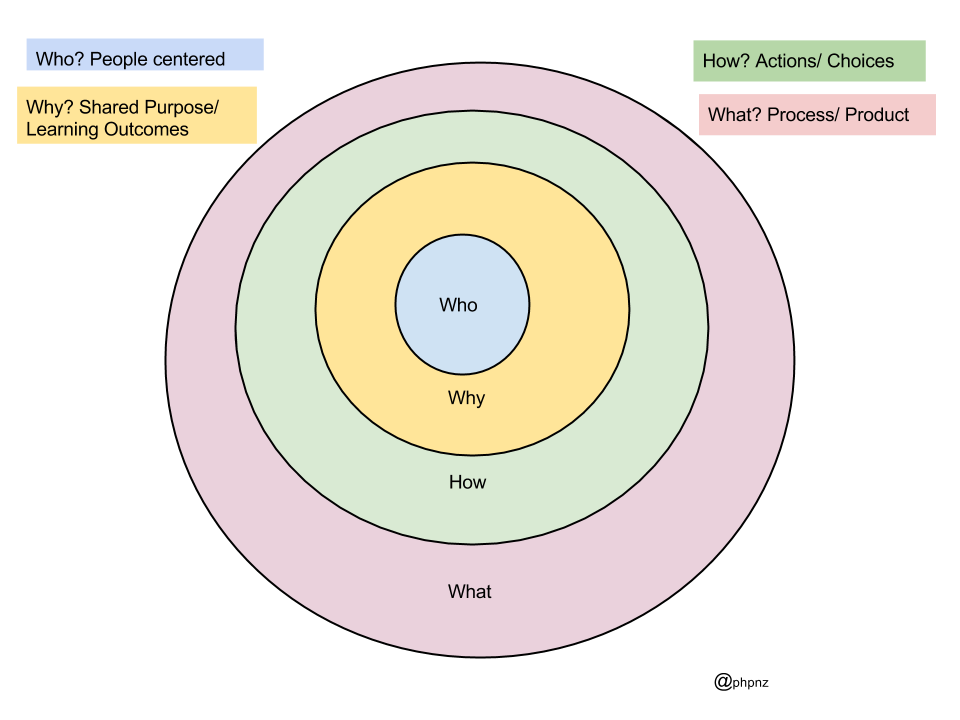
inspired from Julia Atkin's Values & Beliefs about Learning to Principles and Practice
It is about project co-construction at all levels involving conversations and negotiations to establish grounds for collaboration and cooperation, to take action and make choices together but also independently from each other.

We worked around this starting with Who. Quite a few participants had already thought through and defined the project that they would like to carry. Starting with Who reminded them to consider who are the participants in their project  and potentially questions their assumption about the fact that the project they have in mind is the best idea until they know for sure that it is wide enough and encompassing enough for all participants to take ownership of it also.

WHO as identified by participants:
students in French class, History class, English class, vertical classes, librarian , Media studies , art, music teacher/students extra curricular students, principal, parents, school community, RSA, old boys network,

Considering Why also drew in a fair amount of conversation, as the Why? participants came out with is their Why, not the Why that is a common purpose designed and adopted by the community of Who which is going to give the project a life! This served as a reminder that in designing a project, it is important to consider who executes the project, their reasons, their motivation, and to provide a scaffold that allows participants to find their own drivers.

WHY as identified by participants:
opportunity for a cross curricular French led project, create a school partnership with a French school, create a product, opportunity to use language in an authentic communicative context, multilevel, identity, cross generational

Moving onto the How was about thinking of actions that will make the project happen. It was a worthwhile step as it focussed participants on the type of learning outcomes  they want their students to get out of the project. This was also a starting point to think about the type of tools that can serve the purpose and forced people to consider the capturing, selecting, curating of information, the creation of content during the process, the feedback and conversations emanating from this process…

HOW as identified by participants:
research, gather, archive, share, connect, build framework, involve, define setting, communicate for the project, communicate about the project, relate, reflect, build collectively, discuss, manage contacts, feedback, develop global citizenship awareness.

Arriving at the What, participants were invited to consider the value of capturing the process that leads to the completion of a project. Often the proposed projects at this early stage are prescriptive. The stages of development to lead to this are worth capturing as they will tell the story of the project and also allow to get feedback and tweak/progess. Building in regular check points also gives visibility to individual and groups contribution so that all involved have a clear view of their involvement, what they are learning and how they are learning. What is produced out of this process can end up being a range of creations, and a quick brainstorm around what it can look like indicated that participants were considering a product they could have control over (e.g.: a video, a wiki etc). This led to go back to Who? and to build a project framework that allow for creativity and interpretation for all involved to shine through.

Key Words for building a Shared Histories project as identified by participants:
Time, sustainability, partnership, flexibility, communication about the process, about the product, visibility.

Participants can use the Who, Why, How, What circles to work with their partners in their school as well as their French partners. Getting to know each other from the outset is essential to work towards defining a common framework that is negotiated and  actionable over time and distance, including a range of actors, supported by ICTs that are accessible to all involved.

Shared Histories provides an ambitious opportunity. The scope and range of the project came to life as teachers from French and New Zealand met on Saturday morning via video conference. Shared Histories is definitely real and the welcome as well as the input of the French from the Amiens academy was an amazing reminder that what we had been working on for the last few days was actually starting now!

Schools had been provisionally paired in the light of their initial project outline.  Each introduced each other, in their respective or the other's language, exchanged a few ideas around how they envisage to go about the project.

Shared Histories in NZ school actually started on Saturday 7th November. It is an exciting challenge ahead.


14 September 2013

A Lot of Learning

A week on, I can articulate (I think!) some takeaways from the Tauranga StartUp Week End
Rewind back 7 days:  I pitched, my idea did not get traction, went round the room, liked a few ideas, hard to put forward my "soft skills" when people just want to get going, needing a developer or a designer, and then chose to hang around an idea that inherently involved learning and self directed learning, as well as speaking competence and ability, and enhancement of these through feedback and feedforward, through the development of an online community dedicated to do just that. All stuff that I relate to through language teaching, ePortfolio development, understanding of what good expert and peer feedback consists of,  credentialing of evidence with Open badges, online community building experience both as a user and a facilitator... The SpeakEazy idea talked to me on many levels.
Now to make a Minimum Viable Product from an idea like this and turn it into a convincing business plan...That's the challenge.
Lean Canvas
This is where the words Motivation, Team and Leadership come alive. Those very words that are the foundation for a positive productive and supportive learning environment.
The team had a difficult challenge, the one they set themselves to solve.
The team had the tools: each other's experience, expertise and contribution, the devices, the internet, an outline of the success criteria, and the Lean Canvas.
The team had the support: honest mentors with a range of expertise, a set framework, food, drink, attentive organisers
The team had time: well not really (54hrs sounds a lot but...) in fact yes there was time since we were in "locked down" doing anything but work on the project uninterrupted.
Challenge+Tools+Time+Support =  Motivation.
> Isn't this level of engagement that we want in school?

Co constructed under effective leadership
The team members have never met before.The team recognised the role individuals within the team could play, and the strengths and limitations each has. There is respect, there is collaboration and there is ownership.  The sum of their contributions will lead to solving the problem if the pathway to it is underpinned by a thought through strategy, facilitated by a leader. The team was well lead indeed, by someone who not only had given careful consideration to what it will take to succeed but who also could articulate the steps, as well as enable team members to contribute at their level of competence, while providing opportunities to stretch beyond.
> Isn't this the type of  leadership of learning we want in school?

Then came the evaluation, the 5 minute presentation of the project to the Judges, in front of your peers turned audience, culmination of the hard work but also the competition. And the celebration of success, not just for the winning team, but for all that have fully immersed in the experience, each individual taking away with them something to reflect on, grow, emulate, extend.
> Isn't this the type of individualised learning we want in school?

In learning mode...
Just felt I have actually lived Ewan McIntosh's Design Thinking for Learning, including the ah ah moment! That ah ah moment applies actually to ThinkAgency as I have been working on getting to the value proposition. It is about serendipity also!
Isn't this the type of success what we want all learners to experience?   ;-)

5 September 2013

A different kind of a week end...

How to find real life learning, with an authentic purpose, in a supportive, energetic environment, where collaboration and competition keep momentum, curiosity and drive going?
How to test what I can add to a team of people I don't know, in an unknown setting with an unknown challenge?
I have signed up for Tauranga StartUp Weekend•, a 54hr "learning curve" where up to 80 people from various professional backgrounds (tech, design, marketing, entrepreuneurs...) get together to form/join a team on an idea that is pitched on the first night, build a viable business, convince investors.
This is going to be a little... "uncomfortable"!

So what shall I take with me to "pad the ride?"
- a bit of tech end user experience,
- some facilitation skills
- a burgeoning understanding of the Design Thinking mindset (I'll have to tell you about that as I am putting this in real time practice for ThinkAgency!)
- my ability to generate ideas
- a capacity to look for, find and analyse relevant information
- my "to do" list obsession
- an aptitude to look for "work arounds"
- all that the world of teaching and learning has armed me with: patience, stayability, keeping things simple, working with others, curiosity, solving problems... will all this come handy?
- an open mind, ready to fill the kete!
- my brand new phone (again!) my laptop, my chargers.

And here is what I shall leave behind:
- preconceived ideas
- fear of the unknown
- feeling overwhelmed in front of awesomeness
- worry that I will be out of my depth.

So will I pitch on the night or what? One minute to convince an audience that your idea is worth spending time and energy on? It has got to be done.

• About Startup Weekend: Startup Weekends are 54-hour events designed to provide superior experiential education for technical and non-technical entrepreneurs.  Beginning with Friday night pitches and continuing through brainstorming, business plan development, and basic prototype creation, Startup Weekends culminate in Sunday night demos and presentations.  Participants create working startups during the event and are able to collaborate with like-minded individuals outside of their daily networks. All teams hear talks by industry leaders and receive valuable feedback from local entrepreneurials. The weekend is centered around action, innovation, and education.  Whether you are looking for feedback on a idea, a co-founder, specific skill sets, or a team to help you execute, Startup Weekends are the perfect environment in which to test your idea and take the first steps towards launching your own startup.

6 June 2013

Bundle of Inspiration


I am currently buried under the self motivated (!?) task of identifying and verbalising concisely why I do what I do at the moment. It stems from the realisation that it is through experiencing with and gaining fluency* in the use of a range of tools that I am seeing the transformative learning processes that they enable. Another root is that through experience and increased fluency has developed an "online me", a digital self, an identity that I have total control over, that is an amplification of who I actually am. This online identity gives me visibility, connectedness and a consciousness of self that leads more naturally to bursts of reflection like this one! To capture learning moments, curate them, share them, get feedback and reflect upon them constitute a journey. A life long learning journey that augments my understanding of self, no end in sight no certificate no pay rise. I am told that it should be leading to plenty of satisfaction. Right now it is pretty messy.
So enters the opportunity to list where I get my inspiration from, and to use a new tool that is pretty useful to bundle together a range of reference websites and display them to share. It is called Bundlr .

This tool could be used in the classroom to bundle reference websites to share with students or students could work together to create a class one on themes that make them tick. What this makes visible to me right now is that my Inspiration comes very much from the world of Education. Which is not surprising considering I am a teacher and trainer. But I take it as a reminder to look at ways at opening my horizons further, especially when considering bringing a range of people from a range of spaces together around eportfolios. I feel this is going to stay messy for a while yet!

*Silvia Rosenthal Tolisano
talks about iPad fluency and makes the analogy with grammar and language learning. It talked to me.

24 April 2013

Day 3 #Ignition13

I went to Ignition13 with a couple of things in mind and came back with many more... Since I have been thinking about it all day,  I called this post Day 3!

Here is what I wanted to find out about:
-  What does a two day unconference look like? I wanted to experience how the succession of time slots complement each other. My only prior experience was with attending some Educamps and with running a immersed FrenchCamp last year.
-  How are teachers accessing PLD in their schools? What if it has not been "planned for?" Some of the participants paid their own registration, others came as a school team but all came to share something with others beyond their school and all recognised that there is something to learn from one another. What are some models of "in house" PD? Thought to hang on to #1
- Is eportfolio part of the landscape, if so to what extent and how? I got asked about MyPortfolio beyond Dec. 2013 which I can't answer because I don't know and it is frustrating, but I am better off thinking happy thoughts. There was evidence of use by teachers, there was talk that it is too much for primary, there were also concerns that despite building the eportfolio in primary it was never looked at by the next teacher at Intermediate. There is a need for more eportfolio information. What is going to change the game here? Thought to hang on to #2
- I set out to feel very humbled as I expected to mix with a wide range of people "who are doing it" "who are walking the talk" and "sticking their necks out". I was right to be prepared and I hope not too many noticed my jaw drop at their awesomeness. I had not thought though that the format and above all the people would make this such an inclusive event. And such a provocative one. Phew and thought to hang on to #3

SO this is where it gets very messy!
                                       Thanks @NatashaLowNZ  for the reading me so well!
Some general observations:
Emerging Leaders at #ignition13 are self directed learners. The conversations are about Teaching and Learning. Period. We are not exchanging resources here: this is big picture stuff.
All have a network outside of their schools, some outside of the country, ideas they share willingly, warts (very few...) and all,  use social media to connect with others, read extensively, lean on research and best practice, tend to substantiate what they talk about, use ICT naturally, don't think in terms of eLearning as it is before anything Learning, want to learn and use Te Reo more and have an awareness that Culture is in Language and that Language is in Culture. Many present a side of themselves through Ignite talks and this adds to the respect and warmth and support.
The following words are used not because they sound clever simply because they are internalised, (maybe to various degrees but still no need to "unpack"!): Student centred Pedagogy, Assessment for Learning, Key competencies, Teaching as Inquiry, Student Voice, Co construction, NZC Vision and Principles, Te Tataiako.
NCEA is recognised for what it is: an opportunity to evaluate in this very context. Rapport with families and communities around their schools is built and taken into consideration in their work.

All participants' are encouraged to share Ignition13 experience beyond and across so spread ideas further and beat the echo chamber effect, to find "your way to change the world". Tall order for this isolated disinstutionalised cookie but I ll give it a shot here and there to start with.

About thought #1: 
- do Professional Learning Programmes and PLD providers (Universities?) build self direction in their programmes? What tools can they use?  Te Kotahitanga as an excellent model is caned for "costing too much?" What next? Rethink PLD all together?
- is the gathering of evidence of professional learning occurring systematically towards the key indicators of the Registered Teacher Criteria? (Could be collected from evidence gathered over Teacher as Inquiry and tagged according to the RTC?)
- do teachers actually get any "mastery" and "autonomy" to support their professional lives (one of those big "badaboom" questions that did not get answered!) Am I right to think the following happens: school principals align the school goals to the Ministry Goals, state them in their Charter, then Faculty/Departments/Learning Areas state goals in line with these goals and same for teachers who them make these Professional Goals their appraisal goals? Is this allowing for mastery and autonony? Why not?
About thought #2:
- What is the core purpose of ePortfolio? To film the learning occurring over time. A conversation I have re centers the core business of an ePortfolio: think Assessment for Learning, Co Construction, Student Voice. It makes learning visible, amplifies learning, connects learning, shares learning. That should be my pitch if I wish to continue investigating how I can make myself useful in the support of the adoption of the eportfolio approach in NZ schools. I need to bring this to the fore more prominently and convincingly: this is Why. And this is the reason why workshop PD does not work, because this needs discovery and conversations over time. I need to read and research more in this area in particular if I intend the "change the world" there!!  And ought to use an inquiry cycle too. I know that ePortfolio will support the students' learning and the teachers' professional learning. 
About thought #3:
-  A series of sessions I attended complemented each other. The first piece of the puzzle was facilitated by a secondary teacher inviting to discuss Student's Voice and Co Construction and where we where at with that.
There was mention of knowing the students before the planning and using the rigor of the Teaching as Inquiry for the Planning, of the importance of knowing the NZC backwards to frame the action, to engage deeply with the Assessment objectives and all documents, to survey to co construct not as tokenism, to find a common language between students and teachers in order to allow for that. ( I think now too about the Key Competencies as indicators and to "trust the process" as urged by Guy Claxton for positive students outcomes in formal assessment). The contributions, ideas, practice shared flowed very well. 
Then one question arose "What about co constructing between teachers?" Some practitioners in the room have experienced collaborative teaching, some are in schools where it is the practice. Some are not. Some are doing change on their own, no matter what/who gets in the way, for the good of their students and to be true to their pedagogical beliefs.

                            "Knowledge emerges when people take uncertain action"

Then boom! Another torpedo of a question: How to co construct change in schools? followed by "What decade is your school at?" to start debunking. Another session that attracted another fair few, yet did not quite flow so well: end of day 2-itis maybe? Maybe simply because those are hard out questions. While other conversations had revolved around familiar (to a certain extent) themes, this one felt left field. It stuck around appraisal (box ticking appraisal?) and a tad of management bashing. Hard questions, little time to investigate together to assess if yes or no there is the freedom to do just that: change the lot. Would be a great question to explore with Design Thinking the NoTosh way. I think that more time and a bit of structure would have lead to a more satisfactory outcome. Or maybe it would be something for a World Café event?
And I have been thinking about this all day!
If schools were stripped down naked what would be the bare essentials to create an environment where each child succeeds and is equipped for his/her life ahead?
What if collaboration forever replaced competition?
If the teacher facilitates learning for the students by empowering them to own their learning, what if  the principal applies the same principles to empower teachers to own their the professional learning? (Helen Timperley's 10 Principles of Active Leadership)
And what if the Key Indicators of the Registered Teacher Criteria and Teachers' Council really were used as they are intended?

Twitter today led me to The Essence of School Leadership for the 21st C : it looks that this Principal is co-creating a culture of change by utilising the powerful, creative, daring bare essentials NZ schools have at their disposal.

Needless to say all this thinking is contributing to change my way of being in this world ;-), through raising my awareness of some really deep issues and inviting me to further my understanding of Assessment for Learning in particular. Still at cross roads, but not stuck in the mud!


25 February 2013

On peut toujours si on veux!

Une petite histoire très chouette qui illustre détermination, volonté, collaboration, esprit de communauté, imagination,  de discipline et de perséverance. Tout ce qui est possible lorsqu'il y a un but commun, tangible, auquel chacun apporte quelque chose en fonction de ses moyens et de ses capacités mais aussi apprend des autres!
Un clip à montrer à tes élèves quand elles ne trouvent pas la motivation ou oublient pourquoi elles apprennent!

11 February 2013

Kimbra, Ken (Robinson) and Creativity

I've just had a first read of your second post on ICOT. There's so much there to investigate and I'm looking forward to following through all the links tonight. I'm not sure how I should be preparing myself in a practical sense for my return to the classroom at the beginning of March, as I wouldn't presume to come in with a neatly planned programme for groups of students I've never met, but I'll certainly be going back with a sound set of values and principles to underpin my pedagogy. I'm hoping that I'll have the courage of my convictions and won't buckle under pressure to conform.
This brings me to the subject of my post. By a felicitous coincidence today, I was watching a 2011 presentation by Ken Robinson which had somehow slipped under my radar, which I'll come back to in a moment, when I received the news that Kimbra (from little old Hamilton) had just been awarded a couple of Grammys for this rather ingenious performance with Gotya. (Paradoxically and parenthetically, the award isn't for her own compositions for which she's really been making a name for herself. Now, you'll be asking yourself, 'where's this going?'
Kimbra (second from left at this Roman banquet in Nîmes in 2006) was a French student of mine for 5 years at Hillcrest High School. Whereas I'd like to be able to say that I contributed in some measure to her spectacular success I'm not sure that I can claim any credit. I can say, though, that it was Kimbra in particular who lead me to question the narrowness of the assessment criteria in place at the time. She was a talented French scholar but had difficulty limiting herself to the parameters of the assessment tasks. She did all the things I admire in a student, she took risks, she had a go and wasn't deterred by errors. She was a communicator. She was curious. She was experimental. She was reflective. She was very imaginative and creative, going far beyond the requirements - sometimes too far to earn the excellence that she deserved. In short she was what Guy Claxton would recognise as a powerful learner. If I find other Kimbras among my new students I'll be encouraging them to write French poetry and put it to music.
Now, I think I can claim to have always been a creative teacher, devising nifty activities, all scrupulously laminated, and ways of making classes more engaging, but with hindsight I feel that it was me who was being creative rather than the students.  I've hitherto missed the boat in helping students to develop their creativity. Was I afraid of the chaos that might ensue, the learning objectives that might be strayed from? It takes courage to relinquish control and trust that learning will take place, and all the more effectively for being self-generated. Now that I have a solid weight of expert opinion and evidence behind me in favour of adopting new educational paradigms, I intend to tap into the talents and passions of the students wherever possible (all 200 of them), rather than putting them through the same, tired old, neutral funnel. As a self-confessed hedonist, I find the only way I can engage with any learning is if I'm passionate about it. Let me digress for a moment to talk about my brush with Mandarin. About 5 years ago, as part of a Graduate Diploma of TESOL, I was required to reflect on my experience of learning a new language. The 'choice' was between Korean and Mandarin (neither of which I had any particular wish to learn at the time). I opted for Mandarin. The teacher was personable and amusing and delivered well-prepared lessons where we all learned the same words and expressions and were tested regularly on our progress. Having learned other languages I had no difficulty gaining very good marks in these tests by employing the old last-minute cramming strategies. On paper I was pretty good at Mandarin but the object of the exercise was to reflect on our learning and that part at least was salutary. I knew what was required to get the results but it was an academic rather than a heart-felt engagement with the subject. The lack of choice made me feel coerced into learning, with the result that I now remember nothing of what I learned in that course and have no real curiosity about Mandarin. How many of my students ended up feeling like this about French? But I'm rambling and will leave intrinsic motivation for a future post...... Revenons a nos moutons! (this particular 'mouton' being Ken Robinson).
If you didn't have a spare 50 minutes to watch his presentation (above), then I've made some notes (uncharacteristically disciplined of me, isn't it?) outlining the salient points. My apologies if they seem rather truncated. I'll bullet point them so it's easier on the eye. He embellishes his talk with lots of narrative and laughter.
  • He describes education as 'the other climate crisis', citing drop-out rates, disaffection, disengagement, high unemployment and suicide.
  • The problem lies in the standardisation of education. He uses a neat analogy of fast food (uniformity), and high-end Michelin restaurants (diversity) saying that the tendency has been to increasing uniformity. 'Every school should be different and great. Every classroom should be different and great. It should be built on diversity not on conformity'.
  • There is a division between intellect and feeling, with reason and objectivity prevailing.
  • He illustrated the value of movement as a creative catalyst with a story about his children playing on a swing.
  • He contrasted Descartes' 'I think therefore I am' with Wittgenstein's 'I feel therefore I am'
  • There are two worlds, the outer (independent of us) and the inner (private consciousness). He claims that education systems are remorselessly turned outwards, getting children focussed on the external world of data and information, a world that is rapidly becoming more distracting and kaleidoscopic.
  • We all need time to dwell on that inner space where we find the things that make sense to us.
  • He sees the role of the Arts as being to manage the relationship between the inner and outer worlds.
  • 'I think we pay a high price for the exile of feeling in education.....'
  • What identifies us as human beings.....are the powers that flow from our deep resource of the imagination. From this comes creativity and empathy, the power to put oneself in someone else's shoes.
  • Education needs to recognise that our feelings are forms of perception. Part of the task of education is to connect ourselves with ourselves.
Practical Strategies
  1. Education has to be personal. Remedial education is based on personalised, negotiated programmes, collaboration, group work and mutual support. The mainstream has rocketed away on these rails of conformity. It's time to make the alternative into the main stream.
  2. Put the arts into the centre of education. Through music, dance, theatre and art we express our own unique individual humanity. We can also learn about other cultures through the Arts.
  3. Practice techniques of mindfulness.
Education tends to be data-driven, mechanistic and impersonal. But humans are organisms not mechanisms. Schools are also like organisms. In some cultures we flourish and in others we feel demeaned. It's about looking at the nature of the school-wide culture.
He ends by quoting Anais Nin "The pain of remaining tight in a bud was greater than the pain it took to blossom", and concludes that in schools the pain of containing people who are being disengaged is more than the effort it would take to reconnect with them if we changed our metaphors.

I hope that's coherent, Madame Hibou-Chouette. And now to go back to your links.......