Showing posts with label Thinking. Show all posts

7 December 2013

The year that has been

The year that has been… I woke up this morning realising today is December 7th. 2013 is nearly over.
There has been some good, some great and some less good and some messy! 

I have:

 - deepened my understanding of the scope and role of ePortfolios, researched and analysed methods of implementation outside of schools, inquired into their potential for employability, professional certifications and acreditations, as well as personal branding.
- dived in to identify and articulate the attributes of the Life Long Learner
- related the building of an ePortfolio to digital identity, digital footprints and key digital literacies.
- made sense of the inherent links between personal learning and social learning and how to scaffold them
- assessed ways of restructuring the way we work to make best use of both personal and social learning
- evaluated a range of online tools and services to support the ePortfolio approach
- started using design thinking
- worked on OpenBadges, instructional design
- realized I am only a technology consumer ...
- had a first go at synthesing this into a minimum value proposition to get started with ThinkAgency
- contributed by invitation to many projects and conversations but failed (so far) to get all the stakeholders I have engaged with to contract me…

This has led me to:
 - identify salient common points between the "world of education" and the "world of work"
-  slowly break away from my "edu" echo chamber and go and listen/participate in other communities
-  discover an engaging and switched on to learning professional community
 - see the need for a common vocabulary when labeling and describing skills, strengths, competence
-  invest in attending conferences where I have listened, participated, presented, met with
-  see and work through others' problem with them
-  value openness as the modus operandi
-  talk a lot around dreams and ideas (sigh…)
-  throw myself in a lot of new related stuff wanting to start to understand OpenBadges potential, IT stuff around metadata, experiencing basic coding...
-  feel frustrated by not staying focus


Which in turns has opened my eyes to:
(the confronting....)
- how limited I actually am to see the big picture: I find it hard placing boundaries around my ideas to have them evolve beyond just that
- the tyranny of too much autonomy! (especially let lose with a connected device)
- how limited my mastery around IT is beyond using/consuming
- how easily I forget I can't assume and must verify all hypothesis...
- how unable I seem to be at actually establishing my own actionable purpose!

Yet fabulous stuff happened such as:

- experiencing the world of entrepreneurship and start ups
- getting a feel for this whole ecosystem and going in with eyes wide open
- drawing some connections to the world as I have known it so far
- acquiring vast amount of new learning (some of it yet to be connected)
- witnessing what truly persuasive and convincing look like in practice
- starting to understand value in a commercial and business sense
- developing solid partnerships


I have maintained and grown lasting existing friendships.
I have worked on balancing my PLN, opened new channels and participated in a range of conversations.
I might have done it with too much gusto….
My teenage-like heart has fallen in love at first sight with many enlightening, supportive, challenging, critical new friends.
I count on time and actions to tell how these influences evolve!
I live with and love the most honest and caring dragon. I must never lose sight of this.

2013 as the "Year of Trying"! 
In the unstoppable momentum I have been saying yes yes and yes to so many things: I have done, got feedback, got knocked, undone, redone.
Today it feels that in terms of accomplishments for the year, well,  it is close to a "not a lot to show for". 
To move forward into 2014 I will need to do less Yes to learning and more Yes to executing.
I have a few weeks before making New Year's Resolution. Phew.

Why am I doing this?
The ability to learn is the only lasting competitive advantage for any organization. H. Jarche
Can I build a business model around this?
I have the ideas, the people, the want and the drive.
2014 will be the Year of the Concrete Steps.

6 October 2013

ePortfolio Forum Takeaways

Thoughts in no particular order arising from having attended the 2013 ePortfolio forum organised by ePortfolioAustralia.

- Met lots of like minded people whom you don't need to explain what an ePortfolio is!
But:
- What is an ePortfolio? remains an open question. A tool? A space? An approach? A story?
For me the ePortfolio starts with the "who". Who is  making use of it? "Who" moulds the shape the ePortfolio takes as it is his/her specific purpose (evidencing of learning for assessment, reflective practice, professional learning, workforce entry, employability, career management, online presence, showcase of achievements, process of learning etc) that is the driver. "Who" 's life journey leaves positive digital traces, the ePortfolio, dynamic by nature, documenting and keeping a memory of experiences and accomplishments.
So:
- When introducing ePortfolio it is crucial to know "who" and empathize with the needs and wants, the goals and aspirations of "who".
The actions involved in building a structured ePortfolio (collecting digital assets, selecting them for a purpose and a determined audience, of connecting ideas through thinking, and connecting with others for comments/ collaboration) constitute a personal, educational, professional story.
And:
- by showing selected parts of a structured, purposeful ePortfolio, users demonstrate digital competence. And a digital presence. Enough said.
Also:
- Implementing an ePortfolio has to combine a top down and bottom up approach, framed by learning design. Top down to ensure infrastructure, access, support are available. Top down to support relevant curriculum development and pedagogy that lend themselves to ePortfolio development. Bottom up by giving tangible, relevant, authentic reasons to develop an ePortfolio and opportunities to users. Bottom up by making explicit the potential for developing digital literacy as well as making visible a wide range of skills beyond the qualification recognized by the institution.
Talking of skills:
- More and more conversations around employability revolve around not only the hard earned qualifications, but also around soft skills (communication, critical thinking, willingness to learn, knowledge sharing, being a team player, listening skills and ability to teach, mentor…) The ePortfolio is a perfect venue to evidence and develop these skills.
Thus:
- To engage learners into an ePorfolio development, they must be involved in shaping it and taking control of it from the outset, through punctual explicit training if necessary, but mainly by empathizing with each individual's goals and scaffolding their steering.
Moreover:
- an ePortfolio is not just the work of an individual: the sharing with an audience, commenting from peers, feedback and feedforward from teachers or lecturers, collaborating on projects and gathering feedback, communicating on forums, crowd sourcing an idea that shape a personal ePortfolio. Learning is social.
Which leads me to the tool:
- Mahara allows for granular permissions, ensuring privacy if/when/where needed, has a resume building, aggregates productions made in range of files off or online, has a built in social network. It allows for pages to be submitted for assessment. It can be hosted on a dedicated server or online. Which means also that it has got to be institutionalized in the first place… This is important for context. At least to start with!
What is (even more) exciting?
-   ePortfolio, the learning centre, evidence gatherer, thought processor + open badges, the visible indicator of accomplishments, skills, interest, across communities and platforms = lifelong and life wide learning!

Why are ePortfolio supporters still pushing the rock uphill?


- Learning in 21st c has changed. Not everyone has noticed.
- ePortfolio have mainly gained traction in education so far. Period.
- Technology is changing everyday. It is not at the heart of ePortfolio building though.
- ePortfolio as a vehicle for common vocabulary across stages of life (school> training/university> work/life) is yet to be realized (although OpenBadges may offer a step towards this!)
- their potential for employability and careers is huge, or so it promises. Employers need to be shown ePortfolio more readily. Employers want qualifications AND skills so employers need to be involved and asked if/ how they can make use of eportfolio for recruitment but also for productivity and skill evidencing for themselves and their employees. While supporting digital literacy development. Or else it will remain an academic pursuit.
- Professional associations need to be made aware of ePortfolio potential for ongoing professional learning, accreditations and evidencing of on the job skills. That could have some impact on the employers' perception of ePortfolio.
- Careers services outside of learning institutions (job re entry, immigration, skills gap analysis etc) need to be made aware also.
- There is no longitudinal research (that I am aware of so please do correct me and comment if I am wrong) to see if ePortolios continue to be populated by their owner pass education.

It's time to get out the building and into the "world" post education to go and find out if ePortfolios live up to their status of life long learning companion!
That is the road I am choosing to take with ThinkAgency. While remaining faithful and committed to my interest in ePortfolios in schools.


References: 
Prof Phillip Long from the University of Queensland’s Centre for Educational Innovation and Technology will share what the role of the eportfolio will have in a distributed digital learning future.
Dr Alan McAlpine (Queensland University of Technology’s Career and Employment Unit) will share what’s happening with the use of eportfolios in the recruitment and employment marketplace.
(Will link to both keynotes recording when made available)
Shane Nuessler Learning Design Reflections in Higher Education
Portfolio the work of an individual? Kristina Hoeppner
Pictures from the ePortfolio Forum
Angela Shetler' Storify of ePortfolio Forum


14 September 2013

A Lot of Learning

A week on, I can articulate (I think!) some takeaways from the Tauranga StartUp Week End
Rewind back 7 days:  I pitched, my idea did not get traction, went round the room, liked a few ideas, hard to put forward my "soft skills" when people just want to get going, needing a developer or a designer, and then chose to hang around an idea that inherently involved learning and self directed learning, as well as speaking competence and ability, and enhancement of these through feedback and feedforward, through the development of an online community dedicated to do just that. All stuff that I relate to through language teaching, ePortfolio development, understanding of what good expert and peer feedback consists of,  credentialing of evidence with Open badges, online community building experience both as a user and a facilitator... The SpeakEazy idea talked to me on many levels.
Now to make a Minimum Viable Product from an idea like this and turn it into a convincing business plan...That's the challenge.
Lean Canvas
This is where the words Motivation, Team and Leadership come alive. Those very words that are the foundation for a positive productive and supportive learning environment.
The team had a difficult challenge, the one they set themselves to solve.
The team had the tools: each other's experience, expertise and contribution, the devices, the internet, an outline of the success criteria, and the Lean Canvas.
The team had the support: honest mentors with a range of expertise, a set framework, food, drink, attentive organisers
The team had time: well not really (54hrs sounds a lot but...) in fact yes there was time since we were in "locked down" doing anything but work on the project uninterrupted.
Challenge+Tools+Time+Support =  Motivation.
> Isn't this level of engagement that we want in school?

Co constructed under effective leadership
The team members have never met before.The team recognised the role individuals within the team could play, and the strengths and limitations each has. There is respect, there is collaboration and there is ownership.  The sum of their contributions will lead to solving the problem if the pathway to it is underpinned by a thought through strategy, facilitated by a leader. The team was well lead indeed, by someone who not only had given careful consideration to what it will take to succeed but who also could articulate the steps, as well as enable team members to contribute at their level of competence, while providing opportunities to stretch beyond.
> Isn't this the type of  leadership of learning we want in school?

Then came the evaluation, the 5 minute presentation of the project to the Judges, in front of your peers turned audience, culmination of the hard work but also the competition. And the celebration of success, not just for the winning team, but for all that have fully immersed in the experience, each individual taking away with them something to reflect on, grow, emulate, extend.
> Isn't this the type of individualised learning we want in school?

In learning mode...
Just felt I have actually lived Ewan McIntosh's Design Thinking for Learning, including the ah ah moment! That ah ah moment applies actually to ThinkAgency as I have been working on getting to the value proposition. It is about serendipity also!
Isn't this the type of success what we want all learners to experience?   ;-)

5 September 2013

A different kind of a week end...

How to find real life learning, with an authentic purpose, in a supportive, energetic environment, where collaboration and competition keep momentum, curiosity and drive going?
How to test what I can add to a team of people I don't know, in an unknown setting with an unknown challenge?
I have signed up for Tauranga StartUp Weekend•, a 54hr "learning curve" where up to 80 people from various professional backgrounds (tech, design, marketing, entrepreuneurs...) get together to form/join a team on an idea that is pitched on the first night, build a viable business, convince investors.
This is going to be a little... "uncomfortable"!

So what shall I take with me to "pad the ride?"
- a bit of tech end user experience,
- some facilitation skills
- a burgeoning understanding of the Design Thinking mindset (I'll have to tell you about that as I am putting this in real time practice for ThinkAgency!)
- my ability to generate ideas
- a capacity to look for, find and analyse relevant information
- my "to do" list obsession
- an aptitude to look for "work arounds"
- all that the world of teaching and learning has armed me with: patience, stayability, keeping things simple, working with others, curiosity, solving problems... will all this come handy?
- an open mind, ready to fill the kete!
- my brand new phone (again!) my laptop, my chargers.

And here is what I shall leave behind:
- preconceived ideas
- fear of the unknown
- feeling overwhelmed in front of awesomeness
- worry that I will be out of my depth.

So will I pitch on the night or what? One minute to convince an audience that your idea is worth spending time and energy on? It has got to be done.

• About Startup Weekend: Startup Weekends are 54-hour events designed to provide superior experiential education for technical and non-technical entrepreneurs.  Beginning with Friday night pitches and continuing through brainstorming, business plan development, and basic prototype creation, Startup Weekends culminate in Sunday night demos and presentations.  Participants create working startups during the event and are able to collaborate with like-minded individuals outside of their daily networks. All teams hear talks by industry leaders and receive valuable feedback from local entrepreneurials. The weekend is centered around action, innovation, and education.  Whether you are looking for feedback on a idea, a co-founder, specific skill sets, or a team to help you execute, Startup Weekends are the perfect environment in which to test your idea and take the first steps towards launching your own startup.

3 September 2013

ePortfolio: what tools, what functionalities?

I have recently come across two amazing examples of professional ePortfolios:

- @traintheteacher is a regular and prolific blogger whose reflections are tagged, using the Registered Teacher Criteria, collected and selected for the purpose of her PRT ePortfolio using Wordpress (a powerful blogging platform)

- Don Presant's career ePortfolio presents selected personal information, his CV as well as the services he offers, alongside much evidence of his research and presentations, using Mahara(a purpose built ePortfolio system).

A range of online services can be used and combined and together make an ePortfolio for their owner who want to showcase and flesh out their achievements, skills, and competences beyond the wording on their CV.

Typically the blog (like this one!) is a place of where one goes to put down ideas, or accounts of experience, or reflect on what they have done, where they are now and what they can do next. 
What else is there?
Vizify can be used as a visually pleasing aggregator of the stuff one produces in a range of spaces, for a range of interests (eportfolio for life wide learning!)
About.me can be used as a cover page to your ePortfolio.
Belonging to groups (on Facebook for instance), nings , listserves,  having a twitter account,  etc is a way to bring in the social component to one's learning, where you get some and you give some and where ideas can be tested out.

Using online services like those imply that the user has embedded a level of comfort with publishing online for a purpose that is usually self determined, or for personal branding.

Developing an ePortfolio, and the mindset to go with it, is the result of a range of factors: it is undoubtedly beyond the "tick the box" requirement that any professional body or employer may require. ePortfolios are a place where one can let things stew and develop, as work in progress. They also allow the owner to showcase their stuff when/where/to whom it is necessary or timely. One does not become a reflective practitioner the minute they create an account on MyPortfolio nor do they always keep organised, meaningful traces of their learning with Instagram or SoundCloud. Nor necessarily act on the feedback left on way of comments... That is why I am talking about adopting a ePortfolio mindset! And having a self chosen purpose to get started.

Developing an awareness that any of these tools actually support learning by making it visible to the owner while at the same time making the owner visible to a chosen audience or to the world at large is well worth investigating. ePortfolios have the potential to accompany the development of a range of digital competencies as well as being a space to display them.

I have also recently stumbled upon netice.fr a French start up focused on providing ePortfolio services as well as a Mahara instance, for employability with an emphasis on insertion in the world of work (post formal education or after unemployement)  supported by the development of digital competencies. Netice.fr has caught my attention, in particular as it seems to be what I would like to be part of here in NZ!

So that finally takes me to the point of this entry, phew! Why a dedicated ePortfolio space like Mahara for instance rather than a suite of etools that the owner bundles together? After reading the report of ePortfolio use at Plymouth State University to which Ellen Mary Murphy contributed (and which link is no longer available), here is what I came up with to start visualising what functionalities support ePortfolio development, when they accompany the development of digital competencies and require an element of privacy and control over what is published. Work in progress...


16 June 2013

A week of two halves!

France is in New Zealand for three test matches against the All Blacks at the moment. Typically it means intense rugby watching. Succession of high highs: admiration, exhilaration, discovery of talents, enthusiasm, connections, cheering, a win... Intermittently interspersed by low lows: indecisions, refs' decision, frustration, lack of direction, a loss! And that is pretty much the story of my week!

While there has been some talk since December that some ongoing community support for MyPortfolio has received funding, and I have been asked what I could contribute to this, things are only lifted slowly of the ground. I am not waiting. I am thinking.
Why am I so passionate about this ePortfolio thing? ePorfolio is about learning, is about learning to learn, is about life long learning. It is about gathering one's own evidence of learning, organising it, reflecting on it, sharing it. It is about keeping traces, it is about readying oneself for opportunities. This happens best if the eportfolio is building out of purpose, powered with drive,  by individuals who make choices, are proactive about their own learning and have an understanding of the power of sharing, who have embedded reflection as a way of being. Along the way, the eportfolio user develops digital skills, digital literacy and a digital identity. In becoming agent of their learning, they proof themselves against the unknown an ever changing world is putting in front of them.  They have at the ready,  evidence of who they are as a student or professional, of what they can contribute and of their reflections on how to go about it. They understand qualifications is the What, ePortfolio is the Why and the How. And they understand it is what makes them stand out from the crowd: the Why is deeply individualised and the How is much personalised.

How have I drawn this picture of the ePortfolio user? Working with teachers and students and developing my knowledge and my understanding of the New Zealand Curriculum. This awesome picture is stuff from the world of Education. It's extremely good stuff. It is education talk. Is it heard, and understood, beyond that realm at all? Are employers, recruiters, business owners, professionals ready to pay attention to the potential a 21st century learner with an ePortfolio and to leverage what 21st century learning can bring them and their organisations?
If we spend time with students in schools learning to develop an ePortfolio approach, the best way to make it an authentic learning experience for them is that they see it has a value beyond formal education, that it is not merely something one does in French or Art.
If an ePortfolio succeeds in conveying this extremely good stuff about its owner as self directed, reflective, connected, how is this presented, explained, experienced to society at large?
I spent much of the last couple of weeks continuing to "meet" people, some synchronously but remotely, like Diana Ayling, who researches at tertiary level with interest in developing human potential, some asynchronously through their published work, like Philippe Gauthier who has compiled a Why and How to the ePortfolio approach book with employability in mind in France, or like Don Presant who is championing the use of ePortfolio for employability and career development in Canada. And some face to face, like Steven Vincent, who owns an IT service provider and support company specialising in the business and education markets. His business is about Open Source software. Steve sees helping people make the best choices around the technology that supports their every day life as a cornerstone of his activity. I also had a long chat with a woman I know socially who had a successful career in HR prior to having children and who now wishes to reenter the business world. An ePortfolio could help her capitalise on the "soft competence" she has grown and harnessed through being a mum to add to her otherwise brilliant CV.
All these encounters contribute to the high High! By moving my focus slightly out of ePortfolio in New Zealand schools and by looking beyond, it becomes clear to me that there is a direct application for an ePortfolio in the "real world" and that at the mention of its potential, people are very interested in knowing more, and getting started!
All these encounters contribute to the low Low! What to do with this understanding? Where to start? Who with? How? What is my next step?
But I start to look up again as essentially there is a Why! So that there is continuity from school to work, there needs to be a common language about Learning across sectors. So that these worlds complement each other, the people who inhabit them ought to recognise and value future proofed skills and competences, to recognise and value creativity and self direction in individuals. I believe ePortfolios are the opportunity to establish this common language.
Now what? To test the theory. This is what I am going to do locally, while continuing to learn from the world of Education!

PS: Like the image? Just a little fun reminder to self that I have got to start believing that I can be a little part of that!


6 June 2013

Bundle of Inspiration


I am currently buried under the self motivated (!?) task of identifying and verbalising concisely why I do what I do at the moment. It stems from the realisation that it is through experiencing with and gaining fluency* in the use of a range of tools that I am seeing the transformative learning processes that they enable. Another root is that through experience and increased fluency has developed an "online me", a digital self, an identity that I have total control over, that is an amplification of who I actually am. This online identity gives me visibility, connectedness and a consciousness of self that leads more naturally to bursts of reflection like this one! To capture learning moments, curate them, share them, get feedback and reflect upon them constitute a journey. A life long learning journey that augments my understanding of self, no end in sight no certificate no pay rise. I am told that it should be leading to plenty of satisfaction. Right now it is pretty messy.
So enters the opportunity to list where I get my inspiration from, and to use a new tool that is pretty useful to bundle together a range of reference websites and display them to share. It is called Bundlr .

This tool could be used in the classroom to bundle reference websites to share with students or students could work together to create a class one on themes that make them tick. What this makes visible to me right now is that my Inspiration comes very much from the world of Education. Which is not surprising considering I am a teacher and trainer. But I take it as a reminder to look at ways at opening my horizons further, especially when considering bringing a range of people from a range of spaces together around eportfolios. I feel this is going to stay messy for a while yet!

*Silvia Rosenthal Tolisano
talks about iPad fluency and makes the analogy with grammar and language learning. It talked to me.

24 April 2013

Day 3 #Ignition13

I went to Ignition13 with a couple of things in mind and came back with many more... Since I have been thinking about it all day,  I called this post Day 3!

Here is what I wanted to find out about:
-  What does a two day unconference look like? I wanted to experience how the succession of time slots complement each other. My only prior experience was with attending some Educamps and with running a immersed FrenchCamp last year.
-  How are teachers accessing PLD in their schools? What if it has not been "planned for?" Some of the participants paid their own registration, others came as a school team but all came to share something with others beyond their school and all recognised that there is something to learn from one another. What are some models of "in house" PD? Thought to hang on to #1
- Is eportfolio part of the landscape, if so to what extent and how? I got asked about MyPortfolio beyond Dec. 2013 which I can't answer because I don't know and it is frustrating, but I am better off thinking happy thoughts. There was evidence of use by teachers, there was talk that it is too much for primary, there were also concerns that despite building the eportfolio in primary it was never looked at by the next teacher at Intermediate. There is a need for more eportfolio information. What is going to change the game here? Thought to hang on to #2
- I set out to feel very humbled as I expected to mix with a wide range of people "who are doing it" "who are walking the talk" and "sticking their necks out". I was right to be prepared and I hope not too many noticed my jaw drop at their awesomeness. I had not thought though that the format and above all the people would make this such an inclusive event. And such a provocative one. Phew and thought to hang on to #3

SO this is where it gets very messy!
                                       Thanks @NatashaLowNZ  for the reading me so well!
Some general observations:
Emerging Leaders at #ignition13 are self directed learners. The conversations are about Teaching and Learning. Period. We are not exchanging resources here: this is big picture stuff.
All have a network outside of their schools, some outside of the country, ideas they share willingly, warts (very few...) and all,  use social media to connect with others, read extensively, lean on research and best practice, tend to substantiate what they talk about, use ICT naturally, don't think in terms of eLearning as it is before anything Learning, want to learn and use Te Reo more and have an awareness that Culture is in Language and that Language is in Culture. Many present a side of themselves through Ignite talks and this adds to the respect and warmth and support.
The following words are used not because they sound clever simply because they are internalised, (maybe to various degrees but still no need to "unpack"!): Student centred Pedagogy, Assessment for Learning, Key competencies, Teaching as Inquiry, Student Voice, Co construction, NZC Vision and Principles, Te Tataiako.
NCEA is recognised for what it is: an opportunity to evaluate in this very context. Rapport with families and communities around their schools is built and taken into consideration in their work.

All participants' are encouraged to share Ignition13 experience beyond and across so spread ideas further and beat the echo chamber effect, to find "your way to change the world". Tall order for this isolated disinstutionalised cookie but I ll give it a shot here and there to start with.

About thought #1: 
- do Professional Learning Programmes and PLD providers (Universities?) build self direction in their programmes? What tools can they use?  Te Kotahitanga as an excellent model is caned for "costing too much?" What next? Rethink PLD all together?
- is the gathering of evidence of professional learning occurring systematically towards the key indicators of the Registered Teacher Criteria? (Could be collected from evidence gathered over Teacher as Inquiry and tagged according to the RTC?)
- do teachers actually get any "mastery" and "autonomy" to support their professional lives (one of those big "badaboom" questions that did not get answered!) Am I right to think the following happens: school principals align the school goals to the Ministry Goals, state them in their Charter, then Faculty/Departments/Learning Areas state goals in line with these goals and same for teachers who them make these Professional Goals their appraisal goals? Is this allowing for mastery and autonony? Why not?
About thought #2:
- What is the core purpose of ePortfolio? To film the learning occurring over time. A conversation I have re centers the core business of an ePortfolio: think Assessment for Learning, Co Construction, Student Voice. It makes learning visible, amplifies learning, connects learning, shares learning. That should be my pitch if I wish to continue investigating how I can make myself useful in the support of the adoption of the eportfolio approach in NZ schools. I need to bring this to the fore more prominently and convincingly: this is Why. And this is the reason why workshop PD does not work, because this needs discovery and conversations over time. I need to read and research more in this area in particular if I intend the "change the world" there!!  And ought to use an inquiry cycle too. I know that ePortfolio will support the students' learning and the teachers' professional learning. 
About thought #3:
-  A series of sessions I attended complemented each other. The first piece of the puzzle was facilitated by a secondary teacher inviting to discuss Student's Voice and Co Construction and where we where at with that.
There was mention of knowing the students before the planning and using the rigor of the Teaching as Inquiry for the Planning, of the importance of knowing the NZC backwards to frame the action, to engage deeply with the Assessment objectives and all documents, to survey to co construct not as tokenism, to find a common language between students and teachers in order to allow for that. ( I think now too about the Key Competencies as indicators and to "trust the process" as urged by Guy Claxton for positive students outcomes in formal assessment). The contributions, ideas, practice shared flowed very well. 
Then one question arose "What about co constructing between teachers?" Some practitioners in the room have experienced collaborative teaching, some are in schools where it is the practice. Some are not. Some are doing change on their own, no matter what/who gets in the way, for the good of their students and to be true to their pedagogical beliefs.

                            "Knowledge emerges when people take uncertain action"

Then boom! Another torpedo of a question: How to co construct change in schools? followed by "What decade is your school at?" to start debunking. Another session that attracted another fair few, yet did not quite flow so well: end of day 2-itis maybe? Maybe simply because those are hard out questions. While other conversations had revolved around familiar (to a certain extent) themes, this one felt left field. It stuck around appraisal (box ticking appraisal?) and a tad of management bashing. Hard questions, little time to investigate together to assess if yes or no there is the freedom to do just that: change the lot. Would be a great question to explore with Design Thinking the NoTosh way. I think that more time and a bit of structure would have lead to a more satisfactory outcome. Or maybe it would be something for a World Café event?
And I have been thinking about this all day!
If schools were stripped down naked what would be the bare essentials to create an environment where each child succeeds and is equipped for his/her life ahead?
What if collaboration forever replaced competition?
If the teacher facilitates learning for the students by empowering them to own their learning, what if  the principal applies the same principles to empower teachers to own their the professional learning? (Helen Timperley's 10 Principles of Active Leadership)
And what if the Key Indicators of the Registered Teacher Criteria and Teachers' Council really were used as they are intended?

Twitter today led me to The Essence of School Leadership for the 21st C : it looks that this Principal is co-creating a culture of change by utilising the powerful, creative, daring bare essentials NZ schools have at their disposal.

Needless to say all this thinking is contributing to change my way of being in this world ;-), through raising my awareness of some really deep issues and inviting me to further my understanding of Assessment for Learning in particular. Still at cross roads, but not stuck in the mud!


17 April 2013

On the subject of Intercultural competence...

Twitter (@Sarah_FLE, a French teacher at the Institut Français in Madrid) and a post on Facebook Le Zinc by Lesley brought this website to my attention:
Voyages en français
http://voyagesenfrancais.fr/?lang=fr
It is inviting interaction from visitors to the site. The curator is also involved in classes quadblogging across countries.
Its section Miroirs is dedicated to adopting an intercultural approach, that awakens the curious and reflective in the learner.
This website is a mine of amazing ideas that would feed a problem based learning approach. Not quite language learning as we know it, but what can be taken from this to incorporate in the classroom as you know it?

9 April 2013

Next steps?

Professionally and personally, I have benefited hugely from teaching and learning with MyPortfolio. I have developed new skills, discovered a newly found self motivation through working with hundreds of teachers and kept in contact with quite a few, received hundreds of messages indicating interest, necessity, questions arising, support needed, often carrying a heartfelt message of thanks, engaged in conversation in my replies. The teachers I met briefly at Taster sessions like the ones I met at workshops just saw something that talked to them, that made visible much of what they had been trying to do, that gave the NZC a form to visualise.

What I don't know is: has what all these teachers I have met learnt that day made a difference to them and above all to their students?
I know the punctual workshop model is NOT the model that makes any difference. But that is what was made available and it served a purpose: to gain awareness of MyPortfolio existence, to start a conversation about eportfolio, to plant a seed. Relying on the growth of the community of users to support one another from within for the long term was a good idea but like any good idea it would need stronger scaffolding to eventuate fully, as MyPortfolio is not learning to use a tool, it is enabling learning to learn with a focus on the future.

MoE laments that while there is plenty of users and groups there is not a lot of activity.  All change especially of this scale takes time, and a lot of time. Using MyPortfolio is not using a tool: it is using a suite of functions which complement each other and replicate a learning environment. A learning environment as complexities, intricacies born from the relationships within, must be flexible, inviting and expandable, needs to welcome the learner so that s/he wants to be in there, in a safe, supportive space where s/he can be on his own when wanted or within a community. MyPortfolio allows for that.
Regular log in in MyPortfolio to look at  the latest (public or shared) pages show students and teachers alike in a range of schools using it: sometimes it's entry level, sometime it's more advanced stuff, sometimes it is the same users, sometime it is new ones. Big users report the transformative changes MyPortfolio has brought about in their practice. Big users also report that short of MyPortfolio being championed by at least one user and this(these) champion(s) being supported by a leader and a clear strategy there is little change at institution level. Hence little activity.

With thousands of schools and accounts registered on MyPortfolio, ongoing interest in getting started, in implementing, with no more taster sessions and with community support limited to developments, with the MoE committted to maintain MyPortfolio till December 2013, what to do?

Facts:

- I am isolated: with no institutional identity, no team or colleague in the same boat to build on what has been acquired together, no visibility passed Dec 2013, it is all the harder to make a sustainable plan.
- My name is linked to MyPortfolio and people stop there: the "tool". As in "Pascale knows how to use the tool".  Pascale knows why to use the tool is the reality.
- I am now able to articulate the Why? of eportfolio and the How? MyPortfolio is one way to achieve this.
- I see the ePortfolio approach gaining traction worldwide, as showing mastery of skills (e.g. critical thinking and communication) and understanding, as evaluating achievement through evidence of improvement are replacing the content knowledge and summative tests once relied on to assess one's abilities.
- I have become aware that to inform and support individual teachers is not going to bring change about, unless they themselves are true change agents within their institutions (and in which case they don't need me!). Principals need to be on board, own it and lead the change.
- I also know that to support any great change involving technology a commitment needs to be made to Professional Learning, and that there is a huge cost to ongoing Professional Learning. And that if you buy Professional Learning you need to have assurances that it is going to bring in results. That is if schools can "buy" it... (Accessing PD for schools in NZ is not a matter of saying "We need"...)

My Options:
- Strategise a plan in knowledge of what I know and who I know to offer ePortfolio support  as a consultant?
    > Need colleague(s)-business plan-investment - business mind- inquiry- well defined/tested product and tool - is there a need for ePortfolio understanding in NZ schools or is it my perception?
- Hang in there to see what becomes of MyPortfolio , if N4L picks it up, and what professional learning will be associated (if any) with their products.  And if any, is that a chance for a trainer to offer a course?
     > More unknown - waiting game-  would positions if any be advertised? - another case of "who I know"? - would be less inclined to go with the flow due to what I now know - join an existing team?
- Further my qualifications formally? Do a series of Uni papers related to the area of interest? a MOOC?
  > better credentials, other opportunities? to find something that is not research based is tough as I dont have an institution to research from.
- Continue voluntary involvement in the MyPortfolio community, the eportfolio community at large and associated communities through forums etc
    > adding to my kete, networking opportunities enhanced, but not active at the chalk face, theoretical knowledge increased not working knowledge, few face to face real contact with a specific goal, no monetary recognition of involvement
- Give up and volunteer to walk the SPCA doggies.
    > instant gratification, feel good factor, no fear to do it wrong, no intellectual demand just fluff!

Now what? I may be sometime trying to answer that...

8 April 2013

Which way back to the Drawing Board? - Part 2

MyPortfolio is the tip of the iceberg! Upon establishing how my involvement with MyPortfolio developed, I now want to attempt and take stock of how it has impacted my understanding of education in the New Zealand context (and beyond?), my personal and professional growth, my interest in Professional Learning  and generally speaking my own Learning. There is a lot in my kete, and it is pretty messy...

Where am I now? 
Being a MyPortfolio trainer has allowed me to fill many gaps in my knowledge and understanding of teaching and learning (not an easy thing to admit but my reality nonetheless...)

- an ePortfolio makes the learning process visible to whom it matters most: the user
- an ePortfolio is user centred
- it helps develop a sense of individual purpose, self direction, achievement, over time
- it provides a space to gather all sorts of information in a same place: links, images,  files etc which are either gleaned in different places or at different stages of development (drafts, notes, productions...)
- it allows to share this information, files, reflections with others and invite their input.  Its online nature lets you connect with others and that contribute to collaboration.
- it supports a reflective approach to learning: through revisiting things in one place it allows the user to step back and think about what s/he is doing
- it stores work that is in progress and keeps it when investigation for more/different info is taking place
- its ongoing use favors:
    > the development of digital competences (use of webtools, effective research, file/resource management, content creation, use of tags, understanding attribution, creative commons, leaving comments and feedback, participating in an online community and associated behaviours, digital footprint... _
    > exploration and curiosity!
An ePortfolio approach (MyPortfolio use) supports the intent and vision of the NZC. 
An ePortfolio approach supports a socio-constructivist pedagogy, authentic learning based on learners' experiences,  group work, trial and error,  learning by doing, where the learner takes responsibility for their own work: an education is not something that one receives, it is something one acquires.
So that is that in a nutshell for the teaching-learning"ah ah" moments.


Here are some of my learning and some of the observations I have made while training teachers to use MyPortfolio:


- Always start by having the group talk about the "Why?" and work back to "How",  massaging in "supporting questions" if/when necessary.
- Have plenty of examples: teachers like to see what it looks like! But dont show them all at once, insert them when the need arises  (And throw in some whizzy tools!)
- Make sure there is a final product: teachers want to be able to have something to show for for their time involvement (in this case a first page, with a few artefacts and a journal entry shared to a friend or to a group for feedback)
- One size does not fit all! Skills, interests, purpose, pre knowledge, contexts, infrastructures are different everywhere! This was particularly a hard one to get around with the time constraint (90 min) the content (presenting the space as a reflective tool) the format (guided discovery) of the Taster Sessions. For half day workshops all of this was extended and the day workshops enabled a lot more conversation and exchange sometimes around the Why but mainly around the How! (This is the object of a concluding remark to follow)
eg: I went over time often, and no one ever rushed out ;-) ! That is my very own measure of the willingness to engage all the teachers I have worked with so far have effectively displayed!  I discovered that teachers did not always see the reflection as the primary buy in, so I weaved it in after presenting the group function (teachers primarily interested in seeing how they and their students communicate on this space for assessment purpose for instance). I saw with my own eyes
there is a huge discrepancy in the level of skills required to perform a range of basic steps on a computer which at times hindered the guided discovery approach.  The least skilled the least likely to work within a small group thus the need for me to take time during the training to show one skill (eg: embed external media) to one person and this person teaches others during the session.
- emphasis is put on the importance to start with a small concrete step and build on it, to be strategic about it and start with the end (the why!) in mind. And if necessary to spend more time on the why. 
- Stepping into the eportfolio world ("What I can do" rather than "what I know") both students and teachers are learners need to own their criteria for success. Hence a departure from traditional practice and process for teachers and their students...

Following this immediately by a list of assumptions born from observations that I can not back with hard evidence but that are surely feeding my interrogations!  (Yet to support some of these generic observations you may want to cast an eye on Cathy Wylie's Secondary schools in 2012 Main findings from the NZCER national survey ).

- Use of ICTs is developing. Is it a part of a school strategy? Is there evidence of it effecting students' learning in any given school? Is there any supporting PD?
- How do teachers move from being internet consumers (the model students get) to content creators?
- Equipment and internet access vary a lot from one school to another one learner to another. What to do to lessen the divide?
- Words used to describe actions are not always accurate (eg: I am an early adopter= I have an eportfolio account, we are implementing = we have played around myportfolio at department level, our students create content = they have shown me their powerpoint made from the template I gave them, my principal wants us to use myportfolio across the school= my principal is justifying allowing the 1/2 day PD, I follow a teacher as inquiry cycle to inform my teaching=  my professional goal is to implement level 3 ncea etc.)
How to ensure terminology use describes a reality?
- Strong focus on NCEA and assessments load: is this concealing at times the teaching and learning changes brought in by some of the AS (eg: .3 in the Learning Languages area)?
- The idea of collaborating across schools is welcome but effectively not done that much. How to move to from a "sharing resources" culture to "sharing experiences and big ideas"?
- Online discussion forums to ask questions are used tepidly (the groups started in myportfolio training are not used,  many myportfolio users contact me via direct message rather than post a question on a forum...) Which is a vastly different from the rich conversations and exchanges I witness on say Twitter (eg: #edchatnz) (totally voluntary) or through dedicated NZ educators forums (eg: VLN) where the conversations are either brought on or kept going by dedicated facilitators.
(Tom Whitby in this recent blogpost summed up eloquently and aptly what I merely sensed:
"There is now a new gap in education. In a system riddled with too many gaps, this is not good news. Technology and social media specifically have provided tools that enable educators to connect, communicate collaborate and create. That ability makes a difference in individuals. It enables reflection and relevance. It is also creating two groups of educators, the connected, and the unconnected. The discussions of the connected seem to be focused on the future and moving toward it. The discussions of the unconnected seem to be steeped in the past with little or very slow-moving forward movement." This is a different conversation and blogpost altogether but it still matters as an eportfolio/myportfolio use hinges on the same principles.
-  How to move from Professional Learning to be considered as something that ought to be provided/received to something to go and get? 

Last but not least of my learning from being a MyPortfolio trainer and involved in the French Teachers' Community:

- Digital literacies play a more and more important role: digital competences and skills need some sort of recognition
- There is a need for a strategic approach to elearning in every school, developed from the Why? and the pedagogy it aims to support/enhance, with criteria for success bought it worked towards by all staff and
- Individual Professional elearning needs (How?) to be identified from professional learning goals which are in line with the school strategy
- Ongoing Professional development plans need to support the strategy.
- All of the above is necessary for the teachers to engage fully and meaningfully, in support of  personal and professional motivation,  into revisiting their pedagogy, their skills in a supportive environment.

Phew... yes I have learnt a lot.
With no community support budget for MyPortfolio as it stands, plenty of individual teachers wanting to know more but have no access to PD budget, heaps of colleagues who have started and wonder about the next step, what am I going to do with all this?


2 March 2013

Cultural, intercultural, bicultural, multicultural - 3

So what tools have we got at our disposal to support the work of the Language teacher to be culturally and interculturally competent?

(I am writing this post to support the facilitation of some aspects of the upcoming ILEP workshops . It is a means to get my head round the complexity! It will be interesting to see how the "knowledge and experience in the room" during the workshop make the conversation evolve! I hope that participants do not turn up thinking they will be given ready solutions!)

Te Tātaiako- Cultural Competencies for Teachers of Maōri Learners
has been developed to meet the goals of Ka Hikitia so that teachers think of what it takes to have success in teaching Maōri learners. Ka Hikitia, the Government Maōri Education strategy is being redeveloped for another 5 years starting 2013.
Te Tātaiako
Te Tātaiako (here) is a highly readable (and printable) 20 page document to support teachers' work in personalising education for Maōri students.
It lists 5 main competencies (in orange my quick summary) :
Wānanga - dialogue with learners and communities
Whanaungatanga - active engagement in working relationships
Manaakitanga - integrity, sincerity and respect towards learners' culture
Tangata Whenuatanga - providing context where the identity, culture, language of the learners affirmed
Ako - teachers taking responsibility for their there own learning as well as for the learning of the learners
Then the document goes on to detail each competence with explanatory criteria as well as examples of learner voice and whanau voice.  "For registered teachers, the focus is möhio: knowing how to validate and affirm Mäori and iwi culture, and applying that knowledge." (p.4 Te Tātaiako)

It is the must-print and the must-discuss when work is done around supporting the achievement of Maōri learners.

I would like to discuss with you and other Language teachers, who may have internalized these, if I am right in thinking that these competences and behaviours are also at the heart of Intercultural competencies, or if not at the heart where they sit in relation with the iCLTs.

Should this turn out to be verified, what needs to be mobilized by the teacher in order to:
- make the connections cultural competence-intercultural competence and ensure they are explicit for all learners?
- provide culturally responsive and engaging contexts for learning?
- provide regular timely feedback/feedforward to help progress and make it visible?
- develop a relationship with all the language learners, with respect of all of the languages and cultures they are bringing in the classroom?
- document classroom and outside actions, student voice, whanau engagement, achievement, success, trials, steps taken to support learner's progress?
- reflect upon progress against the criteria?

In comes the unmissable opportunity to see how ICTs and eLearning can help with evidencing the development and growth of the cultural and intercultural competence of the teacher.
There are many tools out there that allow to :
- access information (eg: MoE websites, professional reading, NZCER, Universities etc)
- initiate/participate in conversations (eg:, professional forums, VLN groups, listserves, social media...)
- collect evidence (eg: webtools, cloud drives, apps, pictures, videos, sound files)
- select and display evidence to demonstrate some particular aspect of the competence
- reflect (individually and/or through sharing with others, in or outside your school) on progress being made, where you were at when starting, where you are now, where you are going next.

I can see how an eportfolio* system like MyPortfolio come in as a handy tool as it allows for all of that to happen in one space!

And in order to document and think about what I am doing and how I am doing it, I really need a meaty driving question which is going to be at the heart of my professional goals for a determined period of time. Central to effective pedagogy is Teaching as Inquiry and this simple reflection tool can be a step to start the process. Teaching as Inquiry has plenty of benefits as it allows to incorporate all of the school/teacher initiatives (eg: particular aspects of Cultural Competence/elearning/ iCLT) in one cycle, and allows to establish a time scale for steps to happen by.
I would actually think along these same lines to document and reflect on my practice over time if my professional goals were assessed through Appraisal. It is a matter of lining up what I set out to do in knowledge of what I ought to do within my context with what I want to achieve over that cycle.

And if carrots are needed to effectively get started or get serious...   Professional learning goals must be aligned with the Registered Teacher Criteria. Te Tātaiako have direct links with all of the twelve criteria. So by working on developing these competences, teachers are effectively working on demonstrating that they are meeting aspects of these criteria. But it is not a box ticking exercise that can be crammed in a month prior to renewing your Teacher Registration. It needs to be planned over a cycle (3 years), all twelve criteria need to be evidenced, the key indicators defining the set of values to measure against. 

The Enabling eLearning Registered Teacher Criteria and eLearning is a "resource that illustrates how e-learning examples can be used to support the  Registered Teacher Criteria. The twelve criteria have been "unpacked" with examples provided for each criteria"(Source).  I used to refer to its precursor a lot and this current version is very recent. I will make use of this and link to MyPortfolio use in the upcoming workshops. Numerous tools are mentioned, there are many options to investigate.


           Cultural Competence + Teaching as Inquiry +  eLearning
=
        effective culturally responsive Language Teacher

Phew...
___________________________________________________________________________________
*an eportfolio lands itself to this type of documenting: it is about filming the process. Understanding, developing, using competences and skills happen over time. It does not all happen at once nor is there a right or wrong. An eportfolio allows to show steps taken to work towards a competence (collecting and selecting evidence), in knowledge of the criteria, to reflect over these steps, to connect with others (HoD, colleagues etc) for feedback and feedforward,  then to decide on the next steps in a learning process knowing what has come before. Hence an eportfolio suits an inquiry and along the way users of an eportfolio gain in digital competence and capability.
___________________________________________________________________________________

20 February 2013

ePortfolio: Tag, Reflect and Assess - Still from ICOT2013

The Tagging the Learning Journey- A new model for assessment by Ewan McIntosh appealed as soon as I saw it on the ICOT2013 programme.

What I am trying to do here is to connect the development of an ePortfolio, the use of Tags as introduced by Ewan, and the principles of Assessment for Learning. I go on to suggest what it could look like for the Language learner.
A tall order: hopefully by the end of this post I will have outlined a vision ofhow it is all meant to work together to "enable student to take more control over their assessment" (E. McIntosh)

ePortfolios can be a showcase of the best, the final products that are the result of following a task.  The teacher can access the product, and grade it. This is an initial step in the eportfolio world for Language students and teachers in NZ: NCEA Interact and Write internally assessed standards require a portfolio of evidence. That is 3 to 5 pieces packaged together to be graded, by the teacher.

Yet a move to portfolio assessment offers a great deal more by opening a wonderful box of opportunities to, amongst others:
- change the nature of the tasks (Is "one fits all" still current when personalising learning?)
- change how the tasks are assessed (feedback, feedforward)
- redistribute the assessesing cards (self, peer, teacher)
- make the learning process visible to both the student (learning to learn) and the teacher (measuring the progress not just the achievement)
- hence know the students better and know how they learn better (to ensure that each assessment is appropriate and fit for purpose)
- give the students a chance to think critically and reflect about their work (gain awareness of not only what they learn but also how they are learning)

Add "e" in front of portfolio and e-porfolio become a vehicle for teachers and students to develop together their digital skills and competences, as well as their creativity.
Then you start having an eportfolio as a process, showing the stages of learning ("filming the learning", from beginning to end, with initial draft, rework, feedback, to final draft) that are now visible, can be revisited to identify how skills have evolved (reflection), to showcase success (to parents and/or third party?) and to establish where to next.

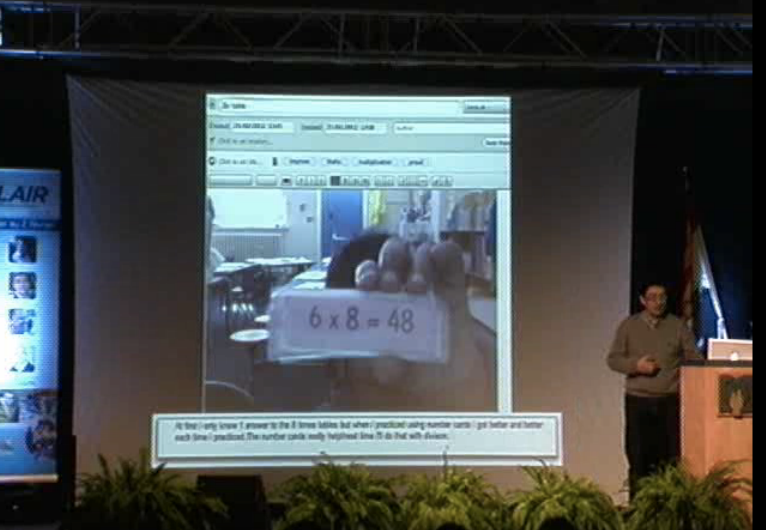
Ewan McIntosh at Clair2013 presenting Reflection
What Ewan McIntosh explained in his workshop is how his team and the teachers in the London school worked together on shifting the onus of assessing from the teacher to the student. So that the students own their learning, by organising it, reflecting on it and sharing it. So that the teacher, by refering to these reflections, gets a way richer, fuller picture of each individual's learning journey, thus empowering him to plan the next learning step, in full knowledge of where the student is at and in conversation with them.

Ok I must add here that Ewan's workshop is set up in the concept of Design Thinking (here is an example), in a provocative inquiry learning project that the students themselves entitled "London is full, evacuate", that all teachers are on board revisiting their assessment strategies, that the notion of time seem to be strategically ignored and that a range of technology is provided.

I am not (yet!) trying to delve too much on how this could look like in a French class.
What I am trying to do here though is to extract the possibilities considering our framework (NZC, Achievement Objectives, Ellis Principles, iCLT, and effective pedagogy) to develop the use of an eportfolio to support language learning. 

- Know your students, spend time,  have them define for themselves why they are learning French, ask them to show you the type of work they produce in other areas, invite them to list what they see as their strengths and weaknesses, what they find easy or hard, what prior knowledge or interest they can bring to the class. Make this a first eportfolio activity, by recording this on a profile page or a blog post for instance.

- Allow to let go of the tyranny of time and programmes. Make time to explain and discuss what a learning process is, why they are engaging in thinking about their learning in the French class, make time to have them "picture" what an eportfolio looks like, what type of stuff there is in it, collaboratively. Suggest they share their strengths and weaknesses with others in the class to build a support network (KC: Relate to others). Make a place and time to really know students, and be able to say how we know them.

- Design authentic ("is there a genuine need to do this?"), passion tugging ("are we going to have a good solid argument about this") and engaging ("would I want to do this if I was 14?) task. If unsure of the response, put it to your students and invite them to tweak it for their purpose. (KC Participating and Contributing). Involvement in the assignment brief can only deepen engagement. Plan for collaborative and collective assessments. Build in opportunities for students' creativity to come through by letting them chose their direction and their medium for completion (slideshow, video, poster, online, on paper...) Model, and if needed, prompt them:

eg: If preparing for an upcoming trip to New Caledonia, brainstorm what preparing involves: some may choose to investigate places to visit and create a pamphlet, other make a useful phrase booklet to print, others prepare a mihi or a cultural show and record the process, others again might publish the itinerary for their hosts families etc. (KC: use of Language Symbol and Text)

- Define, clearly,  together,  what constitutes high quality work: discuss, display on walls, talk together about it... The students ought to internalise this to own it. Use official curriculum or ncea stuff if you want but cut the jargon out of it with your students. Making connections with how they learn in other learning areas can help them engage in the process of learning French and it will show on their eportfolio through their reflections (KC Thinking)

- Consider that any task can lead to potential evidence towards the criteria.

- Assure them that errors constitute learning, that is why there are drafts on which they get feedback and that they keep them as a record of their progress. 

- Hand over to student to capture evidence of learning when it occurs. Great use of devices, own or not, and wifi! Not a "let's record this now because today is recording day"! Not everyone can capture evidence of their own learning at the same prescribed time, and not everyone will update their eportfolio this way either. (KC: Self Management)

- Let the students tag the evidence meaningfully, this will help internalise the criteria for high quality work (KC: using Language, Symbol and Text)
Ewan McIntosh suggests three different categories of tags to start with
(I am adding in brackets some tags that could be used for Languages)

- what it is (Eg: read, write, type of text, interact, present...)
- the skill or competence (eg: language, culture, produce, spelling, pronunciation, past event, future event, accuracy, fluency ...)
- an "emotion tag" how the learner feels about it (Great, hard,  proud, love, must do better, hate, boring, success... those tags could be in the target language)

Tagging online evidence allows to organise it. 
eg: find all the evidence tagged "interact" and "proud" at the click of a mouse and thus help the student identify which they would like to submit for a showcase portfolio towards 1.3
- Prompt them to use these tags to reflect on their progress (KC Thinking)
Ewan McIntosh suggests to scaffold reflective capability with simple questions to start with:
- where have I been? (eg: "I found it hard to describe a situation in writing")
- where am I now? (eg: "here I have used some language with success and x understood my description")
- where am I going next? (eg: "I must do better with the accuracy of my pronunciation to avoid misunderstandings)

Over a period of time and depending on the level of language acquisition, students can start to use the target language to tag and then reflect .
- Comment on their reflections punctually, using a reminder prompt ("do you know what to do next?"), a scaffold prompt ("ss that enough help?') and an example prompt ("what will you do if you get stuck again?". Leave a mark to acknowledge you are reading and using their reflections to inform your teaching.

- Step back, observe and trust them to start commenting following a similar model on their peers' work.  Consider assessing yourself only sporadically at a designated time (eg: maybe only after rework of an initial draft that has been peer assessed twice or for some designated pieces)

- Consider that different students produce different ePortfolios. You may start with carefully designed templates which will help make the purpose transparent and communicable. Accept that they should just help with the process and that individual students will progress and capture evidence of learning at different stages and through different learning opportunity and possibly personalise their eportfolio.

SO here are some ingredients to "film the learning": Provide great assessment activities (and plenty of them), scaffold them to learn new stuff and revisit previously acquired ones, co-define with students what high quality work looks like and what it involves, provide descriptive feedback in a timely manner and always look towards improvement.  Assist in selecting, in conversation with the student, what constitutes the best pieces for submission to be evaluated formally.

As I said at the beginning of this post, I am merely trying to clarify what steps could help students and teachers understand what are really, in my opinion, the reasons to consider building an ePortfolio: it can be hard initially because  students may not have any piece of evidence to add to their portfolio (if they have been used to producing and saving digital evidence in say, their own drive, they are a step closer to get started!)

They will use self management, digital skills, critical thinking, opportunities to work with others, to learn to trust/critic judgement from a range of people, to gather their own evidence that they can meet the requirement of the task,  to learn not to complete an assignment to be seen just by one, the teacher. The type of stuff they will need to do all life long, when school's out for ever!

Next we can start thinking about some tools that can help with this!

What do you think? Can this work? Something wrong in here? Where is the French I hear you think?
___________________________________________________________________________________
Thanks to all the following for your virtual great help:

NoTosh Projects
Playing Tag: Ewan McIntosh on Assessment at ICOT2013
Great tips and tools to create eportfolios
Core ten trends 2013: Personalisation
Assessment for Learning TKI
Using the ePortfolio to validate students' learning
Senior Secondary Achievement Objectives Learning Languages TKI
Effective Teaching in Languages TKI
___________________________________________________________________________________