Showing posts with label ICOT. Show all posts

17 February 2013

Conference or not? ICOT2013

No doubt I took away from ICOT2013 heaps to think about , discuss, weigh etc. BUT!

I sat for five days and listened for five days. I took in: I wanted to be there, both the keynotes and presentations engaged me. I had built my own programme selecting from hundreds of breakouts. I was prepared, I knew what to expect, it was part of the deal.

The speakers were big guns that I respected and wanted to learn from. There was a bit of "fangirl" time going on there.

But a dimension was lacking: I wished some unconference times had been scheduled : I could have heard more but also talked and exchanged, built a better picture there and then.

Hazel blogged live here about her wish to an alternative approach to the conference lecture

And Viv captured it very well in this tweet:


Not saying that big ticket conferences need to go: maybe to be attended sporadically (cost, time value for money, reporting back etc. to be taken into consideration) for the big picture inspirational stuff, where some seriously good presenters are truly going to kick your thinking into action... Or I say, read about it online and engage in discussions with others on matters arising on social media or discussion groups to make sense of it.
What is an alternative? I believe in the value of robust conversations with colleagues,anytime anywhere, as a pillar of professional learning.  User driven conferences, where practitioners share experiences, discuss, make sense of together on matters which actually really matter to them and make the necessary connections, provides a frame for these conversations to take place. Attend an educamp sometime,  there is always one near you. Or there may be a repeat of a frenchCamp!  (Note: what you get out of it is proportional to what you put int, and those gatherings do have a method behind their madness, it's a matter of do what you want in a framework. Nuance!)
Not a place where practitioners expect content delivered in a tidy one hour slot of listening before moving to the next tidy one hour slot, not necessarily connected to the previous, not a space that is partitioned, not an environment that is close to only those present, not a time where somebody tells me what I am going to listen to. I want to choose, I want to lead my learning, I want to decide what I need to learn about to further my understanding, I want to do it as I own it. Stuff that conference conveners,  no matter how much they labour on a programme, coerce presenters to deliver, decide on a venue but are limited by cost, choose what I will eat and drink, try to keep the cost down but still there is a cost, just can not decide for me.
Then that will be teachers embracing their learning and thus being able to truly get students to embrace theirs.

16 February 2013

Making Sense Of - ICOT2013 Goodness

The first I heard of SOLO Taxonomy was at Learning@School 2010. It was back in the glorious days when Flo and I were on a bit of mission to "try heaps". The mission was not clear, that's why maybe it sort of petered out after a few years, yet it was full of joy and questioning. Lots of goodness (one is visible here) came out of it and our friendship is all the richer for it!
So at L@S2010, Flo attended a breakout  where Pam Hook was introducing SOLO. Flo explained to me what she understood, and I sort of left it at that: I was like a possum caught in the headlights and had a kete full of stuff to look at again, investigate and went to look into ePortfolio and mahara-myportfolio as it seemed that providing info on this was answering a genuine need within my Community of Practice. Hence the need to revisit good ideas often, in different contexts, at different times for them to start taking shape...
I have since many a time come across teachers, mainly in primaries, who are hooked on SOLO. I have at times look into it: this introductory clip prompted me to pay more attention:
Lincoln High School Craig Perry and Fiona Bamford's ICOT2013 "Facilitating a whole school thinking framework for lifelong learning" brought it to life for me. (Their presentation here)
I chose to attend their breakout for several reasons: secondary school, lifelong learning, but also the fact that Fiona, Languages amongst other responsibilities, was presenting.

It was just great! And I am not even talking about SOLO! Craig and Fiona's was the story of a secondary school which over time, a long time, have trialled and errored their way into finding a language, common to all, across Departments and Learning Areas, teachers and students,  about learning to help the Lincoln students "say where their learning is at" and "know what they need to do to improve".
Craig Perry and Fiona Bamford ICOT 2013
A story of commitment to make a change, of champions dedicated to the cause, of persistance and of supportive, benevolent leadership. It also highlighted that change happens when specialist support from the outside combines with a genuine identified need from a community. That time is dedicated to make it happen and that it is understood that it does not happen overnight and that there are many hurdles in the way. I appreciated to see how the different Departments at Lincoln have applied SOLO to the NCEA Standards, so that students can see common across subject areas, to help crystalise their learning.  Fiona stressed she was still in the process of doing that for Languages. Nothing happens fast.  I also liked how from their adopting SOLO there is a common approach for literacy. That indicated a great deal of cross curricular collaboration.  I had the opportunity to go to Lincoln in March 2012 when Fiona and a team of Language teachers took a look at MyPortfolio:  I wished I went back to work with them now, equipped of what I know about their work and what I understand about facilitation: we could have made more relevant connections more quickly.

I think that we could benefit, as Language teachers, to hear more from Fiona's journey, how she has moved to thinking in "Thinking" terms rather than just in "Language Learning" terms, how it is effecting her students and her teaching.  We chatted briefly at the end of her presentation and she indicated she had once addressed Language teachers in a PD setting about SOLO but it was not much attended. Hum, maybe the word NCEA was not prominent enough in her prez brief to attract the crowds... (This is intended to be a sharp, cutting remark, you noticed?)

It also confirms that in order to change it is about sharing a vision, believing in it, trusting the process and enabling effective support.

Craig Perry published a really good blogpost today. An eloquent post where he writes that despite being opened to be challenged on his views and beliefs about SOLO by the "Thinking Gurus" at ICOT2013, he walked away all the more convinced that SOLO is providing what Lincoln is about for their students.

I want to come across more similar stories.


Steps towards what? More thoughts fuelled by ICOT2013


I have just finished reading this post entitled "Change or Die".  Two points stick with me:

- change is not supported as the overall agenda is focused on improvement rather than transformation
- there is a lack of "big picture", where steps are managed rather than lead towards a clear common vision.

Individuals, like you and I, have enjoyed and continue to get benefit from discussing, reading, participating 2cts worth to debates, trying to make sense of what Learning is about. I  personally often feel that to give it serious thought and consideration (and to be taken more seriously!), I need to be more systematic (oh here you are Ruth: that is a trigger word that has you switched off!) in order to reflect and take action. This is certainly what Going Back to the Drawing Board means for me.

But hear me out!
  I would be motivated to systematise my approach if there was a need (self motivated or else) to have an outcome for a particular purpose. I am in the rather comfortable position at the moment where no one demands of me to perform at any level. This affords me to spend time considering a range of issues arising from different sectors and interests. I choose to spend time with the NZAFT and associated projects, I choose to continue to support people use of myPortfolio, MoE funded or not,  I choose to keep informed to do these to the best I can and if I have the opportunity, to move things along. I assume that if I was employed as a teacher in a school, time, energy and freedom spent on these choices would be considerably limited.

I have been freed to investigate in my own terms, to learn stuff when the need arose, to seek and find help, to do and undo, to have the confidence and curiosity to do so,  to bring to the light that my absence of formal linguistic training (I am often "found out" in conversation with Language teachers! ) can be made up for with other aptitudes and understanding of Learning I have developed, to create, maintain and continue to widen a network of thought provoking, informed, convincing professionals beyond school colleagues and my immediate community of practice.  It is my own paradigm shift: I have changed. What I have learnt in the last couple of years, exposing myself to arguments and thoughts about teaching, learning, assessments, ICT, theories, practices, social media, internet,  beyond the ones imposed by a manager or a system, is that "things do not have to be the way they are" and that "we don't know what we don't know".  Hence I can say here that all I have learnt from this freedom I would wish to continue to grow in any circumstances.
Kerry Spackman The Moral Scale
But what I can say also is that I am unsure of the reasons why I am doing it...
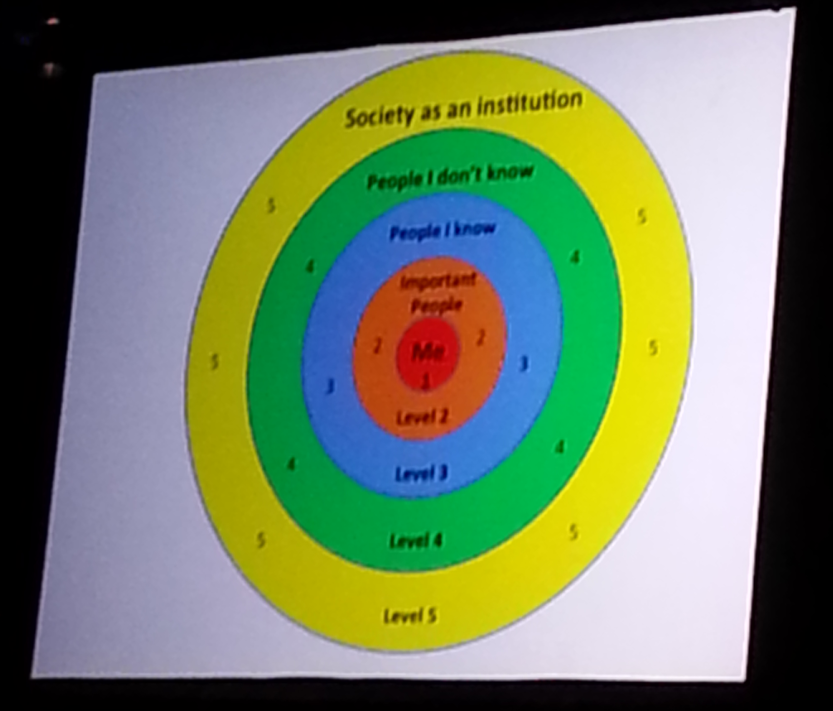
- What level of the Moral Scale  am I really operating at? Am I doing this for me only (since I have no obligation) ?
- Am I doing this because I am looking to "make a dent in the universe?" (Kerry Spackman at ICOT2013) ?
I would like to think it is about taking a tiny step on the Bottom Up approach ladder.
Kerry Spackman The Moral Scale

So to go back to Change or Die: What /who makes a vision clear enough, encompassing enough, trusted enough and supported enough for every teacher to feel empowered that they too can change, and as a result  for every learner to learn to be in control of their learning? That the move from thinking at Level 1 "How does it affect me?" to Level 5 "What's in this for society as an institution?" is enabled?

Derek Wenmoth: Change or Die? Vision, Trust and Support
While aspects of Kerry Spackman's keynote varied from boring me to worrying me  (I am not convinced that I need Knights to save me) one key message that was taken away, as aptly highlighted by Derek Wenmoth, is that "influencing peoples beliefs is very important in the process of bringing about change in society".

And this is something that every teacher can do. Children must be prepared for the world they live in not the one I grew up in: in my today's world, the population is aging and all expect to live a long time, ethnic groups learn to mix and mingle, notions of distance and time are just about a thing of the past, values are open for discussion etc. So who better than a teacher should be in the position to present a clear vision of the future to their students, and should help each one of them make sense of it in their own term, lead them to want to be involved, so that they grow to concern themselves with society and their role within it? All teachers need to question what they do if they are to model and instill this effectively.  And that means questioning and contribute to transform the system they work in.

via Rachel Saxton  ZenPencil
So why am I writing this messy post? If I really want to go Back to the Drawing Board, I need to know where I have been.  I ought to see more clearly where I am at now. And then it will inform me of where I should take my next step.  In the immediate future, it involves taking a step with you Ruth as you go back to school. Then I will see.


12 February 2013

Responding to your Kimbra, Ken, Creativity Post - More ICOT2013

Rosemary Hipkins ICOT2013
I enjoyed the bullet points Ruth! And they prompt me to revisit a few themes and roughly sum up another Icot2013 Breakout. 

I wonder if you can download the slides here as Rosemary Hipkins, in her "Ideas about thinking that challenge traditional education practices", also referred to Descartes. R. Hipkins talks about traditional ideas around thinking (prevalent in school) whereas thinking is "a mental activity that individuals do in a linear sequence and as effortlessly as possible" (Descartes, Mind Vs Body) . She points out that now there are some biological facts that Descartes did not know (Neuroscience and psychology, eg. body and brain are made of the same stuff and thinking patters are influenced by our emotions.). Challenging implications for learning is if we accept that thinking is embodied (e.g.; for the constructivist the body is a structure that learns (think about Wii, 3D printing etc). Challenging also to consider where thinking happens (traditionally in the brain): the internet changes what knowledge is, the idea that "thinking happens in the spaces in between" as knowledge now "lives in the connections of neurons, bones, blood and marrow" is one that I would need to dvelve in more to better understand.
So to leverage thinking in the spaces between individuals R. Hipkins lists 5 conditions. Her source is Engaging Minds (Davis, Sumara, Luce-Kapler) and links these conditions to how we can approach teaching.
Complex systems thinking replaces traditional linear logical and predictable thinking." How do we foster complex systems thinking that will help students make sense own increasingly intertwingly world?"> Epistemic thinking. It is about thinking about knowing and knowledge. And getting our head around this new way is an effort, it' s different. "Epistemic experiences are moments when we become conscious of something about our knowing". So here was another convincing argument to do things differently: Rosemary organised her thoughts for her presentation around thinking and professional learning.

E. de Bono also talks about our traditional thinking as similar to the caveman's(!), describes it with this acronym EBNE (Excellent But Not Enough!) and urges not to be solely concerned with truth but also with perception. "Looking backwards is easier than looking forward and open new tracks". Is it why certain suggest we ought to "start with the end in mind"?

Another thing that your Sir Ken's bullet points reminds me of is discussion about what creativity is. Is it anything to do with the arts? Is it something some have and others don't?  I believe it is Ewan McIntosh (can't find any notes on that...) who says that it is the same creativity that brings works of art and solutions to a problem. Creativity needs to be called for action through posing the right questions, creativity means bringing something new into existence not for the sole purpose of  making art. (Kimbra's award rewards her interpretation of somebody else's song (art), not her own production, she is recompensed for the value she has added to it)  So we may not all be artists but we are all by nature creative: we just need to pay attention to what we are doing and how we do it.  A role of the teacher is indeed to support students gaining this awareness.
You described your creativity to put together resources which shows you are aware of the process. How do you foster it in your class? How can it be you "flip" it so that they are creative, not you?

Worth revisiting the Problem Posing concept Ewan McIntosh exposes in this TedTalk. 


There are another two main themes in your post:
Not only you have a deep and thorough understanding on how you learn yourself and what contributes to make you want to learn but you also can recognize in your students the attributes that contribute to make them awesome learners.  This shows you are well equipped to "turn inwards". I suppose it is a matter of finding the way to turn this outwards so that students learn to do the same.
"Successful people know the why of what they do",  "Knowing the Why", "Making learning whole is essential" "What is the point of the learning?" (Ewan McIntosh): invite your new French learners from an early stage to formulate for themselves their goals, that will be an essential part of the "Know your students" and suggest they keep safe this goal and revisit. Kids won't want to learn to communicate if they dont define their why? in their own terms, no matter how convincingly "Why learn a language" is put together.

I know you usually baulk at the idea of recipes, systems, set pathways... In Ewan's words, one "needs a method to their madness"... May I suggest you establish a list of the key attributes you want to see your students develop, and then a list of those key language acquisition elements? Then we can revisit what stands out for us in what McIntosh, Claxton (6 magnificent qualities) and maybe C. Harte Flip model (that I see you ve got onto now!) put forward.
The Language Learning Task as described by Ellis provides opportunities to develop thinking and problem solving skills.  What type of thinking and how to go about problem solving if the language skills are so few and disjointed?
The heart of our problem is indeed in the task design...
Then from there maybe we could try to make connections and map how to "marry" these three lists, in the light (or rather fog!) of all that we are gathering here? Or what method would you suggest to go about this? I feel we need to be a tad more "scientific" (!?) about it as there is going to be real soon some real learners to infuse not confuse.
                                                                 What do you think?

11 February 2013

ICOT Part 3: The Other Dimension

I wrote here that I went to ICOT2013 by myself.  It is only partly true as a number of factors have contributed to exchange ideas and share experience with many, to meet people and discover their background and their interests, and to work together for the common good.
This is enabled through the Twitter backchannel: the comments using #icot2013 to form a thread, the links to support what is been presented, the immediate reflections, pictures, times for informal meetings, light banter... All that contribute to a sense of community, for all tweeps are "in the same place", but also to broadcast and amplify what is taking place to whoever follows #icot2013 from afar. 

Managing tweets by added them to Favorites allows to keep them for further reading. I chose to collate tweets in a spreadsheet as I know I will refer back to them. I have failed so far to convince you Ruth of the time and place and usefulness of Tweeter. A conference like ICOT2013 is the type of event to experience its strength: my memory of the event and my understanding of it will be all the poorer without it. Many delegates are using Tweeter, more or less regularly, some give it a go for the first time and see it do its thing. 
You could have followed #ICOT2013 and possibly felt that somehow you were there if you could have read the tweets generated during Ewan McIntosh's opening Keynote, or Guy Claxton's breakout! Tweets are informative, questioning, meaningful and often lead to something else, equally or more interesting. If this is not good enough a case to make time for Twitter, then read on!
 
- This tweet leads to this GoogleDoc.   
Follow the link to read the Keynote notes many delegates have contributed to, as they happened. Started by one, "broadcasted" via Twitter, and all the sudden many hands make light work to keep a record of what is being presented. It is certainly of more value if you are or were of attendance, but the quality of the quotes and the ability some have at synthesizing as they take in never stops to amaze me.

And through Twitter, you also get to read what people think or how they make sense of it. They may share their thoughts/ experiences of their blogs and mention it on Twitter. We both agree knowing there is an audience is an incentive to consign reflections. Some might see this as a sort of a showy behaviour, and not all thoughts and reflections are bone equal (here is an example!!). But what best way to collect thoughts and ideas, to later select them for a particular purpose? Why keep your notes to yourself? Will you ever read them again if they are on a bit of pad?  How will you get feedback? What better way to make your learning visible to ... yourself or your boss! 

But no need to convince you of the value of blogs, this is one battle won. For now. Until you and I find or invite an audience, whoever it may be, we can be each other's audience! I could have written about ICOT2013 but it would not be the same should have had not read the following blogs, from various authors, educators with different backgrounds, at different stage of their careers. And I may never have been aware of them should they not had been tweeted about!

  • @howen blogs in real time, as it happens. The Problem Finders are her note on Ewan McIntosh's Keynote and  Creative and Critical Thinking: Creating Space for Innovation is her notes on Ewan McIntosh's workshop she attended. By scrolling through the January 2013 blogposts, more ICOT2013 live commentaries are available. Hazel is a seasoned social media user who has great expertise in online communities facilitation.
  • Matt, a primary teacher in his second year of teaching, @hunch_box, wrote Playing Tag - Ewan McIntosh on Assessment very shortly after the end of the workshop.
  • @dukelyer, an experienced primary teacher, moves Icot2013 into his long term memory in his post where he consigns what he will report back to colleagues who did not get the chance to attend.
  • @mattynicoll, a secondary Science teacher, blogs about his attempts at improving the classroom experience for his students. He publishes his ICOT2013 reflections here 
I will be revisiting these teachers' blogs, amongst others, which I add to GoogleReader and read every so often, as a magazine.
So no, I can't say I know this people well, I can just say that there are commonalities and that all of us are animated by making sense of teaching and learning in our own terms, with the influence and the input of others. I don't know any regular blogger in our immediate community of practice, do you? Is the French teachers community still is my most immediate community I wonder?

I am indebted to educators who like @ewanmcintosh, and many others, blog and share what they do openly. I need to immerse myself more deeply there before I can see better: a case of going deeper in the dark hoping to see some light! Blogging invites questions and comments and conversations. And that is through a comment that I was introduced to @charte' blog. Chris's is highly likely to help me break down how design thinking, formative assessment maybe applied in a language acquisition environment: he was a language teacher in the UK who did a lot of very cool (and well documented) things when they got the New Curriculum there. He is now in Melbourne, has developed a love for SOLO taxonomy and I can't wait to dive in his blog either! 

A gem of a perfect ICOT2013 summary that was just so bang on for me was @virtuallykaren's Big Ideas emerging through the Week. GO read it if you read only one from that list! Spoiler alert: Karen highlights thinking processes and heuristics, necessity to have real meaning and purpose for students to get stuck in, and focus on making thinking process visible. 


ICOT2013 was definitely an opportunity to meet people, and if not face to face then, it happens virtually over time.

ICOT Part 2: Reporting Back

I wish now I had been disciplined enough to put down some reflections at the end of each day at ICOT2013... See the line up of keynotes and presenters here

Mai Chen reminded me in her outstanding keynote (listen to it here) that the students we have in front of us in the classroom need to also be empowered to be citizens with a voice, empathy and willingness to make a difference beyond “Me”. The day after her keynote an article was published in the Herald: “It is becoming clear that we need to be measuring the performance of government very differently”
Picture taken during the subsequent Kerry Spackman Keynote
 that Mai Chen previewed in her address
 Mai Chen asked “What do we think is in the public interest anyway?”, and that if there is a framework how do we hold Governments accountable to act in the public interest?

If these questions drive society involvement we ought to prepare today’s young to feel and to know they are equipped to participate fully. Mai went on to announces that “the fresh thinking for 2013 is that we need to broaden the criteria against which we measure the progress of Government in achieving the public interest, to include those non-material things, like happiness and equity, which are critical to our future sustainability and wellbeing”. 
If I try to make sense of this as a teacher, I interpret it as:
- a further cue to do away with the bean counting credits and standards as a means of evaluating how well students are learning and to incorporate soft data such as enjoyment, sense of personal achievement, reflection, curiosity, optimism in evaluations
- giving teachers and educators the impetus they may need to contribute to help students become better critical learners as they too will have an important role in the society we live in.

Brendan Spillane captured in five short convincing minutes, in his Ignite* talk “Pull up a chair” , how “thinking becomes wisdom”. Thinking is like “a campfire to gather round” and his talk really set the tone for the conference.
*Ignite talks are a 5min presentation format supported by 20 slides. EduIgnite evenings are organised regularly I am looking out for the EduIgnite Evenings
as I would like to attend one this year (as a spectator to start with!)

Thinking of the format where Ignite presenters share their personal and professional passions, using 20 slides that auto-advance every 15 seconds for a total of just five minutes, it would be a fab thing to consider doing in class, first modelling to students on something I really care deeply about and then invite them to come up with their own Ignite talk. An opportunity to communicate a convincing, effective personal response to something they deeply care about.


Guy Claxton and Ewan McIntosh (I’ll come back to Ewan keynote and breakout separately) make it compelling to stop looking at the knowledge look at the process behind learning. What is actually looks like in practical terms for teachers and learners is the heart of our conversation Ruth. What follows may help. I have to immerse more to offer anything practical, and even then, does it mean it will be practical in your own experience? What strikes me is that both make a clear case for having all school, discussed and systematic approach. It will be interesting to see to what extent an individual teacher’s approach, in a secondary, in one learning area breaks through the established patterns. Hence the documenting of the steps taken here on "Back to the Drawing Board"!

Guy Claxton argues that "Mind Expanding has to happen now" (Mind Expanding Education MEE) in a packed solid breakout room.
The Building Learning Power approach creates learning cultures in schools. There is plenty to investigate here.
The first step is to step back and reflect, have a willingness to try things and think on your feet.  He urges to “take a deep breath and look back to look at the way we deliver “ and to get rid of jargon and instead use plain language and not parrot official documents. We need clarity. I see this as teaching as inquiry and/or action research.

Bin these Words! G.Claxton ICOT2013
He mentions how school leavers in the UK are accepted in prestigious universities on the strength of their grades and wind up two month on at the Mental Health service as they are petrified, scared and vulnerable as they are asked questions they do not have a ready answer for. I know how that feels, I am only started 20 years on to know better how to go about investigating and inquiring. Guy Claxton also talked about the Imposter Syndrome,  “a psychological phenomenom in which people are unable to internalise their accomplishments” which can appear if you are , for instance caught unable to answer an on the spot rich question. All of this highlighting “Students must be encouraged to sharpen their wits, ask questions, and think for themselves” (What is the point of school? ) to ensure they are confident and connected. He also says that we can have both high stake assessment and a culture of learning, that we need to TRUST THE PROCESS (Ewan McIntosh uses this too)
In the Vital, Challenging and Possible interview referred in the tweet above, Guy Claxton spells how that there can be Key Competencies AND Assessment , that students can get test scores AND develop the capacity to flourish. This interview followed his lecture Can Schools prepare you for anything? Recorded here.

Will this sustain your inner fan girl appetite for all things Claxton Ruth?

On the topic of Key Competencies and Pedagogy, NZCR  have worked on creating a Self Auditing Framework to support teachers’ inquiries into how well the Key Competencies are being embedded into learning. What strikes me at first glance is that I understand all the questions: NZCR heeding Guy Claxton’s no jargon approach! There are numerous Examples of Practice which could serve as a model to reproduce with a Language class, why not? And it could be an attempt at bringing in the international approaches within the setting of the NZC. What do you think?


10 February 2013

ICOT Part 1: Getting There.

Foreword: writing this "preamble" prior to a more definite account as it is still not clear in my head how/what to report on ICOT2013. Bear with me! What follows is likely to help the process.

I went to ICOT2013 (International Conference on Thinking)  The 5 day, big ticket speakers, breakout loaded event was indeed something to remember.  The outstanding line up  E.  De Bono, G. Claxton, E. McIntosh, Mai Chen, amongst other education and thinking luminaries, was promising: when else would there be the chance to hear all these people in New Zealand, at the same event? The waves of enthusiastic expectation crushing in my twitter timeline were convincing. The opportunity to spend time face to face with people I usually interact through social media was compelling.
I registered early November with the feeling I ought to go and I ought to be prepared to be very much outside my comfort zone. I was going with minimum prior knowledge of what was going to be presented, I was going on my own, with no agenda and no one expecting to hear back from my experience. I justified the expense of the fees, travel and accommodation to Peter by telling him I was going on a geeky city break. He had not asked any justification… I was curious, I just had to go and see.

Then came the dilemma of selecting breakouts. I rationalized my choices by drawing on the following questions:

- What does "thinking" look like in the classroom?
- Can we have critical thinking without an inquiry process?
- How can a teacher help their students make sense of their dispositions for learning?
- Can ICTs effectively support thinking and life long learning?
- How to have a common approach to thinking, learning to learn, in a secondary school with its specialist subject areas and all other silos?
- How to make assessment for learning understandable, visible and "rewindable" for all parties involved?
- And what shape and form does all this take when the focus is second language acquisition?

It has been the best part of three weeks since ICOT2013 finished. I have not answered any of the questions above. I have many more. I can not do it by myself. I can not do it fast.  That is a lot of "not" statements but I will use them as cues to keep my optimism up: here is to a lot more conversations and head scratching ahead, and you Ruth, and Lesley and Kheya and… will be up for it!

Going to ICOT2013 has helped me crystallize bits of knowledge and understanding about teaching and learning gathered over time. What has become more definite is that some primary schools are doing extremely well at fostering students as masters of their learning destiny, within eye-catching, agile learning environments, supported by a range of tools used purposefully, and staffed with reflecting practitioners who share their practice, engage in conversation across the sector, take risks and have strong,supported, opinions. What has taken shape more clearly is that there is a need for a common language about thinking and learning, spanning across subjects, used by both teachers and students. It has shed light on the urgent need to stop doing what we have always done if we are not getting the results we want, sheltering behind NCEA as a shield against changing practice effectively. It has elucidated the problems there may be about using ICTs: if it is merely the substitution of something that can be done with a pen and a pad, then it won't redefine the nature of the tasks learners could otherwise come up with themselves and fail to transform current practice. It has brought to the fore that without inquiring deeply, meaningfully, systematically and collaboratively into teaching and learning,  chances change happens and is significant to impact on students'  confidence and ability to learn independently is close to nil.

These are my ICOT2013 take aways. Until I substantiate. 

David Koutsoukis  The Seven Selfs of Self Leadership