Showing posts with label Languages. Show all posts

26 August 2013

ToolSprint!

Something really cool happened on Saturday: a full house of Language Teachers ready to learn, listen and network at UofA for the revived Auckland Langsem! Aaron Nolan, newly elected NZALT President for the Auckland region supported by an enthusiastic Conference committee did make it happen and the classic conference programme was full of the Best Practice people. (Programme here)

Prof Rod Ellis rocked the lecture theatre with his 11 principles to start the day!). I have read some of his publications, watched many youtube clips taken from participants at his conferences, but it was the first time ever I listened to him live. Was worth it, made the principles come live and inspired me to think about the following: 6 years on, and Prof Ellis who was commissioned by the MoE for the NZC still presents on these principles on which rest the Languages curriculum to Language teachers, and keeps it fairly fresh. I can feel another blog post coming up soon (and will link here!) here!

The unavoidable focus on NCEA standards,  with an example of bad texts and bad questions, presented by the NAF, drew in a crowd...  Felt for the presenters scheduled on the same slot though.

Ass Prof Martin East presented on his research on the adoption of the "Interaction" standard after the "Conversation" standard has been abandoned. He has gathered teachers' voice ( a v. interesting concept which in itself would need a lot more attention paid to by education researchers, don't you think?) and in a nutshell, and I hope not to "interpret' too much, he found that while teachers agree that interaction is more authentic they are finding it very hard to manage to capture evidence of it in a meaningful setting and in practical way, thus are either not offering it or only as an option for their student. There is thus a tension between the pedagogy and way to assess the product of the learning. Would NZQA at any stage engage with language teachers, in the light of this research and Pr East's subsequent one, to discuss/review the interact standard? It got me thinking: interaction would maybe better to importantly underpin all that happens in/outside the language classroom (as suggested in the Principles)  and evidence of progress could be captured, reflected upon by the learner and used for formative assessment by the teacher BUT could be summatively assessed for standard purposes in a different manner (see DELF, IELTS, IBac etc.)

Anyway it will be interesting to see what Pr East, now President of the NZALT will use his research to leverage opportunities for conversation between practitioners and NZQA. I asked him if his findings had been published yet but no. This is Uni stuff with all the protocole, it ain't a blog post! :-)
So that takes me you know where: this format of Professional Learning does provide ideas and stimulation to participants but the rush from one session to another, the variety of input, and styles of presenters always leave the participant a little hazy eye by the end.
It would be interesting to see these formal settings at least provide an opportunity for participantsto share what they have gathered in their kete from the experience before they leave, to allow them to connect the dots between each presentation. Because they do exist of course, the connections, and they contribute to drawing the big picture!

Can you tell the space type I was in from this pic?
An example of this was the invigorating conversation I had with Liz Scally over lunch. She saw a bit of my session where I go over what I have called "Digital Citizen: 10 Desirable Competencies . We connected that the vocabulary used for these competences is quite similar to the one used to describe the Languages standards, and relate to Learning.

These are just raw chunks of thoughts arising.  I would need to refine all of this a great deal more, nothing better than a conversation around any of this would help me move my understanding forward!

Here is the ToolSprint presentation I gave. I love tools. That is if we start using them with the "Why?" !

23 July 2013

One very useful model...

Aaron Nolan, NZALT Auckland Regional Officer, has asked me if I would give a presentation about useful tools for the Language Classroom at the upcoming Auckland LANGSEM (August 24th, UoA, Epsom Campus).
While I would have favored to facilitate a tool "smackdown" à la Educamp, this does not fit well in the standard Conference schedule (I won't give up mentioning it again and again though!)
So what can I do in 30 minutes, which is the time I have available? I can forget hands on, but having said that, connected participants can always have a quick look at the tools if I share the links at the outset. I think it will be pretty fast paced too, so I will pre warn people and stress they can re visit the information at anytime.

Tools for learning or learning supported by tools? 
http://www.hippasus.com/rrpweblog/
I will divide the 30 min into two distinct parts:
a-  tools for the students to learn, create and share
b-  tools for the teachers to connect, curate and share ( and post the link here when done!)
Well... This opportunity opens two doors:
- to stress the need and use for an eportfolio to aggregate creations, to share them with an audience, to receive feedback and to reflect on the learning.
 - to refer participants to one very useful model to help teachers integrate Education technology: the SAMR model.
Here is a very useful short video to explain it:

The SAMR model is useful in many ways:

- it raises awareness of how we use tools in the classroom,
- it indicates that there is progression, until it is seamlessly integrated and ubiquitous
- students direct their learning more effectively as tasks are redesigned and modification takes place
- it also expands the world of the teacher and students beyond the classrom
- above all it reminds us why we use tools in the classroom: for the learning to take place!

It is good to continue to investigate ever changing tools but it is important to keep focus on what learning needs to be achieved.

Helen Prescott  gave an effective 3 min presentation in the Primary context at TeachMeet#2  full of practical examples and links to the Key Competencies

The wheel below combines Blooms with SAMR and a wide range of Apps (while these are apps for Ipad, many are also available via the browser or on Android).
The "graduates attributes and capabilities" (my point of focus at the moment, at the heart of my eportfolio "dada") at center of wheel are closely reminiscent of the Key Competencies.

http://www.edudemic.com/2013/05/new-padagogy-wheel-helps-you-integrate-technology-using-samr-model/
The action verbs and activities are also present in NCEA Languages Assessment standards, from which are derived a lot of the languages programmes in our NZ schools.
There certainly won't be anytime to generate any conversation during this presentation at the Langsem: shame. It would be a chance to start a conversation around how to assess and provide feedback on creations which are not merely text based or just spoken. I'll think of another media, wonder if the good old NZAFT listserve will be receptive this time?
Anyhow I hope that I can direct participants to this post and that it plants a seed for them to grow, as well as allow them to make connections with what is happening in their school and the world of education technology at large.

PS: Blogger's interface, like any other google tool, defaults to French as my IP is in France at the moment. Midly enerving but also rather irritating to have this mish mash of languages on the screen!


20 April 2013

Conversation matters

What follows is a mix of thoughts arising from reading from different altruistic online sharers and talking with a range of people dedicated to French language and culture.
The latter I met at the Alliance Française AGM held in Christchurch where I was invited to attend as representative of the NZAFT. It was a timely reminder, considering where my thoughts were at earlier in the week (as vented in my comments) that Languages must be, ought to be, have to be celebrated as a main dish on the Smörgåsbord on offer to learners in New Zealand schools. And tonight, thanks to the company I kept recently, I am even almost ready to say French rather than the generic Languages ;-)!
You are here flickrcc

My presentation at this meeting allowed me to focus on what most teachers of French do very well: they love French! Not just French the Language but also all things French. Conveying the love to dwindling numbers, through complex pedagogies which need to be given more time than seems available to internalise them, with the perceived end goal limited to striving for a credit count is at times a tall order.
Compare that to the situation of our Alliance Française colleagues whose role (apparently!) consists of teaching students who come through their doors with a self motivation, a need, a reason to learn French, free of any formal assessments, one would have reasons to be thoroughly jealous of these conditions!
Last November I had the opportunity to work alongside some of the young "volontaires internationaux" at the AF in Wellington as we were training to be DELF examiners.  I realised I had much to learn from their take on the Approche Actionnelle as well as their approach to evaluation. To my pleasure they too expressed a vivid interest in understanding more about French in NZ schools. It thus indicated that there are grounds on which to build a rapprochement in order to learn from each other. Yesterday's meeting reminded me of this and it was an opportunity to formalise a wish in public for it to actually happen. What shape it takes is yet to be devised and as NZAFT decide things at committee level, it certainly is not entirely up to me.
But just now I think I know how it could possibly be put to good use for the greater good!
And this is born of several other things happening this week:

- talking about New Zealand school teachers of French lead to talk about NZ schools, in particular the recently opened primary and secondary schools with their modern learning environment, open plan spaces and collaborative teaching aiming to have students direct their learning.  It is indeed here to stay with many existing schools embracing this approach and embarking on the journey of innovation. This was news to the French Embassy Education attaché who was very interested in knowing more. All I know is names of schools, a few teachers who I follow on Twitter and have occasionally met, but enough to understand that this is working on transforming education right here and now. What I also seem to pick from these new schools is that Learning Languages doesn't seem to feature much. It was a shame he thought and why he asked. I suggested, unsure: Teachers not ready for the leap of pedagogical faith,  new principals not ready to give it full attention while either the Correspondence school or the VLN can somehow attempt to fill that gap, not enough parents pushing to have a language taught, teaching teams fully focused on literacy and key competencies and forgetting that the cultural competence of our NZC is intrinsically linked the intercultural competence developed through language learning? Who knows?

- exchanging with you here along our last posts and comments, you describe your attempt at weaving in your new classes a pedagogy which invite students to direct their own learning is meeting with resistance at this stage. As we discussed I am surprised to read that students are so change adverse. This could indicate that it is such a departure from the usual expectations they have grown used to in the environment they are learning in,  that it will take time and continuous effort on your and their part to start to see the long term benefits of the approach.

So from this one could jump to a very quick (and certainly wrong) conclusion:
          - new learning environment, self directed learning=not conducive to language learning
          - traditional learning environment, Sage on the Stage teaching= conducive to language learning

- upon talking new NZ schools with the young AF teacher her eyes just lit up and it all seemed to make sense to her: open space where furniture is arranged to support interaction, nooks and crannies for practice in solo or pairs, breakout spaces for recordings or rehearsing, devices for listening and research, students looking for what they need to make meaning in their own term, decent time allocation to allow for continuity, having her course and resources online for students to access whenever wherever, doing on the spot tutorials when the need arise, offering specific breakouts at specific times, planning with teachers from other learning areas to incorporate language and culture where and when necessary, ... she pictured it all there and then! She got it. Which told me: French Languages can be integrated in this way if you have the teaching and the attitude right. And thus be a fully fledged item on the buffet for the curious and imaginative and risk taking learner, not just a Learning Area in the NZC!

Where am I going with all that I hear you say?
There is a need to investigate, demonstrate and reflect on how French can be incorporated in a student self directed curriculum in order for language learning to fully contribute to make learners connected to the world they live in, confident to meet others and being able to walk in their shoes in full knowledge of who they are, as well as gaining an awareness that learning is a life long journey and that languages can pop in anytime in their lives.

- of the bloggers who have contributed to this thinking is Claire Amos, a New Zealand educator whose excellent online presence I have followed for some years now and whose work has gone a long way in explaining and convincing me of the role of Teaching as Inquiry. The lady is a sharer of good stuff.  I can't say I know her but I can say she sure has the most awesome eportfolio I know of. Anyway Claire in her current position is undertaking with a team of NZ teachers an edutour of self directed schools in the US and Canada.  I have been reading with interest her accounts, which prompted me to google the schools that they are visiting . Through visiting these schools' websites I could see that Languages featured fully. Sure Canada has a different relation to learning languages that NZ has but that sure indicates that it can be done.
- which got me to contact, Jacques Cool a French Speaking Canadian whose tweets both in French and English I value highly for state of the art information. Hence I DMed Jacques this am to ask him if he knew of any English speaking Canadian self directed learning school where languages were fully a part of the curriculum. He was interested by my question and has sent it on to an expert in this field! WOW there are experts in this field! I now am truly excitingly waiting to hear back.

And then what? A little dream situation: advice from an expert + model schools to learn from + language teaching clued up AF teacher + keen to learn and inquire NZ French teacher(s) + new schools environment in NZ + Learning Language integration+ networking = being proactive in ensuring French (Languages!) is an integral part of a varied rich modern curriculum.

Now where do I start to make this happen?


5 April 2013

Which way back to the Drawing Board? - Part 1

Before I can move forward I need to take a good look where I have come from and establish where I am now. Yes that is about my journey with MyPortfolio so far. And it is about my lack of visibility into the future. Something tells me MyPortfolio is here to stay on the NZ Education landscape but as I write someone is still to decide for its funding post December 2013. I usually tend to take things one day at a time, as the journey I am about to retrace indicates. But with what I know now, it just doesn't cut it. I know I need to go back to the drawing board but don't quite know the way.

Where have I been?
- 2009 - New Languages NCEA Internal Standards, aligned to the NZC, require a "portfolio of evidence" "gathered over time" "selected through a student/teacher negocation process"
Immediate thought arising: how to manage this practically? (At this stage I am not thinking too much in terms of pedagogy and NZC!)
- Hear of Mahara an eportfolio software, developed from the needs of a consortium of NZ Universities to provide their students with an eportfolio space. Tiki tour at a local college that has an install. The word eportfolio enters my vocabulary. 
- Feb. 2010 - Attend Learning at School, discover amongst a plethora of tools that "support teaching and learning" (yep I do love the tools still) my first intros to  "Why"  using an eportfolio.
- Keep my ears to the ground in terms of ePortfolio with further investigations to deepen my understanding  The phrases learning journey and lifelong learning become familiar. It also becomes clearer to me that technology pointers are only going to help a little, that what we are looking at is to change the way we have been assessing and to give the students the responsibility to own his/her learning. Which prompts me to download again the NZC and to this time properly read it. Page 36 in particular retains my attention:
 

- I dwelve some more as I am now aware of MyPortfolio a hosted instance of Mahara made available to NZ schools, funded by the MoE.  It is not until Ulearn10 that I find out more information and meet users. The practical in me sees a solution for students and teachers for the internal assessments. I have not got enough hindsight at that stage to gage the transformative "power" of this technology on teaching and learning.
- Feb. 2011 - First real intro to MyPortfolio at Kristina's workshop. I am sold! I also meet Ronja a Language teacher who shares my enthusiasm. She does have classes and students to try it with! (I am no longer teaching). I make my first pages, to discover the functions. The Learning Languages Group is created, I join the MyPortfolio Discussions Group. I effectively take my first steps in the MyPortfolio community. Till then my immediate community has been the French teachers of NZ, being an NZAFT exec  which reinforced the bond created by redeveloping and maintaining french.ac.nz and managing its Listserve.
- Paul (then in MoE team that has started MyPortfolio) was keen to see the MyPortfolio word spread and potential users found.
Free 90min taster sessions were already made available on request to all primary and secondary schools in NZ. There were two trainers and the rapid growth of early enthusiasts contributed a contingent of local trainers. The idea is to grow interest and develop use from within the community of users. Thus a need for a critical mass of users for this to grow organically! 
- Paul asked me "how can I help you?"? 2011 was a NZALT Langsems year. Language teachers meet in the regions. I suggested I could hold MyPortfolio introductions and workshops at each of these Langsems, and that I could contact the then Regional Language Advisers and offer a day's training at Cluster levels. I surveyed Language teachers. I got on the road.  I kept my journal. I learned by doing.
- Jan. 2012 - There is still plenty of demands on the MyPortfolio taster session calendar, and with one trainer left I am offered the opportunity to take his place until the contract runs out end June 2012. 
- New format (90 min taster session is not a half day workshop that I have ran so far), new people (from 48 different schools many primary, a few big secondary, across Learning areas, people I don't know!), new surroundings (visiting schools not conference rooms!) new focus (in 90 min, the standard taster focus on the Reflection, whereas the focus had been on managing assessement and feedback with Language teachers), new geographical horizons (up and down the South Island, and some part of the lower North Island), new way of doing things (making contact at potential user's request, explaining who I was, reminding them of their interest,  connecting them regionally as a small group, facilitating the "finding time and place" that suits all! sending reminders, located the schools geographically, this is NZ after all!, writing invoices, keeping tab of expenses... ) new outlook on what the NZ education landscape looks like on the ground, across sectors, new awareness (no such thing as "one fits all model" rather "one fits one"), new reality (good infrastructure access innovation exist in pockets and are unevenly distributed). One very lasting picture is built from the numerous interactions: MyPortfolio is a shared online space which functionalities definitely "open up new and different ways of learning" (NZC p.36) and supports fully the Vision of the NZC for "young people who will be confident connected actively involved life long learners". These were a short . These six months went so fast.
- March 2012
- New opportunities arise. I am invited to work with GCSN schools as a consultant. That adds another layer to my understanding of the diversity and the complexity of the issues at play when introducing something new. More than ever it is the "Why" that must lead this. I see school grounds really affected by the earthquake  
, whole neighborhoods deserted with houses destroyed and boarding up and places and other schools and neighborhoods which appear to look as they ever looked. What I quickly gather though is that everyone, teacher and student, that I spend time with has been affected deeply by the catastrophe. What I am amazed with is the demand for something new, at the interest generated by eportfolio and myportfolio, at the warmth of the welcome, at the openness of mind. I end up going back to work in Christchurch GCSN schools in November 2012 and again in March 2013. 

- Working with the Christchurch schools lead to work with schools from the Wellington Loop and with a cluster of teachers located in the Nelson region. I meet again teachers I have met before in other myportfolio workshops. Learning happens when it is revisited often, in different contexts, over a period of time.
- I enjoy contributing to the online MyPortfolio group forums where I can, I learn from the questions and I continue to develop my understanding of online communities and how they "work", how its contributors seem to move quite fast and focus on the future.
- I accompany the work of three language teachers in three different secondary schools and of  their students using myPortfolio remotely, we meet regularly online, take stock and map next steps.
- March 2013 - The MoE continues to support hosting and development of MyPortfolio till at least Dec 2013. Some schools continue to want to know more about MyPortfolio and get in direct contact with me. ePortfolio is now almost a household name now for many in New Zealand schools, it appears often in online conversations and generates conversations around the pedagogy which leads to its use, the reasons why, the type of tools to build one etc. It may have entered the vocabulary but not so widely the practice yet. All good things take time. Hence my multiple interrogations! (To be continued)


2 March 2013

Cultural, intercultural, bicultural, multicultural - 3

So what tools have we got at our disposal to support the work of the Language teacher to be culturally and interculturally competent?

(I am writing this post to support the facilitation of some aspects of the upcoming ILEP workshops . It is a means to get my head round the complexity! It will be interesting to see how the "knowledge and experience in the room" during the workshop make the conversation evolve! I hope that participants do not turn up thinking they will be given ready solutions!)

Te Tātaiako- Cultural Competencies for Teachers of Maōri Learners
has been developed to meet the goals of Ka Hikitia so that teachers think of what it takes to have success in teaching Maōri learners. Ka Hikitia, the Government Maōri Education strategy is being redeveloped for another 5 years starting 2013.
Te Tātaiako
Te Tātaiako (here) is a highly readable (and printable) 20 page document to support teachers' work in personalising education for Maōri students.
It lists 5 main competencies (in orange my quick summary) :
Wānanga - dialogue with learners and communities
Whanaungatanga - active engagement in working relationships
Manaakitanga - integrity, sincerity and respect towards learners' culture
Tangata Whenuatanga - providing context where the identity, culture, language of the learners affirmed
Ako - teachers taking responsibility for their there own learning as well as for the learning of the learners
Then the document goes on to detail each competence with explanatory criteria as well as examples of learner voice and whanau voice.  "For registered teachers, the focus is möhio: knowing how to validate and affirm Mäori and iwi culture, and applying that knowledge." (p.4 Te Tātaiako)

It is the must-print and the must-discuss when work is done around supporting the achievement of Maōri learners.

I would like to discuss with you and other Language teachers, who may have internalized these, if I am right in thinking that these competences and behaviours are also at the heart of Intercultural competencies, or if not at the heart where they sit in relation with the iCLTs.

Should this turn out to be verified, what needs to be mobilized by the teacher in order to:
- make the connections cultural competence-intercultural competence and ensure they are explicit for all learners?
- provide culturally responsive and engaging contexts for learning?
- provide regular timely feedback/feedforward to help progress and make it visible?
- develop a relationship with all the language learners, with respect of all of the languages and cultures they are bringing in the classroom?
- document classroom and outside actions, student voice, whanau engagement, achievement, success, trials, steps taken to support learner's progress?
- reflect upon progress against the criteria?

In comes the unmissable opportunity to see how ICTs and eLearning can help with evidencing the development and growth of the cultural and intercultural competence of the teacher.
There are many tools out there that allow to :
- access information (eg: MoE websites, professional reading, NZCER, Universities etc)
- initiate/participate in conversations (eg:, professional forums, VLN groups, listserves, social media...)
- collect evidence (eg: webtools, cloud drives, apps, pictures, videos, sound files)
- select and display evidence to demonstrate some particular aspect of the competence
- reflect (individually and/or through sharing with others, in or outside your school) on progress being made, where you were at when starting, where you are now, where you are going next.

I can see how an eportfolio* system like MyPortfolio come in as a handy tool as it allows for all of that to happen in one space!

And in order to document and think about what I am doing and how I am doing it, I really need a meaty driving question which is going to be at the heart of my professional goals for a determined period of time. Central to effective pedagogy is Teaching as Inquiry and this simple reflection tool can be a step to start the process. Teaching as Inquiry has plenty of benefits as it allows to incorporate all of the school/teacher initiatives (eg: particular aspects of Cultural Competence/elearning/ iCLT) in one cycle, and allows to establish a time scale for steps to happen by.
I would actually think along these same lines to document and reflect on my practice over time if my professional goals were assessed through Appraisal. It is a matter of lining up what I set out to do in knowledge of what I ought to do within my context with what I want to achieve over that cycle.

And if carrots are needed to effectively get started or get serious...   Professional learning goals must be aligned with the Registered Teacher Criteria. Te Tātaiako have direct links with all of the twelve criteria. So by working on developing these competences, teachers are effectively working on demonstrating that they are meeting aspects of these criteria. But it is not a box ticking exercise that can be crammed in a month prior to renewing your Teacher Registration. It needs to be planned over a cycle (3 years), all twelve criteria need to be evidenced, the key indicators defining the set of values to measure against. 

The Enabling eLearning Registered Teacher Criteria and eLearning is a "resource that illustrates how e-learning examples can be used to support the  Registered Teacher Criteria. The twelve criteria have been "unpacked" with examples provided for each criteria"(Source).  I used to refer to its precursor a lot and this current version is very recent. I will make use of this and link to MyPortfolio use in the upcoming workshops. Numerous tools are mentioned, there are many options to investigate.


           Cultural Competence + Teaching as Inquiry +  eLearning
=
        effective culturally responsive Language Teacher

Phew...
___________________________________________________________________________________
*an eportfolio lands itself to this type of documenting: it is about filming the process. Understanding, developing, using competences and skills happen over time. It does not all happen at once nor is there a right or wrong. An eportfolio allows to show steps taken to work towards a competence (collecting and selecting evidence), in knowledge of the criteria, to reflect over these steps, to connect with others (HoD, colleagues etc) for feedback and feedforward,  then to decide on the next steps in a learning process knowing what has come before. Hence an eportfolio suits an inquiry and along the way users of an eportfolio gain in digital competence and capability.
___________________________________________________________________________________

1 March 2013

Cultural, intercultural, bicultural, multicultural - 2


Ko te kai o te rangatire he kōrero (leadership is putting words into action) summed up Deanne Thomas and Wharehoka Wano's  ICOT2013 breakout Cultural Leadership

When I saw De and Whare presented, I jumped to the opportunity to "meet" them. I had listened to their Keynote Language, culture, identity and raising student achievement a while back. It had sat at the back of my mind since for two reasons:
 - the importance and place of story and personal story telling
 - the importance of history
in any educational context and more particularly the educational context of Aotearoa.
De and Whare in this Keynote pointed out that some Maōri students know little about their language their culture, their place, and that is a slow process to re establish that. Part of this process is acknowledging local histories and tikanga of the students, so that all are "comfortable in (their) own self, (their) own boots before moving on into the wide word".  

Can iCLT techiques, which aim to foster interculturally competent learners who can confidently navigate intercultural interactions and relationships, apply to support Maōri learners learn as Maōri?

I need help understanding what cultural responsive pedagogy encompasses. For that I wrote  Tamara Bell  an email to ask her if she could help:
"... I was wondering if you could put me in the direction of a couple of edtalks or other short videos that could be used as a starter and/or support to conversations around teaching and learning strategies for Māori learners and raising/working on cultural responsiveness in the Language secondary classroom please.
I see there is a wealth of information out there. But I would like to make the right choices to instill curiosity and foster reflection for the participants at upcoming workshops for French and Spanish teachers, organised by ILEP,*  to continue to look into this post workshop, to make connections with what is happening school wide in their institutions
Language teachers base their curriculum on the Six principles for intercultural communicative language teaching and if you had any suggestions to make on how this can, potentially, link with cultural responsiveness, I would be grateful for your input... "
Tamara graciously replied really shortly afterwards with a wealth of resources! I felt so supported!

Here are some clips Tamara has recommended
to watch:
(>what follows each resource are my quick notes upon listening)

Russell Bishop "A Culturally Responsive Pedagogy of Relations"
> care for Maōri students as Maōri, for their performance, that they learn/embrace/give opportunity for the funds of knowledge they bring to the classroom, interact, negociate, use strategies to engage effectively, keep evidence of student performance to guide where the teacher is taking the teaching and the students know their outcome in a formative way.
> improving teaching strategies and the effectiveness of teachers in increasing the engagement and academic achievement of Māori students.

Phoebe Davis "Critical Elements for Raising Maōri Achievement"
> forming relationship with students and whanau is fundamental
> know that there are a range of kids, which iwi  and acknowledge whakapapa
> it says that you are for real and they are for real > what matters is that you try

> make the effort, think of activities that connect the teacher and the students (eg: acknowledge the different places, the people you may know in common etc)
> being culturally located >  talk to maori iwi > Where is our school? what does it mean? acknowledge the community
.

Maria Tibble "Professional Responsibility to Maōri students"
> what has had the most impact for Maria are Te Kotahitanga and Ka Hikitia as both allow to move away from an emotional approach to an evidence based professional approach to discuss the types of relationships, the pedagogy that make a difference for Maōri students.
> Rather than the teachers intellectualising the situation it is the students' voices that said that pedagogy, culture and relationship make the difference to Maōri students
> Maria urges all teachers to read, reflect, keep informed and relentlessly look into what makes a difference to Maōri Students, to commit to change.


Maria Tibble "Culture Counts"
> locate yourself culturally (where I am from, who I am )
> show you care about students as people (you invite students into your world as you culturally locate yourself, this opens a pathway for the students to follow and in return bring into the classroom their story)

> engender a relationship that has to be authentic,  spend the time, authenticate your commitment to Maōri students by saying to them "your culture counts"
> show you care about their learning


Questions: So what to take away from these videos? Do I recognise the cultural differences?  What does cultural responsiveness look like in the language classroom? How is the scene set? How do we know the rapport is building? Which activities foster inclusiveness? What has been tried and tested? Where is the part of the Target Language? How do we know it works? What do I adapt in my teaching?

Tamara also shared this acronym listing key ingredients to consider to that effect :


Questions: Which of these ingredients make it regularly, all the time, seldom in the language classroom? What do they look like in practice? Which activities are they incorporated in? How aware of them are we? What contributes to embedding them? What do we action to know the students in front of us? How do students and teachers keep trace of their performance? How do we know it works?
Another two great resources Tamara shared for feeding the conversation and the reflection:
  • Culturally Responsive Practice in a mainstream school
  • a Refresher about What Works for Maōri Learners a forum on the VLN where educators exchange stories and ideas. Lots to read and learn from, and definitely the type of conversation to aim for with Language Learning in mind. Many Language teachers work with Te Reo teachers and form the same Department. What can be learnt from each other?

    Where am I at now? Can iCLT techniques apply?
  • To move on to implement a more culturally responsive pedagogy there is need for conversation amongst teachers who are actively involved, for seeking and finding evidence, keeping track of it (taking responsibility for their learning), for making connection with the students, knowing what they have got to say, bearing it in mind in the teaching, using it to inform the next steps of learning,  connecting and interacting with family and community, enabling support from within the institution, for wanting to keep informed and reflect on practice often and meaningfully.  These to me are the tenets of effective pedagogy.
  •  What if a more culturally responsive pedagogy brought about the better more effective teacher and thus benefited all of our learners, regardless of cultural and ethnical backgrounds?
  •  And in order to make this learning journey "visible, traceable, rewindable and sharable" what if it was the perfect opportunity to blend in tools and online spaces in the practice to assist in this journey?
Writing this post is about raising my own awareness of what Cultural Competence entails. I am hoping to learn from your own experiences and other colleagues' who may have been more exposed than me in their school environment and have started to embed or are embedding these competences in their teaching. 
I also start to see where culturally responsive pedagogy and iCLT interweave as there is a common vocabulary and a common intent.  It may be worth bearing in mind the teams of extremely competent educators that might support Language teachers in their inquiry, namely TMoA at Core Education and Te Toi Tupu Blended learning PLD (that I am aware of). I would like to suggest that NZALT and ILEP make contact with these organisations in order to invite them to facilitate workshops and give presentations.
________________________________________________________________________________
*the workshop that I will facilitate aims to raise awareness of moments of learning, capturing these moments in order to be able to say how we know where we are at and decide on a next step: this can happen with the digitalising, collecting and organising of learning evidence (for students) and of professional engagement(for teachers) and the tools that support the necessary reflection that emanates from this process.

20 February 2013

ePortfolio: Tag, Reflect and Assess - Still from ICOT2013

The Tagging the Learning Journey- A new model for assessment by Ewan McIntosh appealed as soon as I saw it on the ICOT2013 programme.

What I am trying to do here is to connect the development of an ePortfolio, the use of Tags as introduced by Ewan, and the principles of Assessment for Learning. I go on to suggest what it could look like for the Language learner.
A tall order: hopefully by the end of this post I will have outlined a vision ofhow it is all meant to work together to "enable student to take more control over their assessment" (E. McIntosh)

ePortfolios can be a showcase of the best, the final products that are the result of following a task.  The teacher can access the product, and grade it. This is an initial step in the eportfolio world for Language students and teachers in NZ: NCEA Interact and Write internally assessed standards require a portfolio of evidence. That is 3 to 5 pieces packaged together to be graded, by the teacher.

Yet a move to portfolio assessment offers a great deal more by opening a wonderful box of opportunities to, amongst others:
- change the nature of the tasks (Is "one fits all" still current when personalising learning?)
- change how the tasks are assessed (feedback, feedforward)
- redistribute the assessesing cards (self, peer, teacher)
- make the learning process visible to both the student (learning to learn) and the teacher (measuring the progress not just the achievement)
- hence know the students better and know how they learn better (to ensure that each assessment is appropriate and fit for purpose)
- give the students a chance to think critically and reflect about their work (gain awareness of not only what they learn but also how they are learning)

Add "e" in front of portfolio and e-porfolio become a vehicle for teachers and students to develop together their digital skills and competences, as well as their creativity.
Then you start having an eportfolio as a process, showing the stages of learning ("filming the learning", from beginning to end, with initial draft, rework, feedback, to final draft) that are now visible, can be revisited to identify how skills have evolved (reflection), to showcase success (to parents and/or third party?) and to establish where to next.

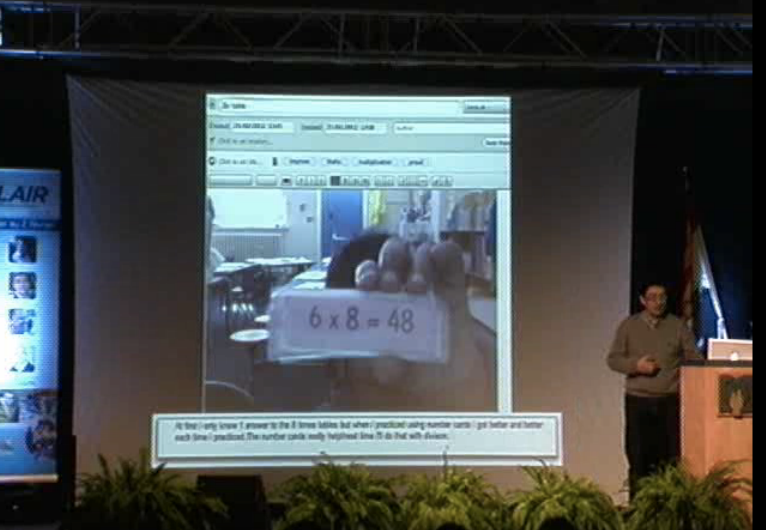
Ewan McIntosh at Clair2013 presenting Reflection
What Ewan McIntosh explained in his workshop is how his team and the teachers in the London school worked together on shifting the onus of assessing from the teacher to the student. So that the students own their learning, by organising it, reflecting on it and sharing it. So that the teacher, by refering to these reflections, gets a way richer, fuller picture of each individual's learning journey, thus empowering him to plan the next learning step, in full knowledge of where the student is at and in conversation with them.

Ok I must add here that Ewan's workshop is set up in the concept of Design Thinking (here is an example), in a provocative inquiry learning project that the students themselves entitled "London is full, evacuate", that all teachers are on board revisiting their assessment strategies, that the notion of time seem to be strategically ignored and that a range of technology is provided.

I am not (yet!) trying to delve too much on how this could look like in a French class.
What I am trying to do here though is to extract the possibilities considering our framework (NZC, Achievement Objectives, Ellis Principles, iCLT, and effective pedagogy) to develop the use of an eportfolio to support language learning. 

- Know your students, spend time,  have them define for themselves why they are learning French, ask them to show you the type of work they produce in other areas, invite them to list what they see as their strengths and weaknesses, what they find easy or hard, what prior knowledge or interest they can bring to the class. Make this a first eportfolio activity, by recording this on a profile page or a blog post for instance.

- Allow to let go of the tyranny of time and programmes. Make time to explain and discuss what a learning process is, why they are engaging in thinking about their learning in the French class, make time to have them "picture" what an eportfolio looks like, what type of stuff there is in it, collaboratively. Suggest they share their strengths and weaknesses with others in the class to build a support network (KC: Relate to others). Make a place and time to really know students, and be able to say how we know them.

- Design authentic ("is there a genuine need to do this?"), passion tugging ("are we going to have a good solid argument about this") and engaging ("would I want to do this if I was 14?) task. If unsure of the response, put it to your students and invite them to tweak it for their purpose. (KC Participating and Contributing). Involvement in the assignment brief can only deepen engagement. Plan for collaborative and collective assessments. Build in opportunities for students' creativity to come through by letting them chose their direction and their medium for completion (slideshow, video, poster, online, on paper...) Model, and if needed, prompt them:

eg: If preparing for an upcoming trip to New Caledonia, brainstorm what preparing involves: some may choose to investigate places to visit and create a pamphlet, other make a useful phrase booklet to print, others prepare a mihi or a cultural show and record the process, others again might publish the itinerary for their hosts families etc. (KC: use of Language Symbol and Text)

- Define, clearly,  together,  what constitutes high quality work: discuss, display on walls, talk together about it... The students ought to internalise this to own it. Use official curriculum or ncea stuff if you want but cut the jargon out of it with your students. Making connections with how they learn in other learning areas can help them engage in the process of learning French and it will show on their eportfolio through their reflections (KC Thinking)

- Consider that any task can lead to potential evidence towards the criteria.

- Assure them that errors constitute learning, that is why there are drafts on which they get feedback and that they keep them as a record of their progress. 

- Hand over to student to capture evidence of learning when it occurs. Great use of devices, own or not, and wifi! Not a "let's record this now because today is recording day"! Not everyone can capture evidence of their own learning at the same prescribed time, and not everyone will update their eportfolio this way either. (KC: Self Management)

- Let the students tag the evidence meaningfully, this will help internalise the criteria for high quality work (KC: using Language, Symbol and Text)
Ewan McIntosh suggests three different categories of tags to start with
(I am adding in brackets some tags that could be used for Languages)

- what it is (Eg: read, write, type of text, interact, present...)
- the skill or competence (eg: language, culture, produce, spelling, pronunciation, past event, future event, accuracy, fluency ...)
- an "emotion tag" how the learner feels about it (Great, hard,  proud, love, must do better, hate, boring, success... those tags could be in the target language)

Tagging online evidence allows to organise it. 
eg: find all the evidence tagged "interact" and "proud" at the click of a mouse and thus help the student identify which they would like to submit for a showcase portfolio towards 1.3
- Prompt them to use these tags to reflect on their progress (KC Thinking)
Ewan McIntosh suggests to scaffold reflective capability with simple questions to start with:
- where have I been? (eg: "I found it hard to describe a situation in writing")
- where am I now? (eg: "here I have used some language with success and x understood my description")
- where am I going next? (eg: "I must do better with the accuracy of my pronunciation to avoid misunderstandings)

Over a period of time and depending on the level of language acquisition, students can start to use the target language to tag and then reflect .
- Comment on their reflections punctually, using a reminder prompt ("do you know what to do next?"), a scaffold prompt ("ss that enough help?') and an example prompt ("what will you do if you get stuck again?". Leave a mark to acknowledge you are reading and using their reflections to inform your teaching.

- Step back, observe and trust them to start commenting following a similar model on their peers' work.  Consider assessing yourself only sporadically at a designated time (eg: maybe only after rework of an initial draft that has been peer assessed twice or for some designated pieces)

- Consider that different students produce different ePortfolios. You may start with carefully designed templates which will help make the purpose transparent and communicable. Accept that they should just help with the process and that individual students will progress and capture evidence of learning at different stages and through different learning opportunity and possibly personalise their eportfolio.

SO here are some ingredients to "film the learning": Provide great assessment activities (and plenty of them), scaffold them to learn new stuff and revisit previously acquired ones, co-define with students what high quality work looks like and what it involves, provide descriptive feedback in a timely manner and always look towards improvement.  Assist in selecting, in conversation with the student, what constitutes the best pieces for submission to be evaluated formally.

As I said at the beginning of this post, I am merely trying to clarify what steps could help students and teachers understand what are really, in my opinion, the reasons to consider building an ePortfolio: it can be hard initially because  students may not have any piece of evidence to add to their portfolio (if they have been used to producing and saving digital evidence in say, their own drive, they are a step closer to get started!)

They will use self management, digital skills, critical thinking, opportunities to work with others, to learn to trust/critic judgement from a range of people, to gather their own evidence that they can meet the requirement of the task,  to learn not to complete an assignment to be seen just by one, the teacher. The type of stuff they will need to do all life long, when school's out for ever!

Next we can start thinking about some tools that can help with this!

What do you think? Can this work? Something wrong in here? Where is the French I hear you think?
___________________________________________________________________________________
Thanks to all the following for your virtual great help:

NoTosh Projects
Playing Tag: Ewan McIntosh on Assessment at ICOT2013
Great tips and tools to create eportfolios
Core ten trends 2013: Personalisation
Assessment for Learning TKI
Using the ePortfolio to validate students' learning
Senior Secondary Achievement Objectives Learning Languages TKI
Effective Teaching in Languages TKI
___________________________________________________________________________________


16 February 2013

Making Sense Of - ICOT2013 Goodness

The first I heard of SOLO Taxonomy was at Learning@School 2010. It was back in the glorious days when Flo and I were on a bit of mission to "try heaps". The mission was not clear, that's why maybe it sort of petered out after a few years, yet it was full of joy and questioning. Lots of goodness (one is visible here) came out of it and our friendship is all the richer for it!
So at L@S2010, Flo attended a breakout  where Pam Hook was introducing SOLO. Flo explained to me what she understood, and I sort of left it at that: I was like a possum caught in the headlights and had a kete full of stuff to look at again, investigate and went to look into ePortfolio and mahara-myportfolio as it seemed that providing info on this was answering a genuine need within my Community of Practice. Hence the need to revisit good ideas often, in different contexts, at different times for them to start taking shape...
I have since many a time come across teachers, mainly in primaries, who are hooked on SOLO. I have at times look into it: this introductory clip prompted me to pay more attention:
Lincoln High School Craig Perry and Fiona Bamford's ICOT2013 "Facilitating a whole school thinking framework for lifelong learning" brought it to life for me. (Their presentation here)
I chose to attend their breakout for several reasons: secondary school, lifelong learning, but also the fact that Fiona, Languages amongst other responsibilities, was presenting.

It was just great! And I am not even talking about SOLO! Craig and Fiona's was the story of a secondary school which over time, a long time, have trialled and errored their way into finding a language, common to all, across Departments and Learning Areas, teachers and students,  about learning to help the Lincoln students "say where their learning is at" and "know what they need to do to improve".
Craig Perry and Fiona Bamford ICOT 2013
A story of commitment to make a change, of champions dedicated to the cause, of persistance and of supportive, benevolent leadership. It also highlighted that change happens when specialist support from the outside combines with a genuine identified need from a community. That time is dedicated to make it happen and that it is understood that it does not happen overnight and that there are many hurdles in the way. I appreciated to see how the different Departments at Lincoln have applied SOLO to the NCEA Standards, so that students can see common across subject areas, to help crystalise their learning.  Fiona stressed she was still in the process of doing that for Languages. Nothing happens fast.  I also liked how from their adopting SOLO there is a common approach for literacy. That indicated a great deal of cross curricular collaboration.  I had the opportunity to go to Lincoln in March 2012 when Fiona and a team of Language teachers took a look at MyPortfolio:  I wished I went back to work with them now, equipped of what I know about their work and what I understand about facilitation: we could have made more relevant connections more quickly.

I think that we could benefit, as Language teachers, to hear more from Fiona's journey, how she has moved to thinking in "Thinking" terms rather than just in "Language Learning" terms, how it is effecting her students and her teaching.  We chatted briefly at the end of her presentation and she indicated she had once addressed Language teachers in a PD setting about SOLO but it was not much attended. Hum, maybe the word NCEA was not prominent enough in her prez brief to attract the crowds... (This is intended to be a sharp, cutting remark, you noticed?)

It also confirms that in order to change it is about sharing a vision, believing in it, trusting the process and enabling effective support.

Craig Perry published a really good blogpost today. An eloquent post where he writes that despite being opened to be challenged on his views and beliefs about SOLO by the "Thinking Gurus" at ICOT2013, he walked away all the more convinced that SOLO is providing what Lincoln is about for their students.

I want to come across more similar stories.


12 February 2013

Responding to your Kimbra, Ken, Creativity Post - More ICOT2013

Rosemary Hipkins ICOT2013
I enjoyed the bullet points Ruth! And they prompt me to revisit a few themes and roughly sum up another Icot2013 Breakout. 

I wonder if you can download the slides here as Rosemary Hipkins, in her "Ideas about thinking that challenge traditional education practices", also referred to Descartes. R. Hipkins talks about traditional ideas around thinking (prevalent in school) whereas thinking is "a mental activity that individuals do in a linear sequence and as effortlessly as possible" (Descartes, Mind Vs Body) . She points out that now there are some biological facts that Descartes did not know (Neuroscience and psychology, eg. body and brain are made of the same stuff and thinking patters are influenced by our emotions.). Challenging implications for learning is if we accept that thinking is embodied (e.g.; for the constructivist the body is a structure that learns (think about Wii, 3D printing etc). Challenging also to consider where thinking happens (traditionally in the brain): the internet changes what knowledge is, the idea that "thinking happens in the spaces in between" as knowledge now "lives in the connections of neurons, bones, blood and marrow" is one that I would need to dvelve in more to better understand.
So to leverage thinking in the spaces between individuals R. Hipkins lists 5 conditions. Her source is Engaging Minds (Davis, Sumara, Luce-Kapler) and links these conditions to how we can approach teaching.
Complex systems thinking replaces traditional linear logical and predictable thinking." How do we foster complex systems thinking that will help students make sense own increasingly intertwingly world?"> Epistemic thinking. It is about thinking about knowing and knowledge. And getting our head around this new way is an effort, it' s different. "Epistemic experiences are moments when we become conscious of something about our knowing". So here was another convincing argument to do things differently: Rosemary organised her thoughts for her presentation around thinking and professional learning.

E. de Bono also talks about our traditional thinking as similar to the caveman's(!), describes it with this acronym EBNE (Excellent But Not Enough!) and urges not to be solely concerned with truth but also with perception. "Looking backwards is easier than looking forward and open new tracks". Is it why certain suggest we ought to "start with the end in mind"?

Another thing that your Sir Ken's bullet points reminds me of is discussion about what creativity is. Is it anything to do with the arts? Is it something some have and others don't?  I believe it is Ewan McIntosh (can't find any notes on that...) who says that it is the same creativity that brings works of art and solutions to a problem. Creativity needs to be called for action through posing the right questions, creativity means bringing something new into existence not for the sole purpose of  making art. (Kimbra's award rewards her interpretation of somebody else's song (art), not her own production, she is recompensed for the value she has added to it)  So we may not all be artists but we are all by nature creative: we just need to pay attention to what we are doing and how we do it.  A role of the teacher is indeed to support students gaining this awareness.
You described your creativity to put together resources which shows you are aware of the process. How do you foster it in your class? How can it be you "flip" it so that they are creative, not you?

Worth revisiting the Problem Posing concept Ewan McIntosh exposes in this TedTalk. 


There are another two main themes in your post:
Not only you have a deep and thorough understanding on how you learn yourself and what contributes to make you want to learn but you also can recognize in your students the attributes that contribute to make them awesome learners.  This shows you are well equipped to "turn inwards". I suppose it is a matter of finding the way to turn this outwards so that students learn to do the same.
"Successful people know the why of what they do",  "Knowing the Why", "Making learning whole is essential" "What is the point of the learning?" (Ewan McIntosh): invite your new French learners from an early stage to formulate for themselves their goals, that will be an essential part of the "Know your students" and suggest they keep safe this goal and revisit. Kids won't want to learn to communicate if they dont define their why? in their own terms, no matter how convincingly "Why learn a language" is put together.

I know you usually baulk at the idea of recipes, systems, set pathways... In Ewan's words, one "needs a method to their madness"... May I suggest you establish a list of the key attributes you want to see your students develop, and then a list of those key language acquisition elements? Then we can revisit what stands out for us in what McIntosh, Claxton (6 magnificent qualities) and maybe C. Harte Flip model (that I see you ve got onto now!) put forward.
The Language Learning Task as described by Ellis provides opportunities to develop thinking and problem solving skills.  What type of thinking and how to go about problem solving if the language skills are so few and disjointed?
The heart of our problem is indeed in the task design...
Then from there maybe we could try to make connections and map how to "marry" these three lists, in the light (or rather fog!) of all that we are gathering here? Or what method would you suggest to go about this? I feel we need to be a tad more "scientific" (!?) about it as there is going to be real soon some real learners to infuse not confuse.
                                                                 What do you think?