Showing posts with label Guy Claxton. Show all posts

9 March 2013

So?

Hello Ruth,

Congrats about reaching the end of Week One!
I have been thinking of you.
Source
Thought you might appreciate a tisane and some R and R of some sort right now!

You may be interested to read this article by Guy Claxton, called

Virtues of uncertainty


It is not new so you may well have read it before!

Also you may want to listen to this edTalk where Mark Osborne talks about Personalisation, one of the Ten Trends for 2013 identified by Core. If you have 5 minutes you will see why it resonates with me! Those trends are a prediction of what technology changes bring about in the world of NZ education.  It talks about the drivers of change, the impact and the implications. Something for a rainy day maybe... (not that they are few and far between in your turangawaewae!)

Here are a few questions that I have been dying to ask you:
 - What was the best aspect of your first week?
 - If you identify one thing that is going to challenge you in the short term, what are you going to do about it?
 - How is the Wifi? Can you use your phone in class?
 - Are the systems in place straight forward to pick up?
 - Can you take some pics of your learning environment (classroom/s) to show me?

Have a wonderful week end. Off to work with Glenda for a couple of days next week. I have been thinking of a post coming up on Professional Learning, what I ll do in Palmy and NP will certainly provide content.

A bientôt Ruth.
(When I come and visit I want to go there!)


12 February 2013

ICOT inspirations and Guy Claxton, entre autres

Wow, Pascale,
There's a powerful lot of reflecting and digesting to be done on your ICOT experience. I must admit to feeling a little overwhelmed today by the depth and variety of the ideas proposed by the speakers. I know that this feeling will pass as I take time to revisit each presenter's contribution to the great educational think tank. When this feeling of overload happens I just have to take a deep breath and centre myself as a brain which is chasing it's tail is 'good to neither man nor beast' (as my father used to say).
Hitherto I've been making longish comments in response to your posts but I think the conversation will be more visible if I keep them shorter and continue the discussion in my posts. What do you think, my dear correspondent from over the hill (geographical, that is!!)?

What I'm contending with at the moment is the fact that the students with whom I'm hoping to develop some of these ideas are as yet hypothetical. I can't yet visualise how things will be in 3 weeks when I'll be seeing 8 largish classes per week and teaching 23 lessons. How will I (at the venerable age of 61) cope physically and mentally with wave upon wave of students whose names I will be endeavouring to learn as rapidly as possible (as this to me is the most basic mark of respect to ones students)? I expect to be confronting my usual weaknesses of time management, hyping up the kids and not being systematic enough, perhaps with a sprinkling of procrastination. A leopard cannot change its spots! However, I hope that my deep understanding of the New Zealand Curriculum, acquired over the last 6 years, coupled with the wisdom of the sort of thinkers you've been privileged to rub shoulders with at ICOT, will help me to keep my teaching mindful and faithful to the principles I believe should underpin education. One thing is certain. I could never compromise my integrity by being motivated by compliance. I would rather put myself out to grass than be a compliant conformist. So what are the principles that will determine my modus operandi? The NZC first and foremost (I intend to devote a post to this later on), Ellis' principles of effective instructed second language acquisition and Newton's principles of intercultural communicative competence. And then of course there are Guy Claxton's Magnificent Eight Qualities that crystalise so well all that I believe about learning and learners.
(oooooo! While googling the link I came across an address of Claxton's called 'The Virtues of Uncertainty: A Character Curriculum for the Learning Age'. That makes me feel a whole lot better about plunging into the unknown [not that I'm timorous - I actually get a buzz out of leaving my comfort zone] That'll be my bedtime reading!)

I've been thinking, looking at your wonderful reports on ICOT, that you and I process information rather differently. I'm an afficionado/a of connected prose and narrative. It speaks to me in a way that bullet points don't. Try as I might, I've never become a convert to brevity and concision (as witnessed by the fact that my favourite authors are Proust and James Joyce, both famously circumlocutory). I'm somewhat spooked by flow diagrams and positively freaked out by graphs. Given the same information in a series of well-crafted paragraphs, I have a much better chance of grasping it. Images are also a powerful part of my learning. But it's time I got to the point of this post, inasmuch as there is one,  Guy Claxton.
I came across Guy Claxton about 4 or 5 years ago, in a serendipitous manner. Dragging my feet on the way to some meeting or other in the capital, I allowed myself a small detour into Unity Books, Wellington's bibliophile Mecca. On my favourite stand I found the recently published
'What's the Point of School'. I randomly opened it at p25 and was immediately rivetted by the following quote: "As long ago as 1856, educational reformer Joseph Payne was deploring the habit of incessant testing - of, as he put it, 'continually pulling up the plants to see the condition of the roots, the consequence of which was that all good natural growth was stopped'. I was hooked. The horticultural metaphor was just right. I bought the book and it has remained one of my 'livres de chevet' ever since.
Apart from the Magnificent Eight Qualities of the Powerful Learner, he crystalised something else that I had been pondering about for years. I'd always had trouble with the elitism of 'gifted and talented' programmes which single out the fortunate few from the also-rans. He clarified my thinking on the fallibility of the IQ test and put forward the concept of expandable intelligence for all. He underlined the damage that fixed-intelligence labels do to learners, ossifying the expectations of both teachers and learners. With the regular and mindful flexing of different 'learning muscles' all learners can develop the dispositions (The Magnificent 8 qualities) that equip them to face life in all its diversity.
I subsequently discovered that Guy Claxton had been working closely with the NZ Ministry of Education since the 80s and was very likely instrumental in shaping the NZC, what's more he was scheduled to do some workshops in Auckland the following month. Of course I signed up. Here he talked about his programme of Building Learning Power. I asked him if he had any wisdom to offer on how to incorporate BLP into language learning. As it wasn't his field he modestly declined to offer suggestions off the top of his head but he did appear very interested in my efforts to promote virtual exchanges between language learners.
As you know, I've been fairly unsuccessful at getting teachers to adopt this idea and involve their students in partnerships with French-speaking students. After initial polite enthusiasm it was generally relegated to the too-hard basket and yet, to my way of thinking, developing a virtual exchange provides scope for developing all of the Magnificent 8 Qualities. I'm eager to put it to the test myself with my new students, delegating to them the responsibility for making it succeed. If there are obstacles so much the better. It seems to me an ideal project. I'm moved to quote a wee section of the Language Learning Area Statement from the NZC. "Interaction in a new language, whether face to face or technologically facilitated, introduces them to new ways of thinking about, questioning and interpreting the world and their place in it. Through such interaction, students acquire knowledge, skills, and attitudes that equip them for living in a world of diverse peoples, languages and cultures." Why, when it's become so easy to connect with people in any part of the world, should we continue to teach language in a disconnected way, for use in some hypothetical future; learning about when we could be learning with or through? Don't let me get started on John de Mado. That'll be food for a future post.......
Phew, end of sermon. Are you still awake?
^. .^
=+=

11 February 2013

Kimbra, Ken (Robinson) and Creativity

I've just had a first read of your second post on ICOT. There's so much there to investigate and I'm looking forward to following through all the links tonight. I'm not sure how I should be preparing myself in a practical sense for my return to the classroom at the beginning of March, as I wouldn't presume to come in with a neatly planned programme for groups of students I've never met, but I'll certainly be going back with a sound set of values and principles to underpin my pedagogy. I'm hoping that I'll have the courage of my convictions and won't buckle under pressure to conform.
This brings me to the subject of my post. By a felicitous coincidence today, I was watching a 2011 presentation by Ken Robinson which had somehow slipped under my radar, which I'll come back to in a moment, when I received the news that Kimbra (from little old Hamilton) had just been awarded a couple of Grammys for this rather ingenious performance with Gotya. (Paradoxically and parenthetically, the award isn't for her own compositions for which she's really been making a name for herself. Now, you'll be asking yourself, 'where's this going?'
Kimbra (second from left at this Roman banquet in Nîmes in 2006) was a French student of mine for 5 years at Hillcrest High School. Whereas I'd like to be able to say that I contributed in some measure to her spectacular success I'm not sure that I can claim any credit. I can say, though, that it was Kimbra in particular who lead me to question the narrowness of the assessment criteria in place at the time. She was a talented French scholar but had difficulty limiting herself to the parameters of the assessment tasks. She did all the things I admire in a student, she took risks, she had a go and wasn't deterred by errors. She was a communicator. She was curious. She was experimental. She was reflective. She was very imaginative and creative, going far beyond the requirements - sometimes too far to earn the excellence that she deserved. In short she was what Guy Claxton would recognise as a powerful learner. If I find other Kimbras among my new students I'll be encouraging them to write French poetry and put it to music.
Now, I think I can claim to have always been a creative teacher, devising nifty activities, all scrupulously laminated, and ways of making classes more engaging, but with hindsight I feel that it was me who was being creative rather than the students.  I've hitherto missed the boat in helping students to develop their creativity. Was I afraid of the chaos that might ensue, the learning objectives that might be strayed from? It takes courage to relinquish control and trust that learning will take place, and all the more effectively for being self-generated. Now that I have a solid weight of expert opinion and evidence behind me in favour of adopting new educational paradigms, I intend to tap into the talents and passions of the students wherever possible (all 200 of them), rather than putting them through the same, tired old, neutral funnel. As a self-confessed hedonist, I find the only way I can engage with any learning is if I'm passionate about it. Let me digress for a moment to talk about my brush with Mandarin. About 5 years ago, as part of a Graduate Diploma of TESOL, I was required to reflect on my experience of learning a new language. The 'choice' was between Korean and Mandarin (neither of which I had any particular wish to learn at the time). I opted for Mandarin. The teacher was personable and amusing and delivered well-prepared lessons where we all learned the same words and expressions and were tested regularly on our progress. Having learned other languages I had no difficulty gaining very good marks in these tests by employing the old last-minute cramming strategies. On paper I was pretty good at Mandarin but the object of the exercise was to reflect on our learning and that part at least was salutary. I knew what was required to get the results but it was an academic rather than a heart-felt engagement with the subject. The lack of choice made me feel coerced into learning, with the result that I now remember nothing of what I learned in that course and have no real curiosity about Mandarin. How many of my students ended up feeling like this about French? But I'm rambling and will leave intrinsic motivation for a future post...... Revenons a nos moutons! (this particular 'mouton' being Ken Robinson).
If you didn't have a spare 50 minutes to watch his presentation (above), then I've made some notes (uncharacteristically disciplined of me, isn't it?) outlining the salient points. My apologies if they seem rather truncated. I'll bullet point them so it's easier on the eye. He embellishes his talk with lots of narrative and laughter.
  • He describes education as 'the other climate crisis', citing drop-out rates, disaffection, disengagement, high unemployment and suicide.
  • The problem lies in the standardisation of education. He uses a neat analogy of fast food (uniformity), and high-end Michelin restaurants (diversity) saying that the tendency has been to increasing uniformity. 'Every school should be different and great. Every classroom should be different and great. It should be built on diversity not on conformity'.
  • There is a division between intellect and feeling, with reason and objectivity prevailing.
  • He illustrated the value of movement as a creative catalyst with a story about his children playing on a swing.
  • He contrasted Descartes' 'I think therefore I am' with Wittgenstein's 'I feel therefore I am'
  • There are two worlds, the outer (independent of us) and the inner (private consciousness). He claims that education systems are remorselessly turned outwards, getting children focussed on the external world of data and information, a world that is rapidly becoming more distracting and kaleidoscopic.
  • We all need time to dwell on that inner space where we find the things that make sense to us.
  • He sees the role of the Arts as being to manage the relationship between the inner and outer worlds.
  • 'I think we pay a high price for the exile of feeling in education.....'
  • What identifies us as human beings.....are the powers that flow from our deep resource of the imagination. From this comes creativity and empathy, the power to put oneself in someone else's shoes.
  • Education needs to recognise that our feelings are forms of perception. Part of the task of education is to connect ourselves with ourselves.
Practical Strategies
  1. Education has to be personal. Remedial education is based on personalised, negotiated programmes, collaboration, group work and mutual support. The mainstream has rocketed away on these rails of conformity. It's time to make the alternative into the main stream.
  2. Put the arts into the centre of education. Through music, dance, theatre and art we express our own unique individual humanity. We can also learn about other cultures through the Arts.
  3. Practice techniques of mindfulness.
Education tends to be data-driven, mechanistic and impersonal. But humans are organisms not mechanisms. Schools are also like organisms. In some cultures we flourish and in others we feel demeaned. It's about looking at the nature of the school-wide culture.
He ends by quoting Anais Nin "The pain of remaining tight in a bud was greater than the pain it took to blossom", and concludes that in schools the pain of containing people who are being disengaged is more than the effort it would take to reconnect with them if we changed our metaphors.

I hope that's coherent, Madame Hibou-Chouette. And now to go back to your links.......


ICOT Part 2: Reporting Back

I wish now I had been disciplined enough to put down some reflections at the end of each day at ICOT2013... See the line up of keynotes and presenters here

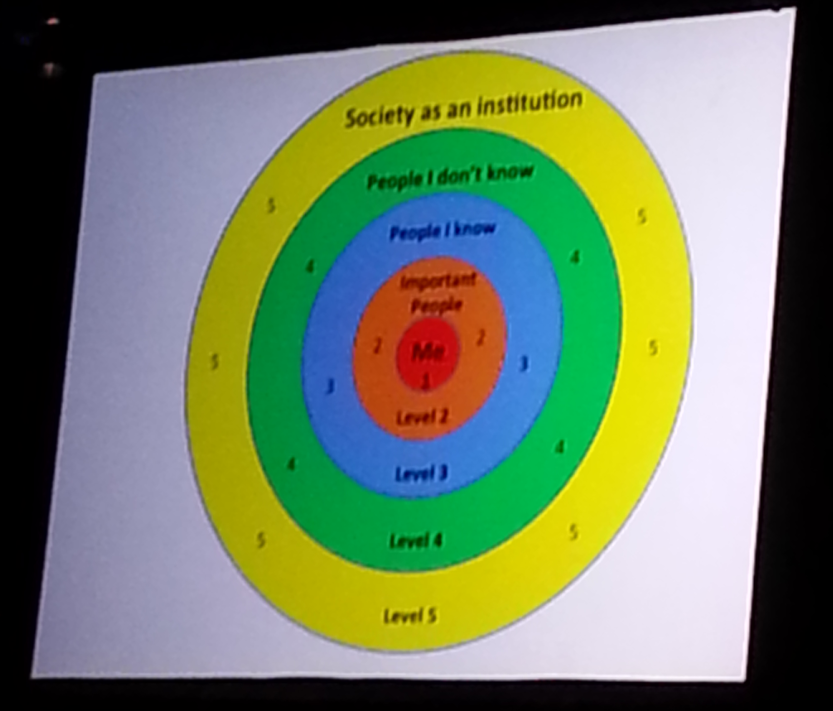
Mai Chen reminded me in her outstanding keynote (listen to it here) that the students we have in front of us in the classroom need to also be empowered to be citizens with a voice, empathy and willingness to make a difference beyond “Me”. The day after her keynote an article was published in the Herald: “It is becoming clear that we need to be measuring the performance of government very differently”
Picture taken during the subsequent Kerry Spackman Keynote
 that Mai Chen previewed in her address
 Mai Chen asked “What do we think is in the public interest anyway?”, and that if there is a framework how do we hold Governments accountable to act in the public interest?

If these questions drive society involvement we ought to prepare today’s young to feel and to know they are equipped to participate fully. Mai went on to announces that “the fresh thinking for 2013 is that we need to broaden the criteria against which we measure the progress of Government in achieving the public interest, to include those non-material things, like happiness and equity, which are critical to our future sustainability and wellbeing”. 
If I try to make sense of this as a teacher, I interpret it as:
- a further cue to do away with the bean counting credits and standards as a means of evaluating how well students are learning and to incorporate soft data such as enjoyment, sense of personal achievement, reflection, curiosity, optimism in evaluations
- giving teachers and educators the impetus they may need to contribute to help students become better critical learners as they too will have an important role in the society we live in.

Brendan Spillane captured in five short convincing minutes, in his Ignite* talk “Pull up a chair” , how “thinking becomes wisdom”. Thinking is like “a campfire to gather round” and his talk really set the tone for the conference.
*Ignite talks are a 5min presentation format supported by 20 slides. EduIgnite evenings are organised regularly I am looking out for the EduIgnite Evenings
as I would like to attend one this year (as a spectator to start with!)

Thinking of the format where Ignite presenters share their personal and professional passions, using 20 slides that auto-advance every 15 seconds for a total of just five minutes, it would be a fab thing to consider doing in class, first modelling to students on something I really care deeply about and then invite them to come up with their own Ignite talk. An opportunity to communicate a convincing, effective personal response to something they deeply care about.


Guy Claxton and Ewan McIntosh (I’ll come back to Ewan keynote and breakout separately) make it compelling to stop looking at the knowledge look at the process behind learning. What is actually looks like in practical terms for teachers and learners is the heart of our conversation Ruth. What follows may help. I have to immerse more to offer anything practical, and even then, does it mean it will be practical in your own experience? What strikes me is that both make a clear case for having all school, discussed and systematic approach. It will be interesting to see to what extent an individual teacher’s approach, in a secondary, in one learning area breaks through the established patterns. Hence the documenting of the steps taken here on "Back to the Drawing Board"!

Guy Claxton argues that "Mind Expanding has to happen now" (Mind Expanding Education MEE) in a packed solid breakout room.
The Building Learning Power approach creates learning cultures in schools. There is plenty to investigate here.
The first step is to step back and reflect, have a willingness to try things and think on your feet.  He urges to “take a deep breath and look back to look at the way we deliver “ and to get rid of jargon and instead use plain language and not parrot official documents. We need clarity. I see this as teaching as inquiry and/or action research.

Bin these Words! G.Claxton ICOT2013
He mentions how school leavers in the UK are accepted in prestigious universities on the strength of their grades and wind up two month on at the Mental Health service as they are petrified, scared and vulnerable as they are asked questions they do not have a ready answer for. I know how that feels, I am only started 20 years on to know better how to go about investigating and inquiring. Guy Claxton also talked about the Imposter Syndrome,  “a psychological phenomenom in which people are unable to internalise their accomplishments” which can appear if you are , for instance caught unable to answer an on the spot rich question. All of this highlighting “Students must be encouraged to sharpen their wits, ask questions, and think for themselves” (What is the point of school? ) to ensure they are confident and connected. He also says that we can have both high stake assessment and a culture of learning, that we need to TRUST THE PROCESS (Ewan McIntosh uses this too)
In the Vital, Challenging and Possible interview referred in the tweet above, Guy Claxton spells how that there can be Key Competencies AND Assessment , that students can get test scores AND develop the capacity to flourish. This interview followed his lecture Can Schools prepare you for anything? Recorded here.

Will this sustain your inner fan girl appetite for all things Claxton Ruth?

On the topic of Key Competencies and Pedagogy, NZCR  have worked on creating a Self Auditing Framework to support teachers’ inquiries into how well the Key Competencies are being embedded into learning. What strikes me at first glance is that I understand all the questions: NZCR heeding Guy Claxton’s no jargon approach! There are numerous Examples of Practice which could serve as a model to reproduce with a Language class, why not? And it could be an attempt at bringing in the international approaches within the setting of the NZC. What do you think?