Showing posts with label Reflection. Show all posts

7 December 2013

The year that has been

The year that has been… I woke up this morning realising today is December 7th. 2013 is nearly over.
There has been some good, some great and some less good and some messy! 

I have:

 - deepened my understanding of the scope and role of ePortfolios, researched and analysed methods of implementation outside of schools, inquired into their potential for employability, professional certifications and acreditations, as well as personal branding.
- dived in to identify and articulate the attributes of the Life Long Learner
- related the building of an ePortfolio to digital identity, digital footprints and key digital literacies.
- made sense of the inherent links between personal learning and social learning and how to scaffold them
- assessed ways of restructuring the way we work to make best use of both personal and social learning
- evaluated a range of online tools and services to support the ePortfolio approach
- started using design thinking
- worked on OpenBadges, instructional design
- realized I am only a technology consumer ...
- had a first go at synthesing this into a minimum value proposition to get started with ThinkAgency
- contributed by invitation to many projects and conversations but failed (so far) to get all the stakeholders I have engaged with to contract me…

This has led me to:
 - identify salient common points between the "world of education" and the "world of work"
-  slowly break away from my "edu" echo chamber and go and listen/participate in other communities
-  discover an engaging and switched on to learning professional community
 - see the need for a common vocabulary when labeling and describing skills, strengths, competence
-  invest in attending conferences where I have listened, participated, presented, met with
-  see and work through others' problem with them
-  value openness as the modus operandi
-  talk a lot around dreams and ideas (sigh…)
-  throw myself in a lot of new related stuff wanting to start to understand OpenBadges potential, IT stuff around metadata, experiencing basic coding...
-  feel frustrated by not staying focus


Which in turns has opened my eyes to:
(the confronting....)
- how limited I actually am to see the big picture: I find it hard placing boundaries around my ideas to have them evolve beyond just that
- the tyranny of too much autonomy! (especially let lose with a connected device)
- how limited my mastery around IT is beyond using/consuming
- how easily I forget I can't assume and must verify all hypothesis...
- how unable I seem to be at actually establishing my own actionable purpose!

Yet fabulous stuff happened such as:

- experiencing the world of entrepreneurship and start ups
- getting a feel for this whole ecosystem and going in with eyes wide open
- drawing some connections to the world as I have known it so far
- acquiring vast amount of new learning (some of it yet to be connected)
- witnessing what truly persuasive and convincing look like in practice
- starting to understand value in a commercial and business sense
- developing solid partnerships


I have maintained and grown lasting existing friendships.
I have worked on balancing my PLN, opened new channels and participated in a range of conversations.
I might have done it with too much gusto….
My teenage-like heart has fallen in love at first sight with many enlightening, supportive, challenging, critical new friends.
I count on time and actions to tell how these influences evolve!
I live with and love the most honest and caring dragon. I must never lose sight of this.

2013 as the "Year of Trying"! 
In the unstoppable momentum I have been saying yes yes and yes to so many things: I have done, got feedback, got knocked, undone, redone.
Today it feels that in terms of accomplishments for the year, well,  it is close to a "not a lot to show for". 
To move forward into 2014 I will need to do less Yes to learning and more Yes to executing.
I have a few weeks before making New Year's Resolution. Phew.

Why am I doing this?
The ability to learn is the only lasting competitive advantage for any organization. H. Jarche
Can I build a business model around this?
I have the ideas, the people, the want and the drive.
2014 will be the Year of the Concrete Steps.

2 November 2013

Digital Presence? Digital Identity? Digital Citizenship?

Introducing, facilitating, training and talking about ePortfolios inveriably leads to consider digital identity, digital competencies and digital citizenship. These are the concepts bandied in educational circles. Increased use of tools purposefully to support learning and framed targeted use of tools to make sense of and create own understanding of the information we have access are redefining how we learn.
Developing an ePortfolio is one way to build sound digital competencies, alongside leaving a purposeful digital footprint.
I read an article this week that prompted me to think about Digital Identity, Digital Presence and Digital Citizenship.
In "What digital presence?" Louise Merzeau describes and explains how we build a digital presence from managing our Digital Identity and exercising our freedom to act or think online.
Her view point has resonated with me: while the technology as it stands to date only allows us to take limited steps to fully control our digital identity,  we as individuals can apply consciousness to our actions when using online services, and develop a managed digital presence. And collectively as users we can establish good practice.
Louise's analysis starts with the traces left behind as we use the internet.
She describes some traces as deliberate: we fill in a form when shopping online.
Some others are created when communicating and sharing: we "like" a Facebook friend's status, we leave a comment on a blogpost.
In both cases these traces are left voluntarily.
Our online activity, using a browser or being connected on LinkedIn, also and mainly generates quantities of traces that we leave behind unintentionally. As a result we in fact have very little control over the activity that shapes our digital identity.
Given the current technology, networks and economic strategies, we leave traces that we do not manage and thus we can not manage our digital identity if we reduce it to the traces we leave. While personal data, traces, privacy... are the object of necessary, current political, ethical and technical debates, they take time to concretise.
What to do in the meantime? We can be proactive and build a digital presence, with applying  deliberate behaviors associated with its management. Louise is not talking about an online presence from a marketing perspective though. While having a digital presence, reputation, clout are legitimate quests that relies on the traces left, she talks rather of being digitally present.
She proposes to include elements of temporality, just like in real life: our digital life is not made of traces that accumulate and that can be used in any order. Introducing the concept of time into our digital activity allows to evaluate and give context to the traces that are left behind for ever. And developing a coherent, rich presence in networks is the surest way to leave traces that are managed.
 Gmail and Facebook, amongst others, are free but we actually pay for them with our personal data: it is the currency, it has economical value for these businesses. Rather than being paranoid and buy in the media frenzy around the topic, best is to get informed, investigate options and negotiate what we are prepared to concede.
Developing sound digital competencies, expressing oneself in the right place in the right tone is also empowering beyond protection per se. Digital competence involves moving from being a consumer of services to being a content producer. Digital competence also involves using the tools to serve our purpose, for information gathering, collaboration, etc.  Just as we do in real life, we need to experience different settings, learn about them, adjust our behaviours, develop our memory of what we did, what we chose to forget, what we develop, what we can share when online.
Information on the web has also become highly personalized, we go and get the information we want and often we go to information that has been validated by someone on our networks, Twitter for instance. Information across the board is no longer top down. Louise argues that beyond the public/private debate, it is the high degree of personalization of the information that is influencing behaviors: we are not reading any article, we are reading an article that has been recommended.
The lines between our private (family, friends…) and public (work, community…) lines feel they are blurring since we are using similar platforms to live our digital life. But Louise also argues that not all conversations on networks are to be considered as public, just like the conversation at a nearby table in a cafĂ©. It is how we use the information we have about others that matters: can we exploit any information we may come across? Is it because it is technically accessible that we can drop our ethical considerations and use the image of a drunken 16 year old to refuse him a job when five years on he presents an otherwise good CV?

All these behaviors are fairly new still and we all are learning together, while big corporate online services companies are moving at a very fast pace with their offerings so that we have little time to pause and think about what we are actually doing!
Schools and universities have a big role to play in framing theses competencies as they have no choice but to work with the tools.
Careful choice around sustainable online practices, scaffolded by teachers who themselves are proactive about their digital presence is attainable for learners from an early age, it is about instilling valuable behaviours that grow and evolve with the different life cycle we go through. Which could be captured, thought about and shared meaningfully and purposefully in an ePortfolio! I know you knew this was coming!

19 June 2013

I am not that visual...

Many are trying to establish a definition of what an ePortfolio actually is. And describing the nature, scope and meaning of ePortfolio will be done in relation with who establishes this definition for what context. I particularly liked this introduction to ePortfolio for students at Victoria Uni.
One comment written by Sarah Stewart on an anti ePortfolio blog post steered me towards picking an other lense to consider ePortfolio. She wrote "ePortfolio is what you want it to be!" Yeah!
I decided to drop (for now!) the institutionalised lense (education context, assessment, evaluation, measured improved outcomes, definition, implementation, eportfolio system...) and to focus on the individual ePortfolio owner* whoever that may be at any time of their life. Folios are life wide and life long and need to be considered from the user's perspective, who is a curious self motivated autonomous proactive agent of his/own learning (coming from a school near us soon!)
I came across this Guide to Digital Portfolio and I liked its presentation format. Maybe because it is flat and linear and that it caught my eye is a reflection of my limited ability to think differently :-)? I would like to master Prezi so that I convey my thoughts and experience about things through using it, but so far my attempts have left me disappointed in the result. I need to work on why? (and suggestions to guide this reflection are welcome!)
Anyhow this is my attempt at describing what an ePortfolio is. For me. Work in progress.

* Bloggers keep blogs, need to think of a name for a person who keeps an ePortfolio...

6 June 2013

Bundle of Inspiration


I am currently buried under the self motivated (!?) task of identifying and verbalising concisely why I do what I do at the moment. It stems from the realisation that it is through experiencing with and gaining fluency* in the use of a range of tools that I am seeing the transformative learning processes that they enable. Another root is that through experience and increased fluency has developed an "online me", a digital self, an identity that I have total control over, that is an amplification of who I actually am. This online identity gives me visibility, connectedness and a consciousness of self that leads more naturally to bursts of reflection like this one! To capture learning moments, curate them, share them, get feedback and reflect upon them constitute a journey. A life long learning journey that augments my understanding of self, no end in sight no certificate no pay rise. I am told that it should be leading to plenty of satisfaction. Right now it is pretty messy.
So enters the opportunity to list where I get my inspiration from, and to use a new tool that is pretty useful to bundle together a range of reference websites and display them to share. It is called Bundlr .

This tool could be used in the classroom to bundle reference websites to share with students or students could work together to create a class one on themes that make them tick. What this makes visible to me right now is that my Inspiration comes very much from the world of Education. Which is not surprising considering I am a teacher and trainer. But I take it as a reminder to look at ways at opening my horizons further, especially when considering bringing a range of people from a range of spaces together around eportfolios. I feel this is going to stay messy for a while yet!

*Silvia Rosenthal Tolisano
talks about iPad fluency and makes the analogy with grammar and language learning. It talked to me.

29 May 2013

No brainer

This is why we* do what we do, why we believe what we do is the way to go, why we trust, amongst others, the Key Competencies, Learning to Learn, Assessment for Learning,  to empower learners to think critically, to be curious and articulate, flexible and adaptable, to act independently and make their own free choices, in their context, in their culture.
Because we** don't want that. Anymore.

* You, me, and so many other teachers
 ** You, me, teachers, lecturers, employers, parents, friends...


26 May 2013

Google here Google there

My week appears to have been dominated by all things Google! Me and million others!
More this week than any other? I did receive lots of messages about googledoc use and discussed them at the NZALT meeting where I presented the NZQA info about online submissions for moderation.
And this level of "Google activity" got me thinking...
Every day several times a day I typically search, email, use calendars, create and share docs, presentations, forms, upload images, follow and participate in groups, watch Youtube clips, use Maps as GPS... I have used googlesites to document or communicate information. I embed elements from my Drive in other online spaces. My Android phone is surgically attached to my hand, the Android tablet is central to our living area.  I have even started to use Chrome and added a range of apps, including Lucidchart, Pocket. Still my default browser is Firefox, firmly, but who knows? I own a macbook air which has virtually no storage place as most of my stuff is cloud based, mostly in Drive and some in Dropbox.
And that is only my personal use..
http://mashable.com/2011/08/03/google-doodles/

The teaching and learning world is taken by storm by GoogleApps for Education: docs, control panel, apps... Excellent teachers are selected to attend the Google Academy, forward thinking and successful schools showcase how the Apps combined with Teacher Dashboard transform teaching and learning, amazing stories of implementation to develop a digital age approach to learning for all students are widely disseminated, whole countries like Malaysia not only adapt the cloud services but also the hardware, Chromebooks are featured prominently, GAFECommunity conferences worldwide are extremely well attended by innovative teachers looking to empower their students to own their learning. Resources to get started, presentations to implement, tips from any of these events are shared widely through social media.
And that is only what I am aware off...

I have actually not set out to learn about Google stuff, it just has grown as part of my daily routine,
it feels as whenever I need to do something there is a Google way, and that it makes my many aspects of my daily life easier:
- googledrive for all NZAFT business
- collaboration on documents with colleagues
- eportfolio publishing
- blog posts
- googledrive to share and organise shared documents
- hangout to allow for those online meetings and record them
- presentations with speakernotes shared
- everything viewable and editable at my fingertips anywhere anytime on phone

Google is omnipresent in my online activities. I can't quite trace back how this has come to be. It all started with a Gmail address and playing with the tabs in iGoogle I think.
What surprises me is that some people I work with can't access googledocs from their place of work: no need sharing a doc with them at their institution address, no need asking them to quickly join a hangout. Others are still under the impression that if you don't send a form or document on paper or attachment to an email, then it won't be replied to, that the link to the form or the doco won't be followed. That only if you have a google account you can fill in a form! And others can't quite get what it means that it is on the cloud.

I can't say I am a Google enthusiast any more than I am a car enthusiast:
- both equally take me from A to B when I need (although I admit that going from A to B with google is far less of a straight road, as often one thing leads to another! ;-))
- both I drive with caution but also with the comfort associated with familiarity and a good dose of safety ( I have googled my name on a range of browsers and devices and different locations and I am yet to see in the first 10 pages of the search any of the documents I have published to the web from Drive),
- both I enjoy the reliability of and the feeling of ownership derived from a certain element of mastery Oh that feeling of freedom when the tool does exactly what you want (eg: I don't think about "How" I drive to B) and that frees you to concentrate on the next step!
So I know what Google enables me to do. I know it now as it is born of need.  I know some know heaps more and use much more Google things and make it work for them and their institutions, schools etc. so I continue looking as something will resonate and it ll get used. (Like the DocStory builder!)

I felt I needed to look at some of these applications in a school context, with learning outcomes firmly in mind, with students experience at the heart, to see what they look like in a context where the freedom of use can be restricted due to the constraints (age limitations, digital competence, infrastructure, access, data ownership etc.) and to see what users make of them (like this or that!), where they can embed, how they can communicate with parents, communities... What makes GoogleApps different so that they seem to be so widely implemented (if not widely and judiciously used)? Is it because their use, contrarily to LMS for instance, revolves around a personal user ID, namely an email address and a user owned product such as a doc? Hum...

Upon receiving info about the GoogleTools for Learning course coming up,  I suggested to the NZAFT exec ATeam that we went on a learning outing together: I have been doing "the Google evangelist" with the team for over a year now, but I'm limited by my own experience. And I am ready to listen to expert advice in the education field. Our team has steadily grown their use and started to see some massive changes in the way we work and relate to others for planning and communication purposes. This is timely for all of us, and the opportunity to work together to share experience and freshly acquired knowledge to our community of practice at the upcoming FransĂšme is too good to miss!

So I am going back on my word: I am going to a "how to" workshop! LOL!  I' ll soon write what I got out of it!

4 May 2013

Stages of Self Directed Learning

@zecool brought my attention to this blog post via Twitter:

Four Stages of Self Directed Learning (SSDL) published on http://www.educatorstechnology.com

The post refers to these slides by Barbara Stokes, who presents the Gerald Grow's SSDL Model.


Theories of Teaching and Learning: The Staged Self-Directed Learning Model, G.Grow. from Barbara Stokes

So what I am taking away from this reading and those slides?
- Self directed learning is not a new concept < is it revisited more readily since technology has brought about means to achieve personalisation and independence more readily? To be investigated...

- The potential for self direction can be enhanced and moving through the stages can be accelerated with the use of ICTs < this would need to be substantiated

- I respond well to theories which you can visualise in stages: it makes approaching it manageable and it offers a progression which can be investigated and documented.

-  Slide 14 : the learner goes through stages of self direction: opportunity for teacher to use a wide range of methods < how to move from teaching centric to learner centric?

- Slide 15 lists some limitations. In the context of the NZC, could it be envisaged that the use of a tool such as Teaching as Inquiry cycle support overcoming some of these limitations? (eg: inquire into where students are at prior to embarking on any teaching, determined by "How do I get the best out of all of my students?' leading question)

- The model in practice hinges on differentiation, individualisation.

- Both the learner and teacher could benefit from using an eportfolio to document the journey. For the student how they evolve from one stage to another, when they respond better, what teacher's style they need to progress, if they are self directed all the time even in front of new learning. For the teacher to investigate their teaching style and adapt it to the students in front of them through gathering evidence over time and reflecting on practice.

- Could the SSDL could be used as a big picture planning tool that would complement the Teaching as Inquiry targeted approach? The Model fits in with the Vision of the NZC


28 April 2013

Nano Presentation!

Upon leaving #Ignition13 Sonya (@vanschaijik) asked if I would give a three minute (nano) presentation at the first #teachMeetNZ that she is courageously (and effectively!) lifting off the ground.
This is happening Saturday 4th May at 2pm! 
It will be via Google Hangout and will stream live.
Sonya got a range of teachers say they d give it a go just like that! (Compare this with what it takes to get to agree on a date and time to meet with some colleagues...)
 

And I said I would join in. 

I am not too worried about the tools, I have used HangOut and screenshare quite a lot (especially since Skype removed screensharing), and right now it looks that the format of TeachMeet requires that I send the moderator (Sonya) my 12 slides spaced with 15" in between. Total time presenting is 3 minutes. That is the scary bit.

Thought I would talk ePortfolio why not? Although I toyed with an idea around Intercultural Competence (maybe another time LOL!)
And that got me to trial the text to speech SlideSpeech. The developer John (@slidespeech)  was showing its capabilities at #Ignition.
I remain unconvinced about the mechanical voice and the intonations. Maybe better than the French accent though. (Edit: I have now chosen to do a voice over version though!)  On the plus side the synthetic voice will deter from focus on content: getting a point across in 3 min flat is a big ask, and I am unsure that what I am saying is either clear or convincing. Having said that I will actually be presenting on the day. If you want to watch, it will stream live from here. There are some cool people lined up.

Anyhow, here is my first ever 3 min worth. I will really welcome feedback my critical friend!

                   You Teach You Learn - ePortfolio approach  

May 4th:
#teachmeet took place and it was a great experience!
Very good presentations indeed! Worth checking out here and more about the presenters on the wiki
Due to last second "stage fright" I pressed on the wrong button and my slides did not display properly. Luckily I was stopped midflow and could readjust! When you show something on Hangout you dont actually see as the other participants. Yet did not capture well on the clip... La prochaine fois!
So here is what I actually presented. Hover over the little cog option tool (bottom left) to bring up speaker's notes):

9 April 2013

Next steps?

Professionally and personally, I have benefited hugely from teaching and learning with MyPortfolio. I have developed new skills, discovered a newly found self motivation through working with hundreds of teachers and kept in contact with quite a few, received hundreds of messages indicating interest, necessity, questions arising, support needed, often carrying a heartfelt message of thanks, engaged in conversation in my replies. The teachers I met briefly at Taster sessions like the ones I met at workshops just saw something that talked to them, that made visible much of what they had been trying to do, that gave the NZC a form to visualise.

What I don't know is: has what all these teachers I have met learnt that day made a difference to them and above all to their students?
I know the punctual workshop model is NOT the model that makes any difference. But that is what was made available and it served a purpose: to gain awareness of MyPortfolio existence, to start a conversation about eportfolio, to plant a seed. Relying on the growth of the community of users to support one another from within for the long term was a good idea but like any good idea it would need stronger scaffolding to eventuate fully, as MyPortfolio is not learning to use a tool, it is enabling learning to learn with a focus on the future.

MoE laments that while there is plenty of users and groups there is not a lot of activity.  All change especially of this scale takes time, and a lot of time. Using MyPortfolio is not using a tool: it is using a suite of functions which complement each other and replicate a learning environment. A learning environment as complexities, intricacies born from the relationships within, must be flexible, inviting and expandable, needs to welcome the learner so that s/he wants to be in there, in a safe, supportive space where s/he can be on his own when wanted or within a community. MyPortfolio allows for that.
Regular log in in MyPortfolio to look at  the latest (public or shared) pages show students and teachers alike in a range of schools using it: sometimes it's entry level, sometime it's more advanced stuff, sometimes it is the same users, sometime it is new ones. Big users report the transformative changes MyPortfolio has brought about in their practice. Big users also report that short of MyPortfolio being championed by at least one user and this(these) champion(s) being supported by a leader and a clear strategy there is little change at institution level. Hence little activity.

With thousands of schools and accounts registered on MyPortfolio, ongoing interest in getting started, in implementing, with no more taster sessions and with community support limited to developments, with the MoE committted to maintain MyPortfolio till December 2013, what to do?

Facts:

- I am isolated: with no institutional identity, no team or colleague in the same boat to build on what has been acquired together, no visibility passed Dec 2013, it is all the harder to make a sustainable plan.
- My name is linked to MyPortfolio and people stop there: the "tool". As in "Pascale knows how to use the tool".  Pascale knows why to use the tool is the reality.
- I am now able to articulate the Why? of eportfolio and the How? MyPortfolio is one way to achieve this.
- I see the ePortfolio approach gaining traction worldwide, as showing mastery of skills (e.g. critical thinking and communication) and understanding, as evaluating achievement through evidence of improvement are replacing the content knowledge and summative tests once relied on to assess one's abilities.
- I have become aware that to inform and support individual teachers is not going to bring change about, unless they themselves are true change agents within their institutions (and in which case they don't need me!). Principals need to be on board, own it and lead the change.
- I also know that to support any great change involving technology a commitment needs to be made to Professional Learning, and that there is a huge cost to ongoing Professional Learning. And that if you buy Professional Learning you need to have assurances that it is going to bring in results. That is if schools can "buy" it... (Accessing PD for schools in NZ is not a matter of saying "We need"...)

My Options:
- Strategise a plan in knowledge of what I know and who I know to offer ePortfolio support  as a consultant?
    > Need colleague(s)-business plan-investment - business mind- inquiry- well defined/tested product and tool - is there a need for ePortfolio understanding in NZ schools or is it my perception?
- Hang in there to see what becomes of MyPortfolio , if N4L picks it up, and what professional learning will be associated (if any) with their products.  And if any, is that a chance for a trainer to offer a course?
     > More unknown - waiting game-  would positions if any be advertised? - another case of "who I know"? - would be less inclined to go with the flow due to what I now know - join an existing team?
- Further my qualifications formally? Do a series of Uni papers related to the area of interest? a MOOC?
  > better credentials, other opportunities? to find something that is not research based is tough as I dont have an institution to research from.
- Continue voluntary involvement in the MyPortfolio community, the eportfolio community at large and associated communities through forums etc
    > adding to my kete, networking opportunities enhanced, but not active at the chalk face, theoretical knowledge increased not working knowledge, few face to face real contact with a specific goal, no monetary recognition of involvement
- Give up and volunteer to walk the SPCA doggies.
    > instant gratification, feel good factor, no fear to do it wrong, no intellectual demand just fluff!

Now what? I may be sometime trying to answer that...

9 March 2013

So?

Hello Ruth,

Congrats about reaching the end of Week One!
I have been thinking of you.
Source
Thought you might appreciate a tisane and some R and R of some sort right now!

You may be interested to read this article by Guy Claxton, called

Virtues of uncertainty


It is not new so you may well have read it before!

Also you may want to listen to this edTalk where Mark Osborne talks about Personalisation, one of the Ten Trends for 2013 identified by Core. If you have 5 minutes you will see why it resonates with me! Those trends are a prediction of what technology changes bring about in the world of NZ education.  It talks about the drivers of change, the impact and the implications. Something for a rainy day maybe... (not that they are few and far between in your turangawaewae!)

Here are a few questions that I have been dying to ask you:
 - What was the best aspect of your first week?
 - If you identify one thing that is going to challenge you in the short term, what are you going to do about it?
 - How is the Wifi? Can you use your phone in class?
 - Are the systems in place straight forward to pick up?
 - Can you take some pics of your learning environment (classroom/s) to show me?

Have a wonderful week end. Off to work with Glenda for a couple of days next week. I have been thinking of a post coming up on Professional Learning, what I ll do in Palmy and NP will certainly provide content.

A bientĂŽt Ruth.
(When I come and visit I want to go there!)


26 February 2013

Cultural, intercultural, bicultural, multicultural - 1

I am setting out here to try to debunk some stuff I am finding somewhat hard to get around. It is likely to take more than this post, so I will start here with what I am trying to do and with some resources gathered to inform my exploration.

Intercultural Communicative Language Teaching is "a set of techniques", six principles "for putting interculturally informed pedagogy into practice"

"Students build their awareness of language and culture, their language knowledge, their cultural knowledge, and positive attitudes towards themselves and others. Intercultural communicative language teaching (iCLT) encourages students to make comparisons and connections between languages and cultures"
(Learning Languages Pedagogy, TKI)

In this 6 principles I recognise the following words that relate directly to Learning:
    - actively involves
    - make connection
    - social interaction
    - reflect
    - take responsibility

"The development of intercultural competencies" has become an essential feature of school education in NZ and other Western countries, and the responsibility for this falls to some extent, but not only, on languages education and thus on the Language teacher.

Statistics New Zealand, in its National Ethnic Population projections, informs us that Maori (+29%), Asian (+145%) and Pacific (+59%) populations will continue to increase their share of the NZ population by 2021 (that's 8 years away!), with Europeans only increasing by 5%. All ethnies bar Europeans will have a much younger age structure on average of NZ population bar Europeans,  who are overall getting older. And all ethnies bar Europeans will have more babies thus more children going through school. Add to this the growing diversity of cultures, backgrounds, religions and languages that migrants bring to any NZ regions (example in the Bay of Plenty) and it is looking vibrant indeed!

All of these reasons (and the specific context of teaching Languages in Aotearoa NZ) makes me want to move on with "developing my intercultural competencies" as this multicultural mix is coming to a classroom near me rapidly (or is already there depending where you are located geographically).

Source


These are all reasons why as a teacher of French,  I am not to merely transmitting information about my culture but I have "focus on raising awareness of culture and culture-in-language in the lived experience of the students and people from the target language culture(s) as well as other cultures present in a classroom or community"

 Language learning itself won't necessarily foster a positive attitude to other's culture hence the need for interculturality to be addressed explicitly and openly in the classroom.


What does interculturally informed pedagogy look like in the language classroom?

  • construct knowledge through EXPLORING cultural practices
  • make CONNECTIONS between cultures, and between existing knowledge of culture and language, and new learning
  • social INTERACTION that involve communicating across cultural boundaries
  • REFLECT ‘critically and constructively on linguistic and cultural differences and similarities’
  • TAKE responsibility for their intercultural growth, assisted by teachers who, for example, foster engagement with difference and awareness of stereotypes. (Ref: Dellit 2005, pp. 26–28)
I would like to discuss this specifically to think of actions in the classroom that support this (use of some radical controversial materials to engage? role playing? online communication with native speakers? make culture explicit, open with key questions to wonder about eg: how do they do it, how do I do it, is it different, the same, what do I notice, why, what do I learn from it, what do I learn about my own culture, myself from what I have learnt? )

What is iCLT setting out to do?


"to foster interculturally competent learners who can confidently navigate intercultural interactions and relationships"
,
  • who are tolerant and have a positive attitude towards others' culture,
  • who can communicate with a native speaker without necessarily being fluent themselves,
  • who welcome diversity and also are able to see some universal similarities amongst cultures including their own,
  • who can confront and reflect on their preconceptions and prejudices,
  • who can resolve and/or learn from misunderstandings arising from miscommunication,
  • who develops a strong sense of one's own identity
    who is a cultural intermediary between one' s own culture and the foreign culture
So what do I do as Language teacher?

I am a French teacher who is French. "What does it mean to me to be French?" "What does it mean to be French in NZ?" "What makes me French?" "Who am I?" are questions that I am now more curious to think about. And if I am to grow a culturally responsive pedagogy, I ought to develop intercultural competences which ban assumptions, distance myself from conventional attitudes about differences, show deep interest in others' cultures, including of my students in my classroom, provide these students with the opportunity to not only eplore another culture and language but above all gain or strengthen their awareness of their own cultural and language through discovering another.

To move forward with this I need to go back and the urgency is to know my students, all of them, for who they are really.
And to learn to do that in a New Zealand context I want to turn to the kaupapa around teaching/learning strategies for Maƍri learners and raising Cultural Responsiveness.


20 February 2013

ePortfolio: Tag, Reflect and Assess - Still from ICOT2013

The Tagging the Learning Journey- A new model for assessment by Ewan McIntosh appealed as soon as I saw it on the ICOT2013 programme.

What I am trying to do here is to connect the development of an ePortfolio, the use of Tags as introduced by Ewan, and the principles of Assessment for Learning. I go on to suggest what it could look like for the Language learner.
A tall order: hopefully by the end of this post I will have outlined a vision ofhow it is all meant to work together to "enable student to take more control over their assessment" (E. McIntosh)

ePortfolios can be a showcase of the best, the final products that are the result of following a task.  The teacher can access the product, and grade it. This is an initial step in the eportfolio world for Language students and teachers in NZ: NCEA Interact and Write internally assessed standards require a portfolio of evidence. That is 3 to 5 pieces packaged together to be graded, by the teacher.

Yet a move to portfolio assessment offers a great deal more by opening a wonderful box of opportunities to, amongst others:
- change the nature of the tasks (Is "one fits all" still current when personalising learning?)
- change how the tasks are assessed (feedback, feedforward)
- redistribute the assessesing cards (self, peer, teacher)
- make the learning process visible to both the student (learning to learn) and the teacher (measuring the progress not just the achievement)
- hence know the students better and know how they learn better (to ensure that each assessment is appropriate and fit for purpose)
- give the students a chance to think critically and reflect about their work (gain awareness of not only what they learn but also how they are learning)

Add "e" in front of portfolio and e-porfolio become a vehicle for teachers and students to develop together their digital skills and competences, as well as their creativity.
Then you start having an eportfolio as a process, showing the stages of learning ("filming the learning", from beginning to end, with initial draft, rework, feedback, to final draft) that are now visible, can be revisited to identify how skills have evolved (reflection), to showcase success (to parents and/or third party?) and to establish where to next.

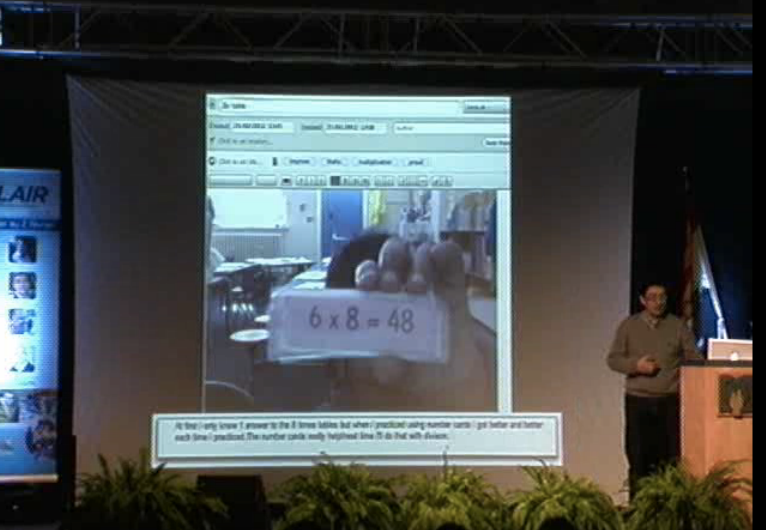
Ewan McIntosh at Clair2013 presenting Reflection
What Ewan McIntosh explained in his workshop is how his team and the teachers in the London school worked together on shifting the onus of assessing from the teacher to the student. So that the students own their learning, by organising it, reflecting on it and sharing it. So that the teacher, by refering to these reflections, gets a way richer, fuller picture of each individual's learning journey, thus empowering him to plan the next learning step, in full knowledge of where the student is at and in conversation with them.

Ok I must add here that Ewan's workshop is set up in the concept of Design Thinking (here is an example), in a provocative inquiry learning project that the students themselves entitled "London is full, evacuate", that all teachers are on board revisiting their assessment strategies, that the notion of time seem to be strategically ignored and that a range of technology is provided.

I am not (yet!) trying to delve too much on how this could look like in a French class.
What I am trying to do here though is to extract the possibilities considering our framework (NZC, Achievement Objectives, Ellis Principles, iCLT, and effective pedagogy) to develop the use of an eportfolio to support language learning. 

- Know your students, spend time,  have them define for themselves why they are learning French, ask them to show you the type of work they produce in other areas, invite them to list what they see as their strengths and weaknesses, what they find easy or hard, what prior knowledge or interest they can bring to the class. Make this a first eportfolio activity, by recording this on a profile page or a blog post for instance.

- Allow to let go of the tyranny of time and programmes. Make time to explain and discuss what a learning process is, why they are engaging in thinking about their learning in the French class, make time to have them "picture" what an eportfolio looks like, what type of stuff there is in it, collaboratively. Suggest they share their strengths and weaknesses with others in the class to build a support network (KC: Relate to others). Make a place and time to really know students, and be able to say how we know them.

- Design authentic ("is there a genuine need to do this?"), passion tugging ("are we going to have a good solid argument about this") and engaging ("would I want to do this if I was 14?) task. If unsure of the response, put it to your students and invite them to tweak it for their purpose. (KC Participating and Contributing). Involvement in the assignment brief can only deepen engagement. Plan for collaborative and collective assessments. Build in opportunities for students' creativity to come through by letting them chose their direction and their medium for completion (slideshow, video, poster, online, on paper...) Model, and if needed, prompt them:

eg: If preparing for an upcoming trip to New Caledonia, brainstorm what preparing involves: some may choose to investigate places to visit and create a pamphlet, other make a useful phrase booklet to print, others prepare a mihi or a cultural show and record the process, others again might publish the itinerary for their hosts families etc. (KC: use of Language Symbol and Text)

- Define, clearly,  together,  what constitutes high quality work: discuss, display on walls, talk together about it... The students ought to internalise this to own it. Use official curriculum or ncea stuff if you want but cut the jargon out of it with your students. Making connections with how they learn in other learning areas can help them engage in the process of learning French and it will show on their eportfolio through their reflections (KC Thinking)

- Consider that any task can lead to potential evidence towards the criteria.

- Assure them that errors constitute learning, that is why there are drafts on which they get feedback and that they keep them as a record of their progress. 

- Hand over to student to capture evidence of learning when it occurs. Great use of devices, own or not, and wifi! Not a "let's record this now because today is recording day"! Not everyone can capture evidence of their own learning at the same prescribed time, and not everyone will update their eportfolio this way either. (KC: Self Management)

- Let the students tag the evidence meaningfully, this will help internalise the criteria for high quality work (KC: using Language, Symbol and Text)
Ewan McIntosh suggests three different categories of tags to start with
(I am adding in brackets some tags that could be used for Languages)

- what it is (Eg: read, write, type of text, interact, present...)
- the skill or competence (eg: language, culture, produce, spelling, pronunciation, past event, future event, accuracy, fluency ...)
- an "emotion tag" how the learner feels about it (Great, hard,  proud, love, must do better, hate, boring, success... those tags could be in the target language)

Tagging online evidence allows to organise it. 
eg: find all the evidence tagged "interact" and "proud" at the click of a mouse and thus help the student identify which they would like to submit for a showcase portfolio towards 1.3
- Prompt them to use these tags to reflect on their progress (KC Thinking)
Ewan McIntosh suggests to scaffold reflective capability with simple questions to start with:
- where have I been? (eg: "I found it hard to describe a situation in writing")
- where am I now? (eg: "here I have used some language with success and x understood my description")
- where am I going next? (eg: "I must do better with the accuracy of my pronunciation to avoid misunderstandings)

Over a period of time and depending on the level of language acquisition, students can start to use the target language to tag and then reflect .
- Comment on their reflections punctually, using a reminder prompt ("do you know what to do next?"), a scaffold prompt ("ss that enough help?') and an example prompt ("what will you do if you get stuck again?". Leave a mark to acknowledge you are reading and using their reflections to inform your teaching.

- Step back, observe and trust them to start commenting following a similar model on their peers' work.  Consider assessing yourself only sporadically at a designated time (eg: maybe only after rework of an initial draft that has been peer assessed twice or for some designated pieces)

- Consider that different students produce different ePortfolios. You may start with carefully designed templates which will help make the purpose transparent and communicable. Accept that they should just help with the process and that individual students will progress and capture evidence of learning at different stages and through different learning opportunity and possibly personalise their eportfolio.

SO here are some ingredients to "film the learning": Provide great assessment activities (and plenty of them), scaffold them to learn new stuff and revisit previously acquired ones, co-define with students what high quality work looks like and what it involves, provide descriptive feedback in a timely manner and always look towards improvement.  Assist in selecting, in conversation with the student, what constitutes the best pieces for submission to be evaluated formally.

As I said at the beginning of this post, I am merely trying to clarify what steps could help students and teachers understand what are really, in my opinion, the reasons to consider building an ePortfolio: it can be hard initially because  students may not have any piece of evidence to add to their portfolio (if they have been used to producing and saving digital evidence in say, their own drive, they are a step closer to get started!)

They will use self management, digital skills, critical thinking, opportunities to work with others, to learn to trust/critic judgement from a range of people, to gather their own evidence that they can meet the requirement of the task,  to learn not to complete an assignment to be seen just by one, the teacher. The type of stuff they will need to do all life long, when school's out for ever!

Next we can start thinking about some tools that can help with this!

What do you think? Can this work? Something wrong in here? Where is the French I hear you think?
___________________________________________________________________________________
Thanks to all the following for your virtual great help:

NoTosh Projects
Playing Tag: Ewan McIntosh on Assessment at ICOT2013
Great tips and tools to create eportfolios
Core ten trends 2013: Personalisation
Assessment for Learning TKI
Using the ePortfolio to validate students' learning
Senior Secondary Achievement Objectives Learning Languages TKI
Effective Teaching in Languages TKI
___________________________________________________________________________________


17 February 2013

Conference or not? ICOT2013

No doubt I took away from ICOT2013 heaps to think about , discuss, weigh etc. BUT!

I sat for five days and listened for five days. I took in: I wanted to be there, both the keynotes and presentations engaged me. I had built my own programme selecting from hundreds of breakouts. I was prepared, I knew what to expect, it was part of the deal.

The speakers were big guns that I respected and wanted to learn from. There was a bit of "fangirl" time going on there.

But a dimension was lacking: I wished some unconference times had been scheduled : I could have heard more but also talked and exchanged, built a better picture there and then.

Hazel blogged live here about her wish to an alternative approach to the conference lecture

And Viv captured it very well in this tweet:


Not saying that big ticket conferences need to go: maybe to be attended sporadically (cost, time value for money, reporting back etc. to be taken into consideration) for the big picture inspirational stuff, where some seriously good presenters are truly going to kick your thinking into action... Or I say, read about it online and engage in discussions with others on matters arising on social media or discussion groups to make sense of it.
What is an alternative? I believe in the value of robust conversations with colleagues,anytime anywhere, as a pillar of professional learning.  User driven conferences, where practitioners share experiences, discuss, make sense of together on matters which actually really matter to them and make the necessary connections, provides a frame for these conversations to take place. Attend an educamp sometime,  there is always one near you. Or there may be a repeat of a frenchCamp!  (Note: what you get out of it is proportional to what you put int, and those gatherings do have a method behind their madness, it's a matter of do what you want in a framework. Nuance!)
Not a place where practitioners expect content delivered in a tidy one hour slot of listening before moving to the next tidy one hour slot, not necessarily connected to the previous, not a space that is partitioned, not an environment that is close to only those present, not a time where somebody tells me what I am going to listen to. I want to choose, I want to lead my learning, I want to decide what I need to learn about to further my understanding, I want to do it as I own it. Stuff that conference conveners,  no matter how much they labour on a programme, coerce presenters to deliver, decide on a venue but are limited by cost, choose what I will eat and drink, try to keep the cost down but still there is a cost, just can not decide for me.
Then that will be teachers embracing their learning and thus being able to truly get students to embrace theirs.

16 February 2013

Making Sense Of - ICOT2013 Goodness

The first I heard of SOLO Taxonomy was at Learning@School 2010. It was back in the glorious days when Flo and I were on a bit of mission to "try heaps". The mission was not clear, that's why maybe it sort of petered out after a few years, yet it was full of joy and questioning. Lots of goodness (one is visible here) came out of it and our friendship is all the richer for it!
So at L@S2010, Flo attended a breakout  where Pam Hook was introducing SOLO. Flo explained to me what she understood, and I sort of left it at that: I was like a possum caught in the headlights and had a kete full of stuff to look at again, investigate and went to look into ePortfolio and mahara-myportfolio as it seemed that providing info on this was answering a genuine need within my Community of Practice. Hence the need to revisit good ideas often, in different contexts, at different times for them to start taking shape...
I have since many a time come across teachers, mainly in primaries, who are hooked on SOLO. I have at times look into it: this introductory clip prompted me to pay more attention:
Lincoln High School Craig Perry and Fiona Bamford's ICOT2013 "Facilitating a whole school thinking framework for lifelong learning" brought it to life for me. (Their presentation here)
I chose to attend their breakout for several reasons: secondary school, lifelong learning, but also the fact that Fiona, Languages amongst other responsibilities, was presenting.

It was just great! And I am not even talking about SOLO! Craig and Fiona's was the story of a secondary school which over time, a long time, have trialled and errored their way into finding a language, common to all, across Departments and Learning Areas, teachers and students,  about learning to help the Lincoln students "say where their learning is at" and "know what they need to do to improve".
Craig Perry and Fiona Bamford ICOT 2013
A story of commitment to make a change, of champions dedicated to the cause, of persistance and of supportive, benevolent leadership. It also highlighted that change happens when specialist support from the outside combines with a genuine identified need from a community. That time is dedicated to make it happen and that it is understood that it does not happen overnight and that there are many hurdles in the way. I appreciated to see how the different Departments at Lincoln have applied SOLO to the NCEA Standards, so that students can see common across subject areas, to help crystalise their learning.  Fiona stressed she was still in the process of doing that for Languages. Nothing happens fast.  I also liked how from their adopting SOLO there is a common approach for literacy. That indicated a great deal of cross curricular collaboration.  I had the opportunity to go to Lincoln in March 2012 when Fiona and a team of Language teachers took a look at MyPortfolio:  I wished I went back to work with them now, equipped of what I know about their work and what I understand about facilitation: we could have made more relevant connections more quickly.

I think that we could benefit, as Language teachers, to hear more from Fiona's journey, how she has moved to thinking in "Thinking" terms rather than just in "Language Learning" terms, how it is effecting her students and her teaching.  We chatted briefly at the end of her presentation and she indicated she had once addressed Language teachers in a PD setting about SOLO but it was not much attended. Hum, maybe the word NCEA was not prominent enough in her prez brief to attract the crowds... (This is intended to be a sharp, cutting remark, you noticed?)

It also confirms that in order to change it is about sharing a vision, believing in it, trusting the process and enabling effective support.

Craig Perry published a really good blogpost today. An eloquent post where he writes that despite being opened to be challenged on his views and beliefs about SOLO by the "Thinking Gurus" at ICOT2013, he walked away all the more convinced that SOLO is providing what Lincoln is about for their students.

I want to come across more similar stories.


Steps towards what? More thoughts fuelled by ICOT2013


I have just finished reading this post entitled "Change or Die".  Two points stick with me:

- change is not supported as the overall agenda is focused on improvement rather than transformation
- there is a lack of "big picture", where steps are managed rather than lead towards a clear common vision.

Individuals, like you and I, have enjoyed and continue to get benefit from discussing, reading, participating 2cts worth to debates, trying to make sense of what Learning is about. I  personally often feel that to give it serious thought and consideration (and to be taken more seriously!), I need to be more systematic (oh here you are Ruth: that is a trigger word that has you switched off!) in order to reflect and take action. This is certainly what Going Back to the Drawing Board means for me.

But hear me out!
  I would be motivated to systematise my approach if there was a need (self motivated or else) to have an outcome for a particular purpose. I am in the rather comfortable position at the moment where no one demands of me to perform at any level. This affords me to spend time considering a range of issues arising from different sectors and interests. I choose to spend time with the NZAFT and associated projects, I choose to continue to support people use of myPortfolio, MoE funded or not,  I choose to keep informed to do these to the best I can and if I have the opportunity, to move things along. I assume that if I was employed as a teacher in a school, time, energy and freedom spent on these choices would be considerably limited.

I have been freed to investigate in my own terms, to learn stuff when the need arose, to seek and find help, to do and undo, to have the confidence and curiosity to do so,  to bring to the light that my absence of formal linguistic training (I am often "found out" in conversation with Language teachers! ) can be made up for with other aptitudes and understanding of Learning I have developed, to create, maintain and continue to widen a network of thought provoking, informed, convincing professionals beyond school colleagues and my immediate community of practice.  It is my own paradigm shift: I have changed. What I have learnt in the last couple of years, exposing myself to arguments and thoughts about teaching, learning, assessments, ICT, theories, practices, social media, internet,  beyond the ones imposed by a manager or a system, is that "things do not have to be the way they are" and that "we don't know what we don't know".  Hence I can say here that all I have learnt from this freedom I would wish to continue to grow in any circumstances.
Kerry Spackman The Moral Scale
But what I can say also is that I am unsure of the reasons why I am doing it...
- What level of the Moral Scale  am I really operating at? Am I doing this for me only (since I have no obligation) ?
- Am I doing this because I am looking to "make a dent in the universe?" (Kerry Spackman at ICOT2013) ?
I would like to think it is about taking a tiny step on the Bottom Up approach ladder.
Kerry Spackman The Moral Scale

So to go back to Change or Die: What /who makes a vision clear enough, encompassing enough, trusted enough and supported enough for every teacher to feel empowered that they too can change, and as a result  for every learner to learn to be in control of their learning? That the move from thinking at Level 1 "How does it affect me?" to Level 5 "What's in this for society as an institution?" is enabled?

Derek Wenmoth: Change or Die? Vision, Trust and Support
While aspects of Kerry Spackman's keynote varied from boring me to worrying me  (I am not convinced that I need Knights to save me) one key message that was taken away, as aptly highlighted by Derek Wenmoth, is that "influencing peoples beliefs is very important in the process of bringing about change in society".

And this is something that every teacher can do. Children must be prepared for the world they live in not the one I grew up in: in my today's world, the population is aging and all expect to live a long time, ethnic groups learn to mix and mingle, notions of distance and time are just about a thing of the past, values are open for discussion etc. So who better than a teacher should be in the position to present a clear vision of the future to their students, and should help each one of them make sense of it in their own term, lead them to want to be involved, so that they grow to concern themselves with society and their role within it? All teachers need to question what they do if they are to model and instill this effectively.  And that means questioning and contribute to transform the system they work in.

via Rachel Saxton  ZenPencil
So why am I writing this messy post? If I really want to go Back to the Drawing Board, I need to know where I have been.  I ought to see more clearly where I am at now. And then it will inform me of where I should take my next step.  In the immediate future, it involves taking a step with you Ruth as you go back to school. Then I will see.


11 February 2013

ICOT Part 3: The Other Dimension

I wrote here that I went to ICOT2013 by myself.  It is only partly true as a number of factors have contributed to exchange ideas and share experience with many, to meet people and discover their background and their interests, and to work together for the common good.
This is enabled through the Twitter backchannel: the comments using #icot2013 to form a thread, the links to support what is been presented, the immediate reflections, pictures, times for informal meetings, light banter... All that contribute to a sense of community, for all tweeps are "in the same place", but also to broadcast and amplify what is taking place to whoever follows #icot2013 from afar. 

Managing tweets by added them to Favorites allows to keep them for further reading. I chose to collate tweets in a spreadsheet as I know I will refer back to them. I have failed so far to convince you Ruth of the time and place and usefulness of Tweeter. A conference like ICOT2013 is the type of event to experience its strength: my memory of the event and my understanding of it will be all the poorer without it. Many delegates are using Tweeter, more or less regularly, some give it a go for the first time and see it do its thing. 
You could have followed #ICOT2013 and possibly felt that somehow you were there if you could have read the tweets generated during Ewan McIntosh's opening Keynote, or Guy Claxton's breakout! Tweets are informative, questioning, meaningful and often lead to something else, equally or more interesting. If this is not good enough a case to make time for Twitter, then read on!
 
- This tweet leads to this GoogleDoc.   
Follow the link to read the Keynote notes many delegates have contributed to, as they happened. Started by one, "broadcasted" via Twitter, and all the sudden many hands make light work to keep a record of what is being presented. It is certainly of more value if you are or were of attendance, but the quality of the quotes and the ability some have at synthesizing as they take in never stops to amaze me.

And through Twitter, you also get to read what people think or how they make sense of it. They may share their thoughts/ experiences of their blogs and mention it on Twitter. We both agree knowing there is an audience is an incentive to consign reflections. Some might see this as a sort of a showy behaviour, and not all thoughts and reflections are bone equal (here is an example!!). But what best way to collect thoughts and ideas, to later select them for a particular purpose? Why keep your notes to yourself? Will you ever read them again if they are on a bit of pad?  How will you get feedback? What better way to make your learning visible to ... yourself or your boss! 

But no need to convince you of the value of blogs, this is one battle won. For now. Until you and I find or invite an audience, whoever it may be, we can be each other's audience! I could have written about ICOT2013 but it would not be the same should have had not read the following blogs, from various authors, educators with different backgrounds, at different stage of their careers. And I may never have been aware of them should they not had been tweeted about!

  • @howen blogs in real time, as it happens. The Problem Finders are her note on Ewan McIntosh's Keynote and  Creative and Critical Thinking: Creating Space for Innovation is her notes on Ewan McIntosh's workshop she attended. By scrolling through the January 2013 blogposts, more ICOT2013 live commentaries are available. Hazel is a seasoned social media user who has great expertise in online communities facilitation.
  • Matt, a primary teacher in his second year of teaching, @hunch_box, wrote Playing Tag - Ewan McIntosh on Assessment very shortly after the end of the workshop.
  • @dukelyer, an experienced primary teacher, moves Icot2013 into his long term memory in his post where he consigns what he will report back to colleagues who did not get the chance to attend.
  • @mattynicoll, a secondary Science teacher, blogs about his attempts at improving the classroom experience for his students. He publishes his ICOT2013 reflections here 
I will be revisiting these teachers' blogs, amongst others, which I add to GoogleReader and read every so often, as a magazine.
So no, I can't say I know this people well, I can just say that there are commonalities and that all of us are animated by making sense of teaching and learning in our own terms, with the influence and the input of others. I don't know any regular blogger in our immediate community of practice, do you? Is the French teachers community still is my most immediate community I wonder?

I am indebted to educators who like @ewanmcintosh, and many others, blog and share what they do openly. I need to immerse myself more deeply there before I can see better: a case of going deeper in the dark hoping to see some light! Blogging invites questions and comments and conversations. And that is through a comment that I was introduced to @charte' blog. Chris's is highly likely to help me break down how design thinking, formative assessment maybe applied in a language acquisition environment: he was a language teacher in the UK who did a lot of very cool (and well documented) things when they got the New Curriculum there. He is now in Melbourne, has developed a love for SOLO taxonomy and I can't wait to dive in his blog either! 

A gem of a perfect ICOT2013 summary that was just so bang on for me was @virtuallykaren's Big Ideas emerging through the Week. GO read it if you read only one from that list! Spoiler alert: Karen highlights thinking processes and heuristics, necessity to have real meaning and purpose for students to get stuck in, and focus on making thinking process visible. 


ICOT2013 was definitely an opportunity to meet people, and if not face to face then, it happens virtually over time.