Showing posts with label language teaching/learning. Show all posts

12 November 2013

Starting with the Who

Last week saw the launch of Shared Histories, a France-New Zealand schools cross-curricular project  spanning the five years of the commemoration of World War One Centenary, starting 2014.
Initiated by the French Embassy in Wellington it corresponds with both the signing of an Arrangement of Education Cooperation between the Ministries of Education of France and New Zealand, the official launch of the Centenary Commemoration by François Hollande, President of France, and of many initiatives up and down New Zealand.
Shared Histories in New Zealand currently receives the coordinating support of the French Embassy, the Ministry of Education (NZ), NZAFT  and ILEP

Shared Histories is about fostering the Duty of Remembrance. Participants will interact around building a consciousness that human experiences are universal.
It provides a framework for New Zealand and French schools to form partnerships and work on common projects on the theme of WW1.

It is not about simply developing language skills:  it is about developing personal relevance for the all the students involved, through genuine social interaction and explorative reflection, supported with authentic documents and experiences.

This is a personal account of two extremely rich days, working with competent, visionary and courageous colleagues who see Shared Histories as the framework for cross curricular collaboration in their schools as well as the opportunity to engage with their students in the discovery and analysis of the world around them.

I was invited to facilitate the conversation around collaborative project building and the scaffolding role of ICTs.
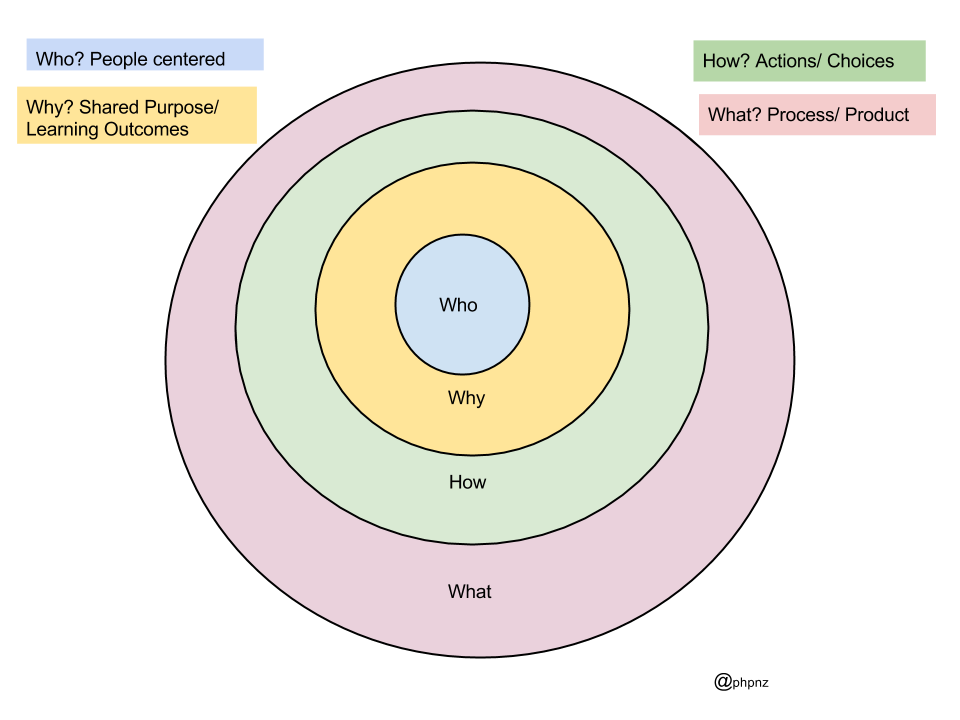
inspired from Julia Atkin's Values & Beliefs about Learning to Principles and Practice
It is about project co-construction at all levels involving conversations and negotiations to establish grounds for collaboration and cooperation, to take action and make choices together but also independently from each other.

We worked around this starting with Who. Quite a few participants had already thought through and defined the project that they would like to carry. Starting with Who reminded them to consider who are the participants in their project  and potentially questions their assumption about the fact that the project they have in mind is the best idea until they know for sure that it is wide enough and encompassing enough for all participants to take ownership of it also.

WHO as identified by participants:
students in French class, History class, English class, vertical classes, librarian , Media studies , art, music teacher/students extra curricular students, principal, parents, school community, RSA, old boys network,

Considering Why also drew in a fair amount of conversation, as the Why? participants came out with is their Why, not the Why that is a common purpose designed and adopted by the community of Who which is going to give the project a life! This served as a reminder that in designing a project, it is important to consider who executes the project, their reasons, their motivation, and to provide a scaffold that allows participants to find their own drivers.

WHY as identified by participants:
opportunity for a cross curricular French led project, create a school partnership with a French school, create a product, opportunity to use language in an authentic communicative context, multilevel, identity, cross generational

Moving onto the How was about thinking of actions that will make the project happen. It was a worthwhile step as it focussed participants on the type of learning outcomes  they want their students to get out of the project. This was also a starting point to think about the type of tools that can serve the purpose and forced people to consider the capturing, selecting, curating of information, the creation of content during the process, the feedback and conversations emanating from this process…

HOW as identified by participants:
research, gather, archive, share, connect, build framework, involve, define setting, communicate for the project, communicate about the project, relate, reflect, build collectively, discuss, manage contacts, feedback, develop global citizenship awareness.

Arriving at the What, participants were invited to consider the value of capturing the process that leads to the completion of a project. Often the proposed projects at this early stage are prescriptive. The stages of development to lead to this are worth capturing as they will tell the story of the project and also allow to get feedback and tweak/progess. Building in regular check points also gives visibility to individual and groups contribution so that all involved have a clear view of their involvement, what they are learning and how they are learning. What is produced out of this process can end up being a range of creations, and a quick brainstorm around what it can look like indicated that participants were considering a product they could have control over (e.g.: a video, a wiki etc). This led to go back to Who? and to build a project framework that allow for creativity and interpretation for all involved to shine through.

Key Words for building a Shared Histories project as identified by participants:
Time, sustainability, partnership, flexibility, communication about the process, about the product, visibility.

Participants can use the Who, Why, How, What circles to work with their partners in their school as well as their French partners. Getting to know each other from the outset is essential to work towards defining a common framework that is negotiated and  actionable over time and distance, including a range of actors, supported by ICTs that are accessible to all involved.

Shared Histories provides an ambitious opportunity. The scope and range of the project came to life as teachers from French and New Zealand met on Saturday morning via video conference. Shared Histories is definitely real and the welcome as well as the input of the French from the Amiens academy was an amazing reminder that what we had been working on for the last few days was actually starting now!

Schools had been provisionally paired in the light of their initial project outline.  Each introduced each other, in their respective or the other's language, exchanged a few ideas around how they envisage to go about the project.

Shared Histories in NZ school actually started on Saturday 7th November. It is an exciting challenge ahead.


29 September 2013

OpenBadges Potential

MOOC "Badges: New Currency for Professional Credentials" - Understanding the Open Badges Ecosystem and Building a Badge System

CHALLENGE TWO: Define the Currency of an Ecosystem
____________________________________________________________________________________

Tania  a Spanish teacher in an Auckland (NZ) secondary, undertook a year long Professional Learning course. Her focus is on improving her classroom pedagogy and deepening her understanding of second language learning acquisition. A fluent Spanish speaker who has travelled extensively to Spain and South America before settling into work and family life, she has developed a love of all "things Spanish" and often refers to her experiences as a language learner to support her students' learning experience and help them empathize with others' culture and ways of doing things, the Language curriculum resting on developing language as well as intercultural competencies for the purpose of communication.
Tania, through experiencing with Task Based Learning with expert support during her course, now realizes the importance of assessment for learning, and of providing timely feedback and feedforward to support her students' next step in their learning. This practice helps her and her students manage the evaluation of the internally assessed standards. She initially felt she was assessing all the time but now she sees her students identify their next step more rapidly. Tania also realizes the importance of providing authentic learning opportunities to motivate her students' engagement and scaffold their language learning. By authentic she understands authentic for her students, learning that will serve them in real life. Tania connects "real life" to jobs using languages. She has coffee with Ian, in charge of the school's career program and they discuss where languages currently fit in career pathways, in connection with assessment standards and credits. As always, Languages are not prominently featured, and retaining students from one year to the next can prove difficult.  It is a timely conversation though:  Ian reminds her to focus on the skills involved in learning a language, such as communication and use of technology to access native speakers for instance, and how these skills, if made explicit, have huge currency for employability.
Tania prints the "Know your own skills" quick reference published by CareersNZ  and takes it to her Department meeting. This prompts the team to revisit the Key Competencies, the "capabilities for living and lifelong learning" as outlined in the NZC. The NZC states that Key Competencies ought to be kept track off continually, monitored rather than assessed. Her school has not explicitly identified a focus on these Competencies, and they have not always been at the forefront of her and her team's attention when developing their learning programs which are articulated around content knowledge.
Yet the deliberate crosschecking by the Language team of the Key Competencies and the employment skills reveals a wide range of common vocabulary. Tania undertakes to unpack the Key Competencies, break them down in more granular skills, especially around Managing Self and Participating and Contributing, which are two competencies that develop in the unfamiliar learning context of Spanish immersion learning:  Managing Self because students need to structure their portfolio of evidence, use a range of tools to produce this evidence and meet deadlines for submission. Participating and Contributing as students must practice to be understood, and interactions in Spanish require that they are both listeners and speakers.
Tania decides on a set a key words for each competence and uses them to label the resources and activities she has uploaded on her Moodle course. She decides that she is going to track how her students develop these particular competencies for a term, as well as draw students' attention to them explicitly in her teaching, making connections with the skills they will require in the workplace.

Abbi is close to making her choices for her subjects for her final year. She has considered more than once to drop Spanish. It is tough and it requires quite a lot of self study for her to complete her assignments. Managing deadlines for submitting portfolio pieces, alongside the volume of her activities in other subjects and out of school is difficult. She finds it hard too to communicate verbally in the target language unless she has learnt a piece off by heart. But through listening to her teacher's consistent use of formulaic phrases in the classroom, she is starting to build a repertoire for herself. She is reusing some of it quite successfully now and can even provide some feedback to her peers when they are working on a common task together. Neither of them can speak English in the classroom (or else, which is "enforced" in a friendly manner by her teacher!) so she is developing new strategies to communicate, sometime using gesture, or her laptop to look up phrases, practice saying them, and then use them when interacting with others. It is really what has been keeping her in the Spanish class that, the fact that tasks require that they work in small groups, assign roles and go and find a way together to solve the problem at hand. It is a nice change from her other academic subjects where she is doing a lot of writing. Verbal interactions are captured by way of videos too, so she and her friends can make good use of their smartphone. Feedback she receives regularly from her teacher helps her decide when she ought to give recording a go. She has now worked out how to upload her video files to her ePortfolio, and she has made good use of the forum function to first ask for help and now to give a few tips on how best to do it. Her teacher recently has started to talk about work skills, and as a class they have spent sometime deciding on a set of labels that describe what skills they are actually developing in class. Since she contributed to the list, she understands all of what these words mean. A girl in her class pointed out in the group forum that Miss was using these labels on Moodle activities. This leads the conversation to the use of tags when organizing evidence of learning in their portfolio. Abbi can see her tag cloud develop and the word "helping others" and "communicating" get bigger. Her teacher has noticed she has helped others in the ePortfolio system through posting replies in the group but also has observed that Abbi is showing peers tips to access good Spanish podcasts and other resources online.  Her teacher awards her a "helping others" badge that she pins on her lapel alongside her Captaincy badge and her Service to Charity badge. Moreover Abbi can identify these two skills are developing now and can relate to this as she has recently filled in a Careers Questionnaire which indicated that if she wanted to work in Early Childhood Education (something she is considering at this stage) these skills were important to foster. Upon reading her Spanish teacher's feedback on her latest assignment she realizes the "time management" word in her tag cloud is yet to appear: her dad has been moaning over dinner at how poor at time management some of the people he employs can be. She makes note to self to ensure she will meet the next deadline. Abbi has noticed her teacher has changed her approach to delivering her lessons. She is starting to get into the swing of self and peer assessment rather than always relying on her teacher to get to her. While she would not say she is taking risks with her learning, she understands from the feedback she gets regularly that she takes initiative and is curious to learn more. Abbi might well take Spanish next year, as she has gained confidence in her ability through persevering. Some practical skills acquired along the way are developing, and are made visible as her teacher makes them explicit in her lesson outlines but also through her tagging. Abbi is starting to see the relevance this subject has with what her life may have in store after school.

Greg notices Abbi's new badge on her lapel as he drives her to school. He congratulates his daughter and asks her how come she has been awarded it. To his surprise, as Abbi usually is quite vague when it comes to talk about school matters, Abbi launches into a list of what she has done to get it, and is quite eloquent when describing how she uses her ePortfolio system. Greg is surprised but suddenly realizes that school is actually preparing his daughter for the real world.


My attempt at a first visualisation
This story takes place in a secondary school (NZ) environment where most of the learning is happening face to face in a classroom setting, with only some elements of the course delivered digitally and some opportunities to use devices. Few connections between Learning Areas are made explicit to the learner. The potential to make the Key Competencies visible, traceable and "rewardable" is being explored and it could help with this.  The teacher is the assessor, she and her students are unpacking the Key Competencies together in their unique way, in their context. This teacher is "creating a mechanism to make students learning visible" (OpenBadges for Life Long Learning, p.3), in a formal context.  The Key Competencies are "future focussed, student centered and interconnected", and school is one of several environments where they can be gained.  To move from a 'Physical badge" system to an Openbadge system would further enhanced the interconnected nature of these competencies. But first of all, the system would need to be tested with other learning areas. It may be with the in school careers' program initially as students have the opportunity to identify a career journey. This would require that Tania took risks to continue her investigation through teaching as inquiry, was willing to share her ideas with colleagues (she is already working well with her Department) and was prepared to face ambient cynicism about change and new ideas. Secondly, it could bring to the fore that the badge can communicate information about the holder which could complement the NCEA qualifications. To that effect, it would be necessary to develop consistent, reliable and valid assessment activities with a determined success criteria to issue a badge, that is valid and recognized across the learning areas of the school. This could be tested by working in tandem with one other department at a similar year level for instance. MyPortfolio/Mahara as badge displayer with Moodle as issuer  would require more teachers and students jumped into the innovation bandwagon to make use of the learning systems available in the school. Badges would have more value if used school wide and recognized for what they represent. Schools have been in the business of issuing badges to recognize achievement outside of the classroom for a long time. What needs to be established is the specific skills they each represent, define a learning path (on and offline) to capture them, to ensure that the badges represent the development of the competencies. It is a dynamic process, a living record. Students have to see for themselves what is in it for them. That will motivate them to lead the development of their own Key Competencies and encourage them to seek opportunities to earn badges. If students recognize the value of badges for themselves and for the reputation of their peers, then there could lay the most potent strength of the system.

26 August 2013

ToolSprint!

Something really cool happened on Saturday: a full house of Language Teachers ready to learn, listen and network at UofA for the revived Auckland Langsem! Aaron Nolan, newly elected NZALT President for the Auckland region supported by an enthusiastic Conference committee did make it happen and the classic conference programme was full of the Best Practice people. (Programme here)

Prof Rod Ellis rocked the lecture theatre with his 11 principles to start the day!). I have read some of his publications, watched many youtube clips taken from participants at his conferences, but it was the first time ever I listened to him live. Was worth it, made the principles come live and inspired me to think about the following: 6 years on, and Prof Ellis who was commissioned by the MoE for the NZC still presents on these principles on which rest the Languages curriculum to Language teachers, and keeps it fairly fresh. I can feel another blog post coming up soon (and will link here!) here!

The unavoidable focus on NCEA standards,  with an example of bad texts and bad questions, presented by the NAF, drew in a crowd...  Felt for the presenters scheduled on the same slot though.

Ass Prof Martin East presented on his research on the adoption of the "Interaction" standard after the "Conversation" standard has been abandoned. He has gathered teachers' voice ( a v. interesting concept which in itself would need a lot more attention paid to by education researchers, don't you think?) and in a nutshell, and I hope not to "interpret' too much, he found that while teachers agree that interaction is more authentic they are finding it very hard to manage to capture evidence of it in a meaningful setting and in practical way, thus are either not offering it or only as an option for their student. There is thus a tension between the pedagogy and way to assess the product of the learning. Would NZQA at any stage engage with language teachers, in the light of this research and Pr East's subsequent one, to discuss/review the interact standard? It got me thinking: interaction would maybe better to importantly underpin all that happens in/outside the language classroom (as suggested in the Principles)  and evidence of progress could be captured, reflected upon by the learner and used for formative assessment by the teacher BUT could be summatively assessed for standard purposes in a different manner (see DELF, IELTS, IBac etc.)

Anyway it will be interesting to see what Pr East, now President of the NZALT will use his research to leverage opportunities for conversation between practitioners and NZQA. I asked him if his findings had been published yet but no. This is Uni stuff with all the protocole, it ain't a blog post! :-)
So that takes me you know where: this format of Professional Learning does provide ideas and stimulation to participants but the rush from one session to another, the variety of input, and styles of presenters always leave the participant a little hazy eye by the end.
It would be interesting to see these formal settings at least provide an opportunity for participantsto share what they have gathered in their kete from the experience before they leave, to allow them to connect the dots between each presentation. Because they do exist of course, the connections, and they contribute to drawing the big picture!

Can you tell the space type I was in from this pic?
An example of this was the invigorating conversation I had with Liz Scally over lunch. She saw a bit of my session where I go over what I have called "Digital Citizen: 10 Desirable Competencies . We connected that the vocabulary used for these competences is quite similar to the one used to describe the Languages standards, and relate to Learning.

These are just raw chunks of thoughts arising.  I would need to refine all of this a great deal more, nothing better than a conversation around any of this would help me move my understanding forward!

Here is the ToolSprint presentation I gave. I love tools. That is if we start using them with the "Why?" !

15 April 2013

Managing the tools, managing oneself?

Further to our wee email exchange on the use of word-processing tools in writing, I've been pondering about your suggestions regarding the use of on-line translation tools. I've been discouraging the students from using them as, although they're fast improving and often give accurate translations for straightforward stuff, they encourage laziness, eliminating as they do the necessity to think about and understand the language the students are producing. On the other hand students seem more motivated when using them. Suddenly it's much easier to be able to say what you want to say rather than waiting for the teacher to tell you what she thinks you should know or might find useful.

I wonder if some of our students wouldn't maintain an interest in language learning for longer if we just went with the flow and accepted that these are tools which are readily available in real life, at any moment. Just thinking of my students who are going on the exchange to Nice at the end of the year and who can hardly string a sentence together, having no deep interest in how languages work, they could easily call up the language they need in almost any situation via their smart phones. It's all about communication, after all. It might not help them so much with listening but even there they could negotiate meaning around problems of comprehension. We can no longer insist, it seems to me, that everyone demonstrate their understanding of how languages work, when there are such obvious short-cuts to communication at hand.

Thankfully, there will always be some students who are curious about how the language works so that old fossils such as myself who love grammar will feel vindicated by their curiosity. I'd have to say, though, that the patience of the majority for mastering structure seems to be decreasing exponentially as they see that they can get by without it. Maybe this is the moment when the focus will shift from language mastery to intercultural communicative competence, even if it is electronically assisted!

It makes me think that language teaching is at a cross-roads. How many people these days know how to do the basic mathematical functions of addition, subtraction, division and multiplication? How many people still know their times tables?Not too many, I'll wager. For me they're the most valuable thing I've retained from my maths days and I use them all the time but if I preferred to use a calculator I would have to admit it's no longer necessary to know how to do them in my head. The other obvious analogy is GPS. There aren't too many people who would prefer these days to use a map to orientate themselves. They trustingly put themselves in the hands of their GPS and let it lead them (sometimes astray). The result is that fewer and fewer people have map-reading skills because they don't seem so necessary any more. Could we be getting to the same point with languages? Maybe on-line translation tools will end up opening language 'learning' to a wider range of students. Maybe we should be focussing more on tasks involving pronunciation, although even here they can get the correct pronunciation at the click of a button.

With my junior classes I've been getting them to make powerpoints and little movies about themselves and using puppets for dialogues. A colleague brought me along another bag full of 'friends' so we now have about 16 assorted creatures who seem to be relishing their stardom. Students appear to really enjoy doing this and some have produced much more sophisticated stuff than we could have expected from students before these tools were available. Differentiation happens naturally as people work in different ways, at different rates. Some work slowly and meticulously and include lots of detail. Others dash something off really quickly and want to get onto the next item on the agenda. Some take the line of least resistance and produce the minimum. The exceptional ones are always focussed and show a good understanding of the task. They go the extra mile, including a lot more than is expected. It's a really good way of evaluating the key competencies as well as giving rein to their creativity. Over the last few days of the term we'll be watching some of these together and eventually they'll all be loaded onto MyPortfolio. We had some problems with files being more than 50MB which we'll have to resolve. For the moment, with interim reports looming I've just had to get them to airdrop them to me which is the simplest short-term solution.

I have no doubt my ponderings will set off some reciprocal ponderings from the North. It'll be interesting to see what you think. Am I right or am I right?