Showing posts with label conversations. Show all posts

12 November 2013

Starting with the Who

Last week saw the launch of Shared Histories, a France-New Zealand schools cross-curricular project  spanning the five years of the commemoration of World War One Centenary, starting 2014.
Initiated by the French Embassy in Wellington it corresponds with both the signing of an Arrangement of Education Cooperation between the Ministries of Education of France and New Zealand, the official launch of the Centenary Commemoration by François Hollande, President of France, and of many initiatives up and down New Zealand.
Shared Histories in New Zealand currently receives the coordinating support of the French Embassy, the Ministry of Education (NZ), NZAFT  and ILEP

Shared Histories is about fostering the Duty of Remembrance. Participants will interact around building a consciousness that human experiences are universal.
It provides a framework for New Zealand and French schools to form partnerships and work on common projects on the theme of WW1.

It is not about simply developing language skills:  it is about developing personal relevance for the all the students involved, through genuine social interaction and explorative reflection, supported with authentic documents and experiences.

This is a personal account of two extremely rich days, working with competent, visionary and courageous colleagues who see Shared Histories as the framework for cross curricular collaboration in their schools as well as the opportunity to engage with their students in the discovery and analysis of the world around them.

I was invited to facilitate the conversation around collaborative project building and the scaffolding role of ICTs.
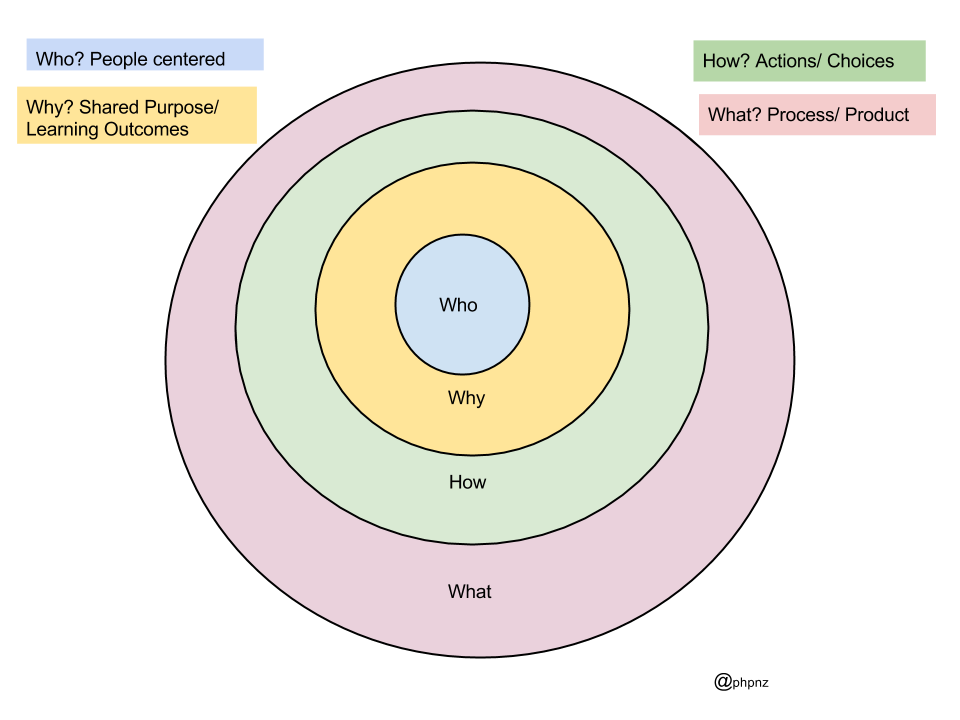
inspired from Julia Atkin's Values & Beliefs about Learning to Principles and Practice
It is about project co-construction at all levels involving conversations and negotiations to establish grounds for collaboration and cooperation, to take action and make choices together but also independently from each other.

We worked around this starting with Who. Quite a few participants had already thought through and defined the project that they would like to carry. Starting with Who reminded them to consider who are the participants in their project  and potentially questions their assumption about the fact that the project they have in mind is the best idea until they know for sure that it is wide enough and encompassing enough for all participants to take ownership of it also.

WHO as identified by participants:
students in French class, History class, English class, vertical classes, librarian , Media studies , art, music teacher/students extra curricular students, principal, parents, school community, RSA, old boys network,

Considering Why also drew in a fair amount of conversation, as the Why? participants came out with is their Why, not the Why that is a common purpose designed and adopted by the community of Who which is going to give the project a life! This served as a reminder that in designing a project, it is important to consider who executes the project, their reasons, their motivation, and to provide a scaffold that allows participants to find their own drivers.

WHY as identified by participants:
opportunity for a cross curricular French led project, create a school partnership with a French school, create a product, opportunity to use language in an authentic communicative context, multilevel, identity, cross generational

Moving onto the How was about thinking of actions that will make the project happen. It was a worthwhile step as it focussed participants on the type of learning outcomes  they want their students to get out of the project. This was also a starting point to think about the type of tools that can serve the purpose and forced people to consider the capturing, selecting, curating of information, the creation of content during the process, the feedback and conversations emanating from this process…

HOW as identified by participants:
research, gather, archive, share, connect, build framework, involve, define setting, communicate for the project, communicate about the project, relate, reflect, build collectively, discuss, manage contacts, feedback, develop global citizenship awareness.

Arriving at the What, participants were invited to consider the value of capturing the process that leads to the completion of a project. Often the proposed projects at this early stage are prescriptive. The stages of development to lead to this are worth capturing as they will tell the story of the project and also allow to get feedback and tweak/progess. Building in regular check points also gives visibility to individual and groups contribution so that all involved have a clear view of their involvement, what they are learning and how they are learning. What is produced out of this process can end up being a range of creations, and a quick brainstorm around what it can look like indicated that participants were considering a product they could have control over (e.g.: a video, a wiki etc). This led to go back to Who? and to build a project framework that allow for creativity and interpretation for all involved to shine through.

Key Words for building a Shared Histories project as identified by participants:
Time, sustainability, partnership, flexibility, communication about the process, about the product, visibility.

Participants can use the Who, Why, How, What circles to work with their partners in their school as well as their French partners. Getting to know each other from the outset is essential to work towards defining a common framework that is negotiated and  actionable over time and distance, including a range of actors, supported by ICTs that are accessible to all involved.

Shared Histories provides an ambitious opportunity. The scope and range of the project came to life as teachers from French and New Zealand met on Saturday morning via video conference. Shared Histories is definitely real and the welcome as well as the input of the French from the Amiens academy was an amazing reminder that what we had been working on for the last few days was actually starting now!

Schools had been provisionally paired in the light of their initial project outline.  Each introduced each other, in their respective or the other's language, exchanged a few ideas around how they envisage to go about the project.

Shared Histories in NZ school actually started on Saturday 7th November. It is an exciting challenge ahead.


14 September 2013

A Lot of Learning

A week on, I can articulate (I think!) some takeaways from the Tauranga StartUp Week End
Rewind back 7 days:  I pitched, my idea did not get traction, went round the room, liked a few ideas, hard to put forward my "soft skills" when people just want to get going, needing a developer or a designer, and then chose to hang around an idea that inherently involved learning and self directed learning, as well as speaking competence and ability, and enhancement of these through feedback and feedforward, through the development of an online community dedicated to do just that. All stuff that I relate to through language teaching, ePortfolio development, understanding of what good expert and peer feedback consists of,  credentialing of evidence with Open badges, online community building experience both as a user and a facilitator... The SpeakEazy idea talked to me on many levels.
Now to make a Minimum Viable Product from an idea like this and turn it into a convincing business plan...That's the challenge.
Lean Canvas
This is where the words Motivation, Team and Leadership come alive. Those very words that are the foundation for a positive productive and supportive learning environment.
The team had a difficult challenge, the one they set themselves to solve.
The team had the tools: each other's experience, expertise and contribution, the devices, the internet, an outline of the success criteria, and the Lean Canvas.
The team had the support: honest mentors with a range of expertise, a set framework, food, drink, attentive organisers
The team had time: well not really (54hrs sounds a lot but...) in fact yes there was time since we were in "locked down" doing anything but work on the project uninterrupted.
Challenge+Tools+Time+Support =  Motivation.
> Isn't this level of engagement that we want in school?

Co constructed under effective leadership
The team members have never met before.The team recognised the role individuals within the team could play, and the strengths and limitations each has. There is respect, there is collaboration and there is ownership.  The sum of their contributions will lead to solving the problem if the pathway to it is underpinned by a thought through strategy, facilitated by a leader. The team was well lead indeed, by someone who not only had given careful consideration to what it will take to succeed but who also could articulate the steps, as well as enable team members to contribute at their level of competence, while providing opportunities to stretch beyond.
> Isn't this the type of  leadership of learning we want in school?

Then came the evaluation, the 5 minute presentation of the project to the Judges, in front of your peers turned audience, culmination of the hard work but also the competition. And the celebration of success, not just for the winning team, but for all that have fully immersed in the experience, each individual taking away with them something to reflect on, grow, emulate, extend.
> Isn't this the type of individualised learning we want in school?

In learning mode...
Just felt I have actually lived Ewan McIntosh's Design Thinking for Learning, including the ah ah moment! That ah ah moment applies actually to ThinkAgency as I have been working on getting to the value proposition. It is about serendipity also!
Isn't this the type of success what we want all learners to experience?   ;-)

5 September 2013

A different kind of a week end...

How to find real life learning, with an authentic purpose, in a supportive, energetic environment, where collaboration and competition keep momentum, curiosity and drive going?
How to test what I can add to a team of people I don't know, in an unknown setting with an unknown challenge?
I have signed up for Tauranga StartUp Weekend•, a 54hr "learning curve" where up to 80 people from various professional backgrounds (tech, design, marketing, entrepreuneurs...) get together to form/join a team on an idea that is pitched on the first night, build a viable business, convince investors.
This is going to be a little... "uncomfortable"!

So what shall I take with me to "pad the ride?"
- a bit of tech end user experience,
- some facilitation skills
- a burgeoning understanding of the Design Thinking mindset (I'll have to tell you about that as I am putting this in real time practice for ThinkAgency!)
- my ability to generate ideas
- a capacity to look for, find and analyse relevant information
- my "to do" list obsession
- an aptitude to look for "work arounds"
- all that the world of teaching and learning has armed me with: patience, stayability, keeping things simple, working with others, curiosity, solving problems... will all this come handy?
- an open mind, ready to fill the kete!
- my brand new phone (again!) my laptop, my chargers.

And here is what I shall leave behind:
- preconceived ideas
- fear of the unknown
- feeling overwhelmed in front of awesomeness
- worry that I will be out of my depth.

So will I pitch on the night or what? One minute to convince an audience that your idea is worth spending time and energy on? It has got to be done.

• About Startup Weekend: Startup Weekends are 54-hour events designed to provide superior experiential education for technical and non-technical entrepreneurs.  Beginning with Friday night pitches and continuing through brainstorming, business plan development, and basic prototype creation, Startup Weekends culminate in Sunday night demos and presentations.  Participants create working startups during the event and are able to collaborate with like-minded individuals outside of their daily networks. All teams hear talks by industry leaders and receive valuable feedback from local entrepreneurials. The weekend is centered around action, innovation, and education.  Whether you are looking for feedback on a idea, a co-founder, specific skill sets, or a team to help you execute, Startup Weekends are the perfect environment in which to test your idea and take the first steps towards launching your own startup.

3 September 2013

ePortfolio: what tools, what functionalities?

I have recently come across two amazing examples of professional ePortfolios:

- @traintheteacher is a regular and prolific blogger whose reflections are tagged, using the Registered Teacher Criteria, collected and selected for the purpose of her PRT ePortfolio using Wordpress (a powerful blogging platform)

- Don Presant's career ePortfolio presents selected personal information, his CV as well as the services he offers, alongside much evidence of his research and presentations, using Mahara(a purpose built ePortfolio system).

A range of online services can be used and combined and together make an ePortfolio for their owner who want to showcase and flesh out their achievements, skills, and competences beyond the wording on their CV.

Typically the blog (like this one!) is a place of where one goes to put down ideas, or accounts of experience, or reflect on what they have done, where they are now and what they can do next. 
What else is there?
Vizify can be used as a visually pleasing aggregator of the stuff one produces in a range of spaces, for a range of interests (eportfolio for life wide learning!)
About.me can be used as a cover page to your ePortfolio.
Belonging to groups (on Facebook for instance), nings , listserves,  having a twitter account,  etc is a way to bring in the social component to one's learning, where you get some and you give some and where ideas can be tested out.

Using online services like those imply that the user has embedded a level of comfort with publishing online for a purpose that is usually self determined, or for personal branding.

Developing an ePortfolio, and the mindset to go with it, is the result of a range of factors: it is undoubtedly beyond the "tick the box" requirement that any professional body or employer may require. ePortfolios are a place where one can let things stew and develop, as work in progress. They also allow the owner to showcase their stuff when/where/to whom it is necessary or timely. One does not become a reflective practitioner the minute they create an account on MyPortfolio nor do they always keep organised, meaningful traces of their learning with Instagram or SoundCloud. Nor necessarily act on the feedback left on way of comments... That is why I am talking about adopting a ePortfolio mindset! And having a self chosen purpose to get started.

Developing an awareness that any of these tools actually support learning by making it visible to the owner while at the same time making the owner visible to a chosen audience or to the world at large is well worth investigating. ePortfolios have the potential to accompany the development of a range of digital competencies as well as being a space to display them.

I have also recently stumbled upon netice.fr a French start up focused on providing ePortfolio services as well as a Mahara instance, for employability with an emphasis on insertion in the world of work (post formal education or after unemployement)  supported by the development of digital competencies. Netice.fr has caught my attention, in particular as it seems to be what I would like to be part of here in NZ!

So that finally takes me to the point of this entry, phew! Why a dedicated ePortfolio space like Mahara for instance rather than a suite of etools that the owner bundles together? After reading the report of ePortfolio use at Plymouth State University to which Ellen Mary Murphy contributed (and which link is no longer available), here is what I came up with to start visualising what functionalities support ePortfolio development, when they accompany the development of digital competencies and require an element of privacy and control over what is published. Work in progress...


13 July 2013

So I went to NetHui2013

I spent two and 1/2 days in Wellington at NetHui this week, missing the first part of Monday. I want to understand what internet issues are. I am an internet user. I was surrounding with people who "get the internet" and "make the internet". As someone tweeted (wished I captured!) "if the building was to collapse it would set back New Zealand for years to come!"

InternetNZ organises NetHui. It has been a great opportunity to understand better the role and work of InternetNZ, it above all feels right and it is well beyond worth my humble membership!  Jordan Carter's (Internet NZ Chief Executive) Scene Setting Comments for NetHui is a great intro.

My few lines won't make the event justice:
Bill Bennett's Ten Things we learned from NetHui  is a sounder analysis!

NetHui brought together all sorts of people from all walks of kiwi life to talk about the internet and how it shapes what they do or rather how they shape it? Who knows... 

If you wanted to read up and see the wealth of conversations that took place, head over to Conversation, where all the collaborative note taking is compiled. This has got to be one great thing about the internet, the fact that I have spent the last hour "rewinding" through NetHui! I have learnt soooo much at a frantic pace. And I need to revisit. And the most relevant will rise to the surface faster while much will  have given me reasons and impetus to explore further.
There were a few highly clued up edu-peeps, and a few teachers talking  Open Internet Networked Learning and Making BYOD work. Wished I had some students to introduce to the youth forum too!

The beauty of these three days is that I spent them out of my depth!
> I am listening to people from "another" world, whose interest in and understanding of the internet reach far beyond mine at first glance and whose activity and/or raison d être have been also deeply turned upside down by the internet  (security, journalism, music, health, business, role of the state, open data...)
> I venture a few comments and contributions here and there as the format of each session, with a mic being passed around, manages to invite me to take a bit of a chance: many venture comments, that is what makes the conversation progress...
> I come to realise as the days progress that many an Internet issue actually deeply concerns me: public interest vs national security, copyright, open source, access for all (Rural, disabilities etc), privacy, digital literacies, identity...

What I take home from NetHui is that the internet is about people, faith in people: relationships, partnerships, high trust, it is also about building together, including,  it is about voice, it is about choice, it is about being pro active, being free to act, to self regulate, organise... All of those "things" I can see baking in every single child in an NZ school and that in fact apply to all!

Quinn Norton
(who has covered extensively Hacktivism and the Occupy movement) gave a breathtaking (literally thanks to the pace of her "tweet" like statements) keynote (I hope the recording becomes available soon and I will edit here with it). She speaks about liminality,  refers to the internet as the Network and its disorganised, organic nature,  that is throwing doubt to established ways, talks about moving from democracy to do a cracy. 
The one concept I related to straight away in her keynote was her mention of Agency:

Agency is the key word that totally underpins all of my thoughts and interest and practice in eportfolio. That is another story, a personal and professional journey, but it is absolutely enabled through experiencing for myself the transformative powers of the Internet.